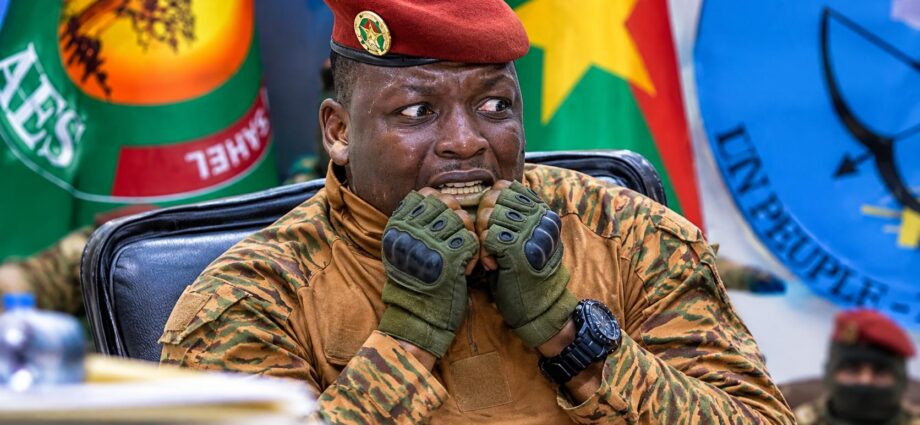
Ibrahim Traoré’s decision not to attend the Russia-Africa Summit has raised questions about the stability of Burkina Faso’s transitional government. Reports suggest the president’s absence may stem from fears of a potential coup within his inner circle, raising doubts about the durability of his leadership.
Diplomatic absence raises questions about internal stability
The Burkina Faso leader’s decision to skip the high-profile summit comes at a time when his administration has increasingly relied on Russia as a key ally. While Traoré has cultivated an image of a decisive leader breaking from traditional partnerships, his absence has prompted speculation about underlying tensions within his government.
Image versus reality: the limits of political messaging
Traoré’s government has heavily promoted an image of strength, emphasizing sovereign decision-making and resistance to foreign influence. This strategy, widely circulated through official channels and sympathetic media, contrasts with ongoing security and humanitarian challenges facing the country.
Critics argue that such messaging masks deeper governance issues, including internal power struggles that could undermine long-term stability.
Internal rivalries and the fragile balance of power
In military-led transitions, the cohesion of the security apparatus is critical to maintaining control. As time passes, the interests of key military and political figures who helped secure power may diverge from the president’s objectives. Loyalty within such circles is often conditional and can be tested by competing ambitions or policy disputes.
Was the summit absence a precaution or a sign of crisis?
While concerns about internal instability are valid, there is no definitive evidence that Traoré’s absence is linked to an imminent coup. The distinction between caution, rivalry, and outright rebellion is crucial each requires distinct proof before conclusions can be drawn.
Leadership in the spotlight: diplomacy versus domestic challenges
Traoré’s international posture, notably his alignment with Moscow, has bolstered his image as a leader prioritizing Burkina Faso’s sovereignty. Yet diplomatic alliances do not guarantee internal cohesion. A president’s absence from a global forum does not, by itself, signal political turmoil but it does invite scrutiny of the conditions behind such a decision.
What does this mean for the future of Burkina Faso’s government?
The speculation surrounding Traoré’s absence underscores a broader challenge: the need to balance external perception with internal governance. If leadership depends heavily on carefully constructed narratives, its credibility may falter when faced with unmet expectations or unaddressed domestic pressures.
As investigations continue, one question remains unanswered: Is the president’s absence a strategic move, a security measure, or the first sign of deeper fractures within his administration?
By Alasane OUEDRAOGO — Journalist
Comments are closed, but trackbacks and pingbacks are open.