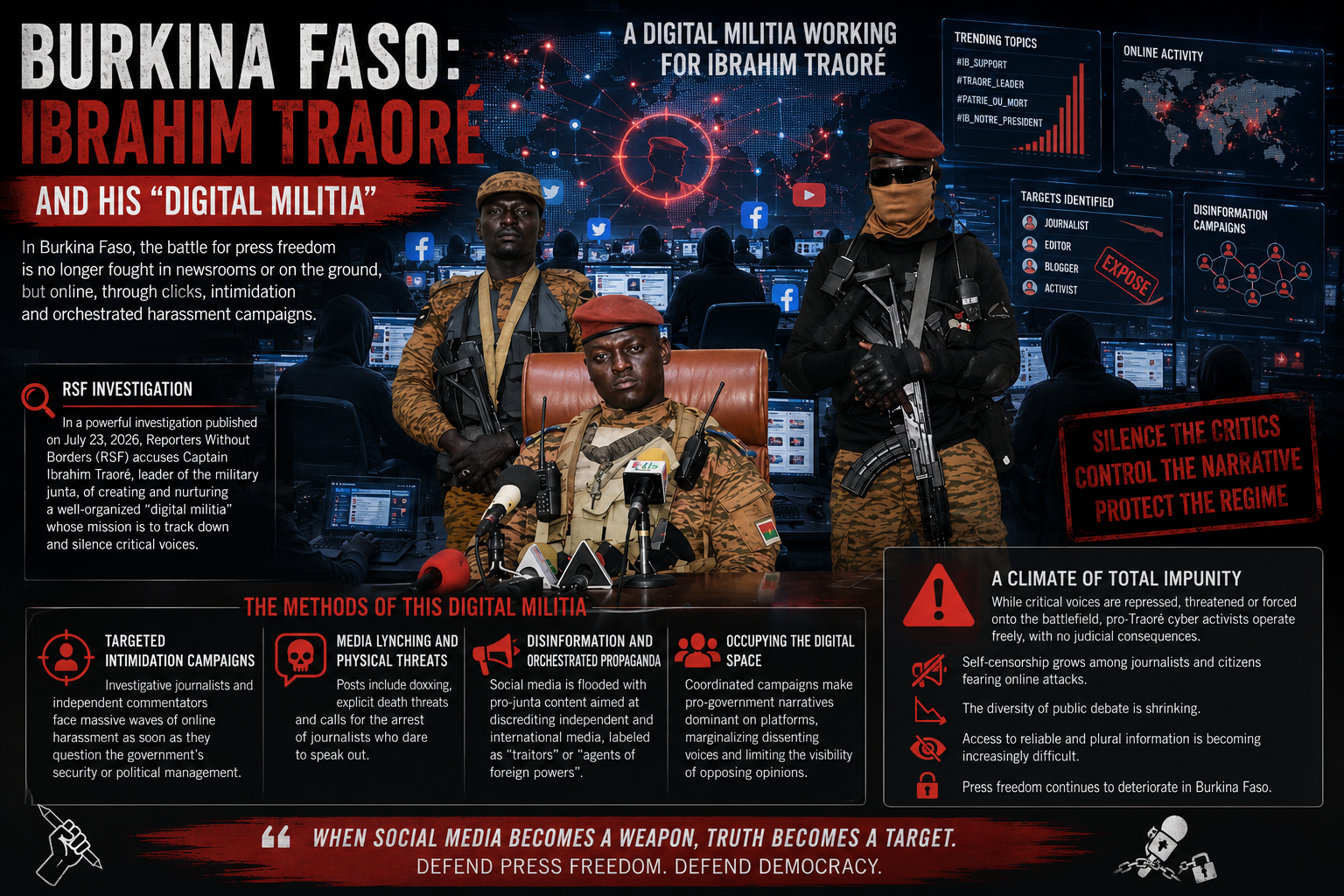
The struggle for press freedom in Burkina Faso has evolved beyond newsrooms and streets, now unfolding through clicks and orchestrated harassment campaigns on social media platforms.
The rise of the BIR-C: virtual battalions targeting dissent
A recent investigation reveals how the military junta, led by Captain Ibrahim Traoré, has cultivated a structured network of cyberactivists known as the Bataillons d’Intervention Rapide de la Communication (BIR-C). Far from being mere political militants, these groups operate as a coordinated digital militia, systematically suppressing critical voices and monopolizing online discourse.
Methods of digital suppression
The BIR-C employs a multi-pronged strategy to silence opposition:
- Targeted intimidation campaigns: Independent journalists and commentators face coordinated cyberharassment when they scrutinize government policies or security operations.
- Doxxing and physical threats: Critics often endure the public release of personal data alongside explicit death threats or calls for their arrest.
- State-sponsored disinformation: Pro-junta content floods social platforms to discredit both local and international media, frequently labeling dissenting outlets as “traitors” or “foreign agents.”
- Digital occupation: Coordinated campaigns push pro-regime narratives to the forefront while burying counterarguments, severely limiting public access to diverse perspectives.
An environment of unchecked impunity
Despite systematic repression of dissent, the authorities fail to address online harassment campaigns. While critical voices face judicial retaliation or forced conscription, cyberactivists aligned with Traoré operate with impunity, shielded by tacit state protection.
Observers warn this climate fosters widespread self-censorship. Many journalists and bloggers now avoid sensitive topics—particularly security, governance, and military operations—due to the psychological toll of potential harassment. This form of silent suppression effectively restricts free expression without overt bans.
Eroding democratic discourse
Political communication experts highlight how coordinated digital campaigns distort public debate. Divergent opinions grow faint while pro-regime narratives dominate conversations, undermining pluralistic discourse. In a country grappling with persistent security crises, this polarization further restricts citizens’ access to balanced information—a cornerstone of democratic governance.
The tactics described mirror those documented in authoritarian and hybrid regimes worldwide, where coordinated cyberactivists defend ruling powers, undermine independent media, and manipulate online narratives. Freedom of the press advocates now recognize these campaigns as a covert but potent form of censorship, often as effective as traditional restrictions.
An additional layer of repression
Digital suppression does not exist in isolation. It compounds existing restrictions on media freedom, including the suspension of international outlets and documented cases of intimidation, forced appearances, and enforced disappearances of journalists.
For press freedom defenders, the combination of administrative measures, security pressures, and online harassment systematically shrinks the space for independent journalism. Observers describe this trend as a dangerous erosion of democratic principles.
International implications
This investigation underscores the accelerating decline of democratic freedoms and press independence in Burkina Faso since the junta’s rise. By weaponizing social media, the Traoré regime transforms digital platforms into instruments of political coercion, making independent journalism increasingly perilous.
The findings may intensify concerns among international partners evaluating Burkina Faso’s governance and institutional environment. Press freedom indicators significantly influence perceptions of a nation’s stability and development prospects. A sustained decline could jeopardize the country’s global standing and deter potential investors.
More broadly, this case highlights the evolving nature of information warfare. While propaganda once relied on state-controlled media, social platforms now serve as battlegrounds where viral content and algorithmic amplification amplify certain narratives while marginalizing dissent. Many analysts view this shift as one of the greatest contemporary challenges to press freedom and democratic discourse in politically unstable nations.