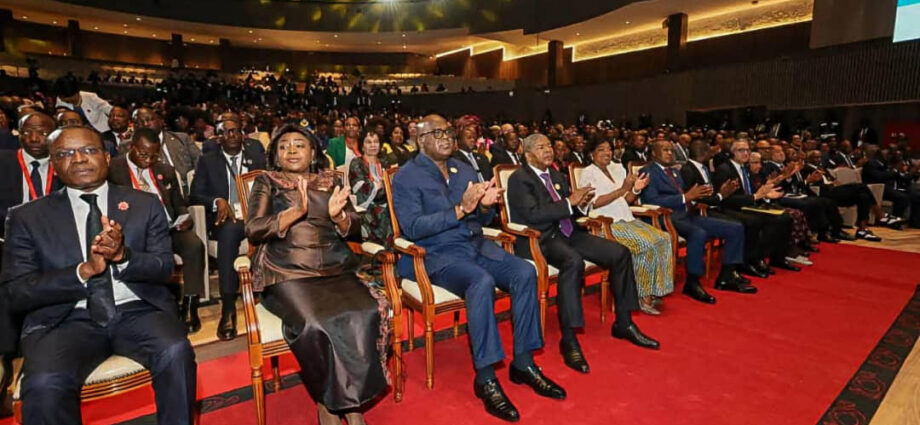
Landmark shift in African water governance unfolds in Luanda
The fourth edition of the Luanda Biennial convened on October 22–23, 2026, under the joint patronage of UNESCO and the African Union with Angola’s government as host. Gathered under the banner of water governance as a catalyst for peace, mediation, and dispute resolution, African leaders and institutional representatives confronted transboundary water challenges that transcend borders and rivalries.
Standing at the podium, Democratic Republic of the Congo President Félix-Antoine Tshisekedi Tshilombo turned the spotlight toward one of Africa’s most critical resources, framing water management as a non-negotiable pillar of national sovereignty and regional stability. His address signaled a decisive moment: the moment when the DRC asserts its leadership in shaping the rules that will govern the continent’s shared rivers.
Congo’s water artery: Africa’s silent superpower
The DRC holds a unique hydrological crown. Carved by the mighty Congo River—the planet’s second-largest by discharge after the Amazon—the country anchors one of the world’s most vital freshwater networks. Hydrologically, this artery nourishes nine neighboring nations through shared basins such as the Oubangui, threading through Central Africa like an invisible highway of life.
These waters unlock transformative potential: vast hydropower reservoirs, irrigated agriculture that feeds millions, navigable arteries for trade, thriving fisheries, and reliable drinking-water supplies. Yet, harnessing such bounty without safeguards invites conflict. Questions of equitable apportionment, ecological safeguarding, and coordinated policy-making dominate every transboundary dialogue.
Diplomacy of the Congo: a new compact for shared basins
President Tshisekedi laid out a forward-looking blueprint: a diplomacy of the Congo built on transparency, shared data, and synchronized investments. He emphasized that sustainable management demands rigorous hydrological information exchange, joint infrastructure planning, and early-warning systems to defuse disputes before they escalate.
A core principle crystallized in his remarks was the primacy of constitutional and legal frameworks. Any cross-basin transfer of water—whether toward the Lake Chad watershed or beyond—must first secure national consent through constitutional processes and withstand scientific scrutiny to preserve ecological balance. This stance closes the door on unilateral initiatives and opens a corridor for inclusive, consensual decision-making.
Transboundary talks gain momentum between DRC and Angola
On the sidelines of the biennial, the DRC and Angola launched intensive bilateral negotiations aimed at converting shared ambitions into tangible action. Key workstreams include exchanging real-time hydrological data, co-managing transfrontier ecosystems, curbing pollution along the common frontier, and training a new generation of water experts.
Modernizing water-supply networks and scaling up renewable energy solutions compatible with watershed health emerged as priorities. A senior Angolan water specialist noted that the success of these ventures hinges on quantifying joint economic gains, social uplift, and environmental dividends before commitments are finalized.
Balancing sovereignty and regional integration in a warming world
As climate change intensifies droughts and floods across Africa, the stakes could not be higher. The Congo Basin’s governance regime must reconcile national prerogatives with collective responsibility. Regional peace, food security, and energy access now depend on instruments that reconcile sovereignty with solidarity.
The Luanda Biennial provides a high-level forum where legal, institutional, and financial tools can be forged to underpin this delicate balance. For the DRC, the breakthrough lies in leveraging its hydropower potential while retaining decisive control over how and when its resources are deployed—ensuring that every drop serves both the nation and its neighbors.
Comments are closed, but trackbacks and pingbacks are open.