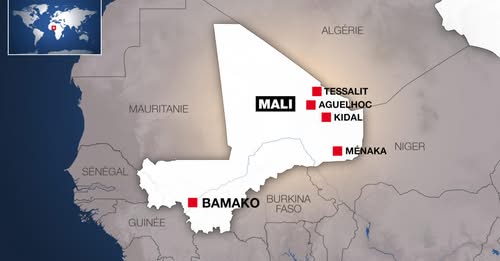
The northern regions of Mali are gripped by unease as the country’s security landscape undergoes a dramatic shift. Within days, the balance of power has been upended, with armed factions making rapid gains. The Groupe de soutien à l’islam et aux musulmans (JNIM) has escalated its campaign by issuing an unprecedented political challenge: a direct appeal for the overthrow of the transitional government.
military setbacks echo past crises
The unfolding events bear a haunting resemblance to the 2012 conflict. On May 1, 2026, fighters from the JNIM and the separatist Front de libération de l’Azawad (FLA) seized key military bases in Tessalit and Aguelhoc. The withdrawal of Malian Armed Forces (FAMa) and their Russian partners, Africa Corps, facilitated the rebel advances without resistance.
A widely circulated image shows Seidane Ag Hitta, a prominent JNIM leader, holding the keys to the Tessalit camp—a symbolic act five years after the departure of the French Barkhane force. Since April 25, additional towns including Ber, Tessit, Hombori, and Gourma Rharous have fallen, leaving residents of Gao and Tombouctou in a state of heightened anxiety.
Bamako’s resilience amid growing threats
Despite the setbacks, the Malian government remains defiant. General Assimi Goïta has urged a « national awakening, » declaring that no « intimidation » will divert Mali from its path. The response strategy focuses on two key areas:
Air and ground operations: The Malian army has intensified precision strikes on Kidal, targeting the governorate and logistical supply points. While rebel factions dispute casualty figures, Bamako claims to have « neutralized several terrorists. »
Logistical resilience: As jihadist blockades disrupt critical supply routes to the capital, a convoy of 800 fuel tankers successfully broke through under heavy military escort this past Friday.
Moscow has reaffirmed its unwavering support for Mali’s transitional authorities. Kremlin spokesperson Dmitri Peskov dismissed concerns about a potential Russian withdrawal following losses in Kidal, reinforcing the alliance’s commitment.
jnim’s strategic shift: blending politics with armed struggle
The JNIM’s latest move marks a significant departure from its traditional rhetoric. In a statement released on April 30, the group adopted a political tone, calling on « vital national forces, » political parties, and religious leaders to unite in establishing a « peaceful transition » and ending the « junta’s dictatorship. » By invoking themes of « sovereignty » and « dignity, » the JNIM seeks to appeal to a disillusioned public while reaffirming its ultimate goal: the imposition of Sharia law.
« In the face of adversity, one must seek the lesser evil, » remarked a former opposition minister, highlighting the moral dilemma now facing Mali’s political elite: Is dialogue with former enemies the only path to halting further decline?
internal fractures and governance challenges
Pressure is mounting within Mali’s institutions. The Prosecutor of the Bamako Tribunal has announced the arrest of several military personnel suspected of aiding last weekend’s attacks. With rebel advances, ambiguous political overtures from the JNIM, and economic strain from blockades, the transitional government faces its most severe test yet. The struggle for Mali’s future is no longer confined to the deserts of the North—it has extended into the halls of power in Bamako.