Ibrahim Traoré challenges Sahel’s hidden history of arab slave trade
By Olivier d’Auzon
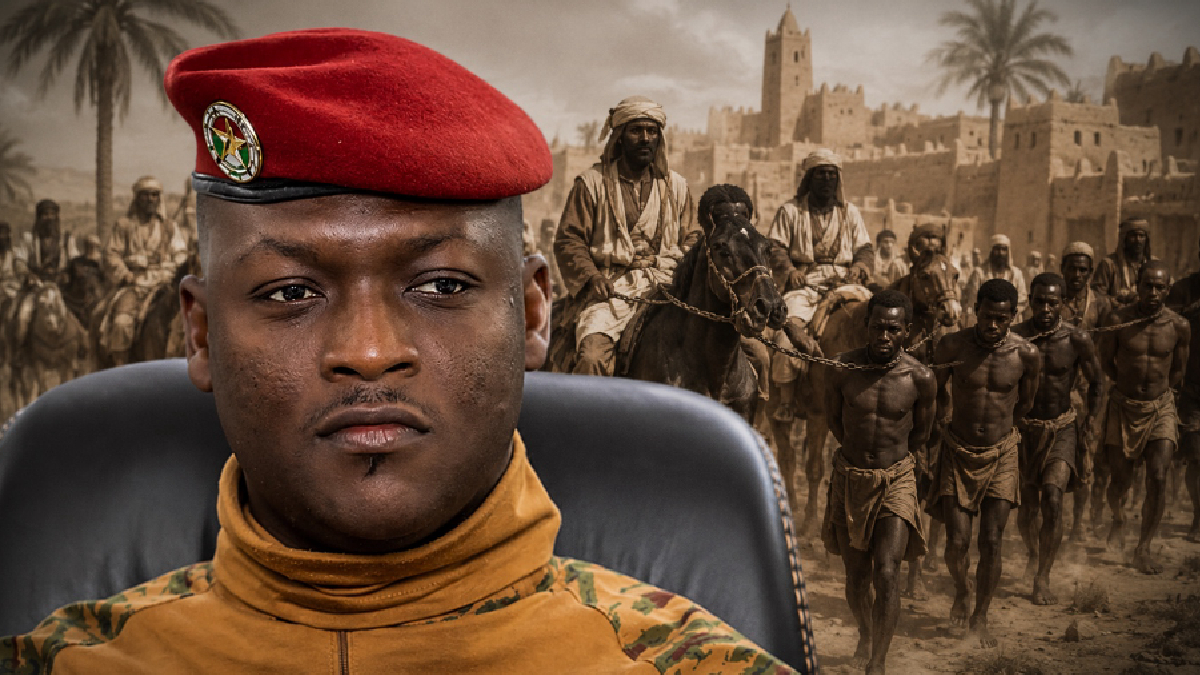
When Captain Ibrahim Traoré of Burkina Faso publicly linked the Arab slave trade to contemporary radical Islam in the Sahel, he didn’t just break a taboo—he exposed a historical blind spot that has shaped the region’s conflicts. His remarks in Ouagadougou weren’t a provocation but a confrontation with a past that elites across Africa and the West have long avoided.
The weight of a millennia-old silence
Some truths weigh heavier than others. Few have been as systematically buried as the Arab-Muslim slave trade—a 1,300-year saga of caravans stretching from Lake Chad to Cairo, Tripoli, and Zanzibar, forcibly displacing millions of Africans. While the transatlantic slave trade has been meticulously documented, its Arab counterpart remains conspicuously absent from official narratives.
Why this silence? Because unlike the Atlantic trade, the Arab slave trade complicates the dominant story of Islam as a purely anticolonial force. Historical records—from Ibn Battuta’s chronicles to manuscripts in Timbuktu—document its systematic nature, yet no truth commission in Agadez or Timbuktu has ever addressed it. No national museum in the Sahel dedicates space to it. Postcolonial elites, trained to rally against former colonizers, chose silence over reckoning.
When historiography bows to politics
Scholars like Olivier Pétré-Grenouilleau have long highlighted this gap, but their work rarely translates into public discourse. The consequences are clear: by ignoring this history, African nations left the narrative to jihadist groups, who now frame their violence as resistance against neocolonialism while obscuring their ideological roots in a tradition of conquest and racial superiority dating back to the Almoravids.
Traoré’s intervention disrupts this narrative. As a soldier, not a historian, he cut through the political correctness that has stifled debate for decades.
The double edge of memory politics
On one hand, Traoré’s stance is a tactical masterstroke. By framing the fight against terrorism as a struggle against an external, historically rooted oppressor, he seeks to unite rural communities—often marginalized by urban elites tied to Gulf funding—against a shared enemy. His message resonates particularly in areas where jihadist violence has deepened ethnic and economic divides.
Yet the risks are severe. By invoking the specter of Arab slavery, he risks alienating allies in the Gulf, whose religious and financial influence in the Sahel runs deep. He also risks dividing the broader Black African front, which has long framed its struggles against Western colonialism as a unifying cause. History, as Traoré’s critics will argue, is rarely black-and-white—and neither is diplomacy.
The West’s selective moral reckoning
What makes Traoré’s words especially uncomfortable for Western capitals is how they expose the hypocrisy of their own memory politics. Institutions like UNESCO and NGOs have perfected the art of selective repentance: they mourn the transatlantic slave trade while ignoring its Arab counterpart, lest they be accused of “Islamophobia.” This double standard isn’t just academic—it’s a tool of geopolitical control.
Traoré isn’t asking Paris or Brussels for reparations or apologies. He’s demanding that Africans confront their own history, even when it challenges allies in Riyadh or Doha. That demand for intellectual sovereignty may be the most unsettling aspect of his stance for Western observers who prefer Africa’s past to be framed through their own lens.
A lesson for the old world
The Sahel’s latest crisis isn’t just about security or governance—it’s about memory. Traoré’s intervention forces a reckoning: the myths that sustain political movements, whether jihadist or anticolonial, are rooted in histories of violence that can no longer be ignored. Whether his approach will unite or further divide remains uncertain, but one thing is clear: Africa is no longer content to let others write its history.
As Western pundits debate intersectionality and postcolonial guilt, a battle-hardened Sahelian officer has just reminded them of a far older truth: history belongs to those who dare to confront it. Traoré has opened the cage. Whether he—and the region—can bear the weight of that truth is another question entirely.