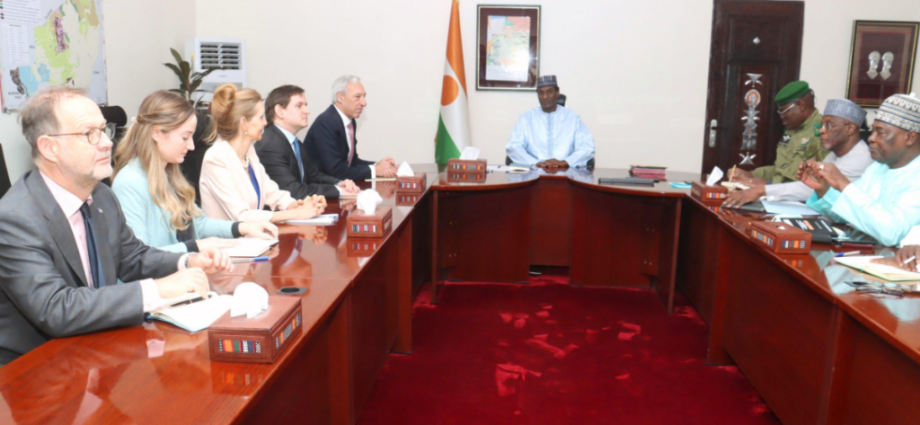
In a move that signals persistent yet strained diplomacy, Niger’s envoy Adamou Moumouni formally presented his credentials to António Costa, president of the European Council, and Ursula von der Leyen, president of the European Commission, on 22 October. The gesture comes after years of friction between Niamey and Brussels, marked by political disputes, humanitarian aid disagreements, and the ongoing detention of former president Mohamed Bazoum.
The question now is whether this diplomatic step reflects a genuine shift in Niger’s approach—or simply an effort to keep official channels open despite deep-seated disagreements.
Strained ties since the 2023 coup
Relations between Niger and the European Union have been rocky since the military overthrew Bazoum in July 2023. Disputes have centered on governance, humanitarian cooperation, and the treatment of the deposed leader. Yet, despite these clashes, both sides have maintained diplomatic engagement.
Moumouni’s accreditation formalises his role as Niger’s representative to the EU, but it does not resolve underlying conflicts. In diplomacy, keeping an official presence allows nations to advance their interests and sustain communication, even amid political tensions. The key question remains: can this institutional continuity lead to a broader reconciliation?
Humanitarian aid dispute sparks fresh crisis
A 1.3 million euro EU aid package for flood victims in late 2024 reignited tensions. Niger’s transitional government argued it had not requested the funds and criticized the EU for announcing the assistance without prior consultation. Authorities also objected to the EU’s decision to distribute the aid through international NGOs—including the International Committee of the Red Cross, Danish Refugee Council, and Cooperazione Internazionale—without what they deemed sufficient coordination.
Niamey accused the EU of unilateral action, insisting its foreign ministry should have been involved. After summoning the EU ambassador, Salvador Pinto da França, in October 2024, Niger demanded his recall, declaring further cooperation impossible. The EU, in turn, expressed strong disagreement, defending its neutrality and independence in humanitarian operations. Brussels also warned against politicising aid and temporarily recalled its ambassador for consultations.
This clash highlights opposing views: Niger’s demand for control over aid distribution on its soil versus the EU’s commitment to impartial, non-political humanitarian principles.
Bazoum’s detention deepens the divide
In March 2026, the European Parliament passed a resolution condemning Bazoum’s continued detention and demanding his immediate release. The vote—524 in favour, two against, with 29 abstentions—underscored Europe’s concerns over Niger’s political trajectory.
For the EU, Bazoum’s fate and democratic restoration remain priorities. Niger’s authorities, however, view external interference in its internal affairs as a breach of sovereignty. This disagreement extends beyond Bazoum’s case, reflecting broader tensions over governance since the coup.
Balancing diplomacy and divergence
Moumouni’s accreditation suggests Niger seeks to sustain dialogue, but it does not signal a policy reversal. The country faces pressing security, economic, and humanitarian challenges, making international partnerships necessary—even with estranged allies like the EU.
For Brussels, maintaining diplomatic ties allows engagement on critical issues, even without broader political alignment. Yet, meaningful reconciliation would require progress on contentious topics: resumed negotiations, better humanitarian coordination, or shifts in stance on sensitive matters.
Symbolic step or strategic shift?
So, is Niger backtracking after years of tension? Not necessarily. The credential presentation neither signals surrender nor confirms reconciliation. It primarily affirms the continuation of official diplomatic relations.
Future developments will reveal the significance of this move. Will both sides move beyond disagreements to revive cooperation? Or will they maintain formal ties while remaining at odds on fundamental issues?
Ultimately, Moumouni’s appointment opens a dialogue window—but does not ensure rapprochement. For Niger, the challenge is balancing its positions with practical diplomatic needs. For the EU, it’s about preserving cooperation while upholding its principles.
Comments are closed, but trackbacks and pingbacks are open.