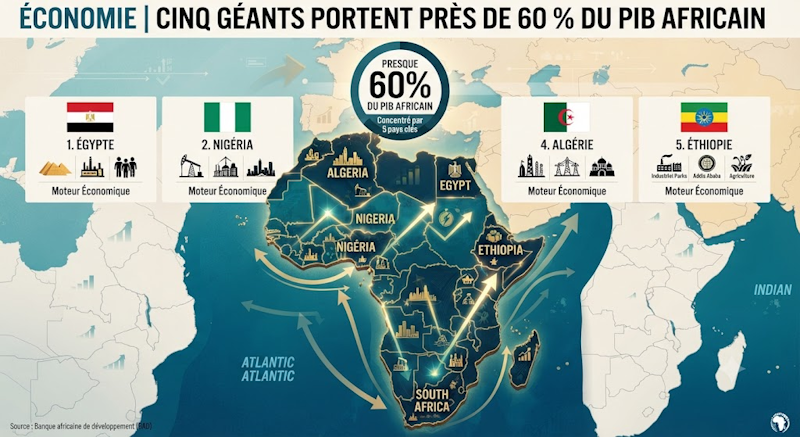
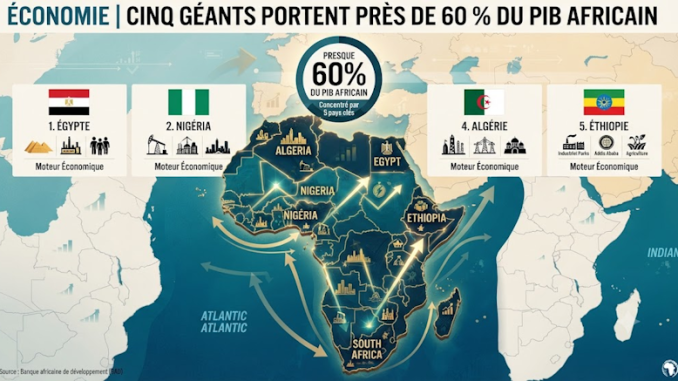
Fresh data from the African Development Bank (AfDB) reveals a striking imbalance in Africa’s economic landscape: just five countries now generate nearly 60% of the continent’s Gross Domestic Product (GDP). Egypt, Nigeria, South Africa, Algeria and Ethiopia stand as the continent’s economic titans, driving growth and shaping the trajectory of African development.
Their dominance is not accidental. These nations leverage vast natural wealth, massive domestic markets, robust industrial bases and strategic investments in infrastructure to maintain their leading positions. However, this concentration also underscores a widening gulf between Africa’s economic powerhouses and its less affluent peers.
Diverse engines behind continental growth
Each of these economies has carved out a unique niche in Africa’s economic ecosystem:
- Egypt and Nigeria combine massive populations with increasingly diversified economic structures, balancing traditional sectors with emerging industries.
- South Africa remains the continent’s industrial and financial powerhouse, anchoring regional trade networks and financial systems.
- Algeria derives significant strength from its hydrocarbon sector, while state-led investment programs continue to stimulate broader economic activity.
- Ethiopia has rapidly industrialized in recent years, backed by large-scale infrastructure projects that connect remote regions to national and international markets.
Challenges of uneven development
The disproportionate share of GDP held by these five nations highlights systemic disparities across the continent. While they propel overall economic expansion, many African countries still struggle with industrialization, financial inclusion and job creation. The result is a two-speed Africa: one segment racing ahead on the back of diversified, high-value economies, while another lags behind in structural transformation.
Economists warn that without targeted interventions, these imbalances could deepen, limiting the continent’s ability to achieve inclusive, sustainable growth. The challenge ahead is clear: how to translate the success of Africa’s economic leaders into shared prosperity across all 54 nations.