New data reveals the true leaders in African military hardware
For years, Russia’s expanding military footprint across the Sahel has dominated headlines about African security partnerships. However, fresh analysis of 2021-2025 defense trade data shows Moscow does not sit at the top of the continent’s arms import rankings. New figures put leaders China and the United States ahead in supplying Africa’s armed forces with the tools to fight terrorism.
Who actually dominates the market?
The latest report from the Stockholm International Peace Research Institute (SIPRI) confirms the shift. Between 2021 and 2025, the United States accounted for 19 percent of major arms transfers to African nations—the largest share. China followed closely with 17 percent, while Russia trailed at 15 percent. France, once a dominant supplier, managed just 8.3 percent.
The rankings tighten even further in Sub-Saharan Africa. China leads with 22 percent of major arms imports, ahead of Russia at 12 percent and Turkey at 11 percent. These figures contradict the narrative of Russia as Africa’s top defense partner.
The rise of China as a defense partner
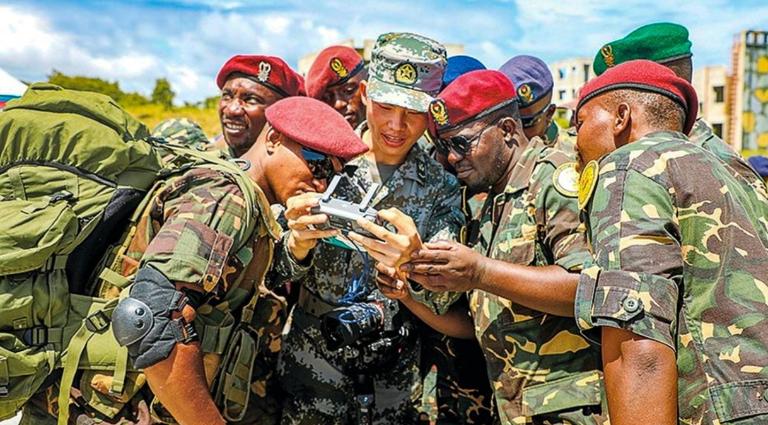
China has aggressively expanded its military export portfolio to meet Africa’s urgent counterterrorism needs. Beijing supplies advanced equipment including armored personnel carriers, surveillance and attack drones, anti-aircraft systems, radar systems, artillery, and transport aircraft.
In the Sahel, China’s presence is already making an impact. Burkina Faso received 116 infantry transport vehicles and six assault vehicles from Chinese manufacturers in 2024. Mali has deepened cooperation with Chinese defense firm NORINCO, focusing on training, technology transfer, armored vehicle deliveries, and artillery systems. These partnerships provide critical mobility, surveillance, and protection capabilities in regions under siege by armed groups.
The drones supplied by Chinese companies are increasingly used to monitor militant movements and gather intelligence, while protected vehicles enhance troop movement and survivability. Beyond sales, Beijing is building long-term defense relationships that include maintenance, operator training, and localized production initiatives.
Russia’s strategic influence vs. its commercial decline
While Russia no longer leads Africa’s arms import market, its security role on the continent remains significant. Through military advisers, contractors, and the restructured Africa Corps, Moscow maintains a strong presence—particularly in the Central African Republic and Mali.
Its approach blends arms sales with operational support: providing military trainers, security advisers, and direct operational involvement. This hands-on presence bolsters its political and media visibility across the Sahel.
Yet commercially, Russia faces sharp headwinds. SIPRI data shows a 64 percent drop in global arms exports between 2016-2020 and 2021-2025. Western sanctions, the war in Ukraine, and internal supply demands have severely constrained Moscow’s ability to fulfill large African orders.
Beyond sales: what matters most in fighting terror
The debate over African security is often reduced to “who sells the most weapons.” But real counterterrorism success depends on more than tanks, drones, or rifles. It requires reliable intelligence networks, air mobility, cross-border coordination, state presence in vulnerable territories, and professional, well-equipped forces.
New entrants like China offer African governments greater choice and leverage. But diversification carries risks: technology dependence, high maintenance costs, spare parts availability, and potential proliferation. Balancing supply chains with strategic autonomy is now a key challenge for defense planners across the region.
What the numbers tell African governments
The data is clear: Africa is not dependent on a single supplier for its security. Instead, it is diversifying. The United States leads continental arms imports, while China dominates the Sub-Saharan market. Russia retains influence, but not as the top seller.
This shift reveals a quieter but powerful transformation in Africa’s defense landscape. As governments respond to relentless terrorism threats, supplier competition is intensifying. And in that competition, China is leveraging industrial strength, commercial flexibility, and strategic engagement—factors no African leader can afford to ignore.
Comments are closed, but trackbacks and pingbacks are open.