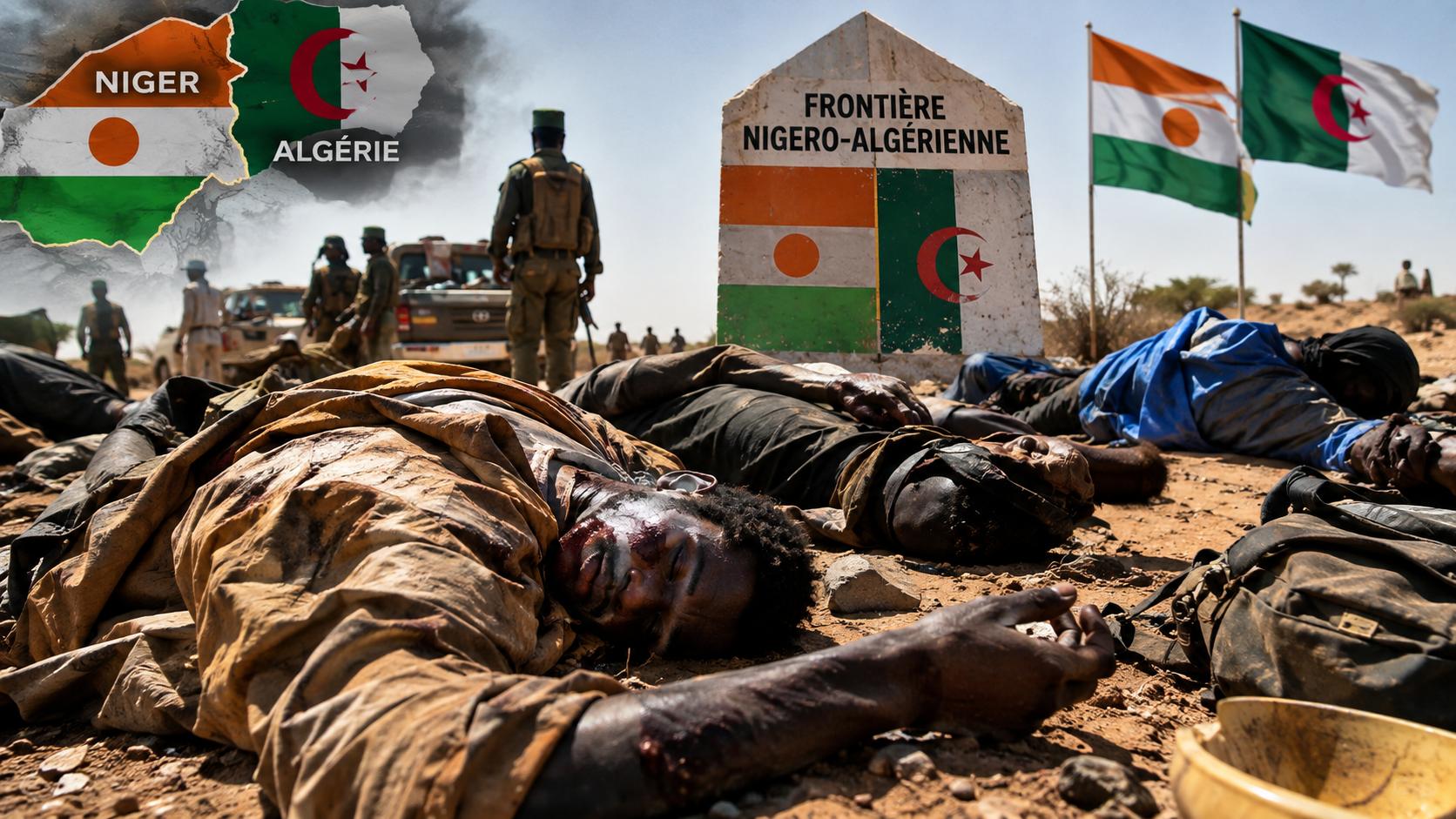
At least 48 civilians were killed when a military helicopter belonging to the Algerian air force bombed an artisanal gold-mining site in the desert strip that separates Niger from Algeria. The strike, carried out in full daylight, has plunged the region into grief — and exposed a political truth that Niamey would rather keep buried.
Among the victims were unarmed men who had travelled to these remote diggings hoping to earn a living. That a foreign army could fire on them without a single official reaction from the Nigerien authorities has left the population stunned and furious.
A gold field turned into a killing ground
Witnesses describe a Russian-made Mi-171 gunship circling low over the workings before opening fire on the makeshift installations and the vehicles parked nearby. The gold-bearing zone is normally crowded with hundreds of young prospectors who come from Niger and from neighbouring countries to scratch a living out of the sand.
Trapped in open desert terrain with nowhere to take cover, the miners had no chance. Beyond the 48 confirmed dead, an unknown number of seriously injured survivors were evacuated in precarious conditions towards the nearest medical facilities.
What is known about the raid
- A Mi-171 helicopter of the Algerian air force carried out the strike
- At least 48 civilians killed, all of them artisanal gold miners
- The raid took place in daytime on a site close to the Niger–Algeria border
- Scores of wounded were moved to clinics in difficult conditions
Algiers routinely presents its aerial patrols along the southern margins as a fight against terrorism and cross-border crime. This time, however, the people who paid the price were informal workers carrying no weapons at all.
Why Niamey’s silence is being read as consent
A foreign power bombing a site on or immediately beside Nigerien soil would normally trigger an open diplomatic crisis, formal protests and a wave of nationalist indignation. Instead, General Abdourahamane Tiani and his junta have said nothing. That embarrassed quiet has become a story in itself.
An ally kept, a border sacrificed
The strike is widely read in the region as having taken place with at least the tacit approval of Niger’s military rulers — possibly more than that. Having broken with its traditional partners and still hunting for legitimacy and regional backing, the regime appears ready to trade the integrity of its own territory, and the lives of its own citizens, for political survival. Algeria, determined to secure its southern edges at any cost, is filling the authority vacuum and dictating its rules on the other side of the frontier.
A security force losing its cohesion
The Algerian military incursion comes at a moment of acute internal strain for the Nigerien armed forces. The army is still reeling from the failed coup attempt during the night of 28 to 29 August, an episode that laid bare deep rifts inside both the high command and the ranks.
An exodus of officers and soldiers
Since then, defections have reached a scale rarely seen in the country. Disillusioned by the junta’s political direction, worn down by deteriorating security and unwilling to be associated with abuses or internal score-settling, many officers and ordinary soldiers are simply leaving their posts. The result is a security apparatus too weakened to cover a vast national territory, leaving room for neighbouring armies and non-state armed groups to move as they please.
Families want answers, and patience is running out
Across Niger, bewilderment has hardened into anger. Relatives of the dead and civil-society organisations are demanding explanations. How can a government that has placed “national sovereignty” at the centre of its rhetoric allow a foreign army to massacre its civilians without demanding accountability?
By turning a blind eye to Algerian operations and struggling to hold its own troops together, the junta in Niamey is revealing the limits of its authority. This frontier tragedy marks a grim turning point for a weakened country where the search for gold has become lethal and where sovereignty increasingly looks like nothing more than a slogan.
Comments are closed, but trackbacks and pingbacks are open.