The arithmetic behind a sovereignty narrative
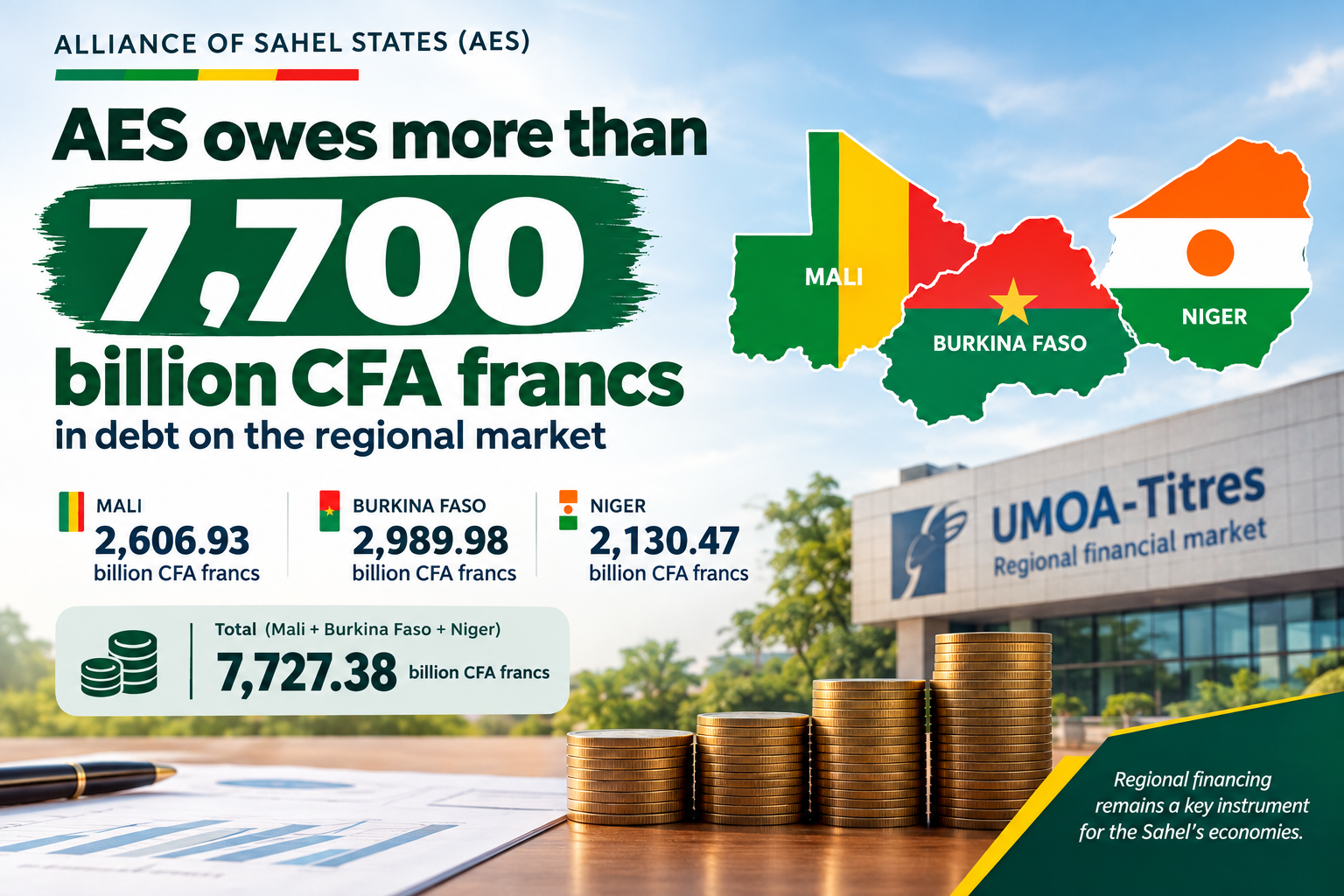
On 31 July 2026, the three states of the Alliance of Sahel States – Burkina Faso, Mali and Niger – together carried 7,727.38 billion FCFA in outstanding public securities on the regional market. That number sits awkwardly beside a political message built on autonomy, a clean break from old dependencies and the financing of national efforts from domestic resources alone.
The gap between the two is not a matter of opinion. It is written into the volume of securities still in circulation on the market West African governments use to fund their budgets.
One clarification matters before any interpretation. These sums are not a debt owed to WAEMU as an institution. They are securities held by investors who bought the Treasury bills and bonds issued by the three governments – a distinction that changes how the figures should be read.
- Burkina Faso: 2,989.98 billion FCFA
- Mali: 2,606.93 billion FCFA
- Niger: 2,130.47 billion FCFA
Added together, the three stockpiles reach 7,727.38 billion FCFA.
Burkina Faso: a stock closing in on 3,000 billion FCFA
Burkina Faso accounted for 2,989.98 billion FCFA of outstanding securities on 31 July 2026, roughly 12.4% of the 24,073.53 billion FCFA held by all WAEMU member states on the same date.
The stock was still expanding – up 2.46% in a single month – which suggests Ouagadougou has not stepped back from the market at all.
The early months of 2026 show the pattern clearly. The government raised fresh money while continuing to pay down older paper. In May alone, it mobilised 99.50 billion FCFA in Treasury bonds and repaid 72.04 billion FCFA.
Sovereign rhetoric, in other words, has not removed the regional market from the treasury management toolkit.
Mali: 2,606.93 billion FCFA, with two flows running at once
Mali’s outstanding stock stood at 2,606.93 billion FCFA at the end of July 2026, about 10.8% of the regional total. By the end of May 2026 it had already reached 2,637.64 billion FCFA. During that month, Bamako mobilised 93.50 billion FCFA while repaying 110.07 billion FCFA.
Borrowing and repaying in parallel is ordinary debt management. The relevant question is not whether Mali issues securities, but at what pace, at what price and to finance what.
Niger: 388 billion FCFA added in a single month
Niger’s 2,130.47 billion FCFA at 31 July 2026 equals roughly 8.9% of the union’s total. The movement behind that figure is more telling than the figure itself.
Between April and May 2026, Niger’s stock climbed from 1,732.05 billion to 2,120.45 billion FCFA – a gain of nearly 388.4 billion FCFA in four weeks, driven largely by heavy financing and debt-reprofiling operations.
In May, Niamey mobilised 567.49 billion FCFA, of which 519.51 billion came from Treasury bonds and 47.97 billion from bills, while 191.31 billion FCFA was repaid. Days earlier, a larger transaction had processed 446.386 billion FCFA in securities, including about 59.710 billion FCFA of short-term paper bought back to ease immediate pressure on cash reserves. Net resources generated by that operation were estimated at roughly 327 billion FCFA.
Three states, a third of the entire regional market
Set the three stocks against the regional picture and the proportions speak for themselves: 7,727.38 billion FCFA out of 24,073.53 billion FCFA, or about 32.1% of everything WAEMU states owed investors at that date.
The paradox sharpens once the departure of Burkina Faso, Mali and Niger from ECOWAS is taken into account. Politically, the three have pledged to chart an independent course. Financially, they keep using the WAEMU market – a market that leans heavily on banks and investors from the very West African space they have distanced themselves from.
Figures recorded in late 2025 showed that investors in other WAEMU countries had cut their exposure to AES debt from 3,174 billion to 2,801 billion FCFA, a decline of 373 billion FCFA between the fourth quarter of 2024 and the third quarter of 2025. Cross-holdings among the three AES states themselves fell by 622 billion FCFA over the same period, to about 3,160 billion FCFA. When lenders grow cautious, borrowing becomes costlier and harder to place.
What the headline figures conceal
Niger’s May operation as a case study
Niger mobilised 567.49 billion FCFA in May 2026 and repaid 191.31 billion FCFA. The separate 446.386 billion FCFA transaction used part of its proceeds to retire maturing paper. Some of the newly raised money, therefore, was not fresh funding for projects at all – it refinanced debt already on the books.
That is standard practice on bond markets, but it deserves to be said plainly: raising hundreds of billions does not mean hundreds of billions in additional resources for development.
Seven questions behind every “billions mobilised”
When a government announces an issue of 500 billion FCFA, several questions should follow. How much is genuinely new? How much retires old securities? What interest rate applies? How long is the maturity? And what will the final bill be for the taxpayer?
In Niger’s case, 446.386 billion FCFA was handled at gross level while about 327 billion FCFA emerged in net resources. The difference is no accounting footnote. It alters the political meaning of the number entirely.
The real test is the cost of debt, not its size
To judge whether these liabilities can be sustained, the outstanding amount alone proves little. Other factors carry equal weight:
- interest rates;
- maturity schedules;
- the annual volume of repayments;
- the capacity to raise tax revenue;
- economic growth;
- the share of spending absorbed by security;
- the ability to roll over debt as it matures.
A state can comfortably carry a large stock if its revenues are strong and its growth solid. Another can run into serious difficulty with a smaller debt if much of it falls due at the same time or if rates climb too high.
Sovereignty does not retire a debt
The debate around the AES should not be reduced to a simple contest between sovereignty and dependency. The numbers describe something more complicated.
The 7,727.38 billion FCFA is not owed to WAEMU as an organisation. It is owed to the investors who subscribed to the securities these states issued. Yet the observation stands: the countries claiming the greatest financial autonomy remain heavy users of regional bond financing to cover their needs.
The question is no longer whether the AES borrows. It is how far these governments can keep borrowing before the price of that financial sovereignty lands on their future budgets.
Comments are closed, but trackbacks and pingbacks are open.