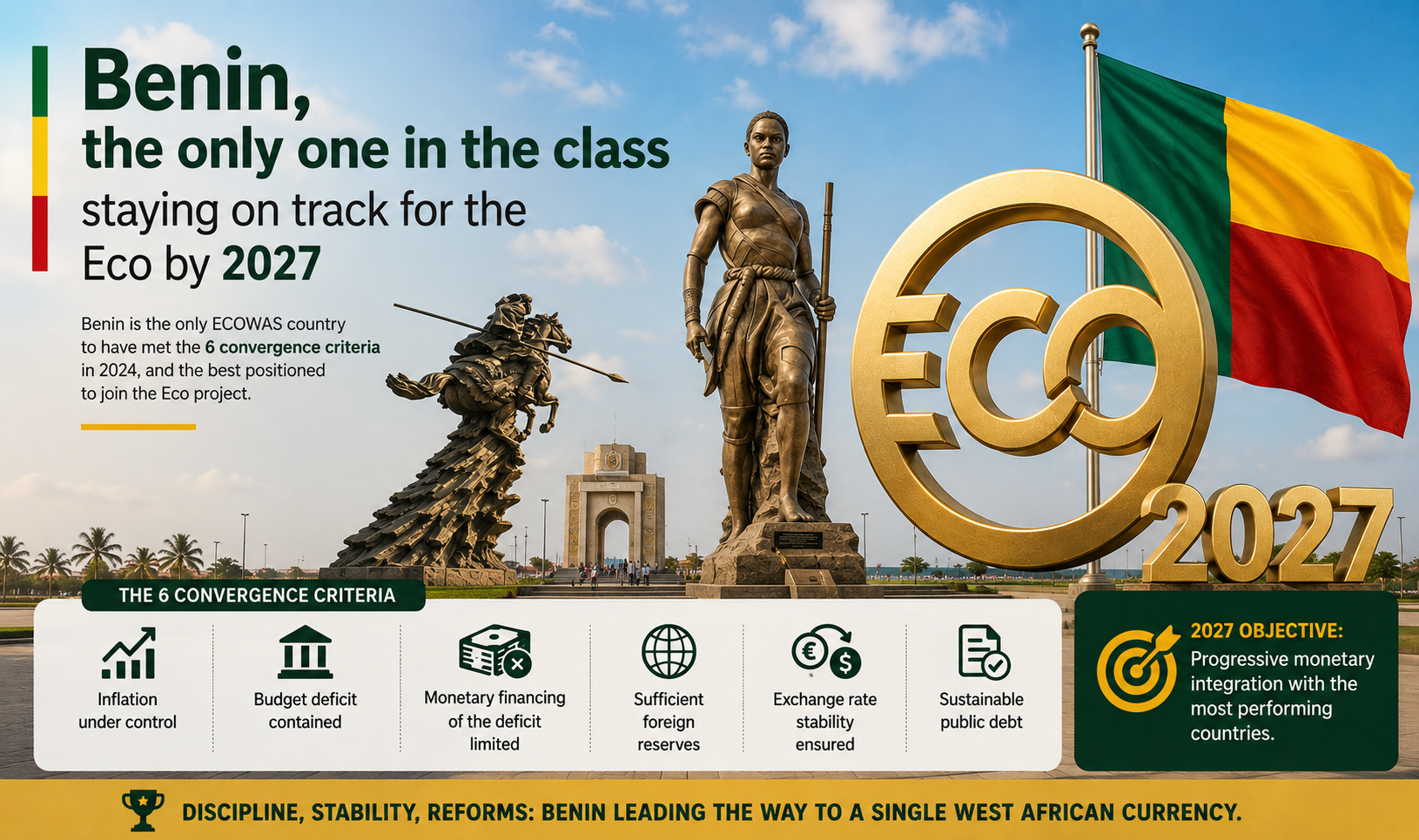
The Economic Community of West African States (CEDEAO) remains committed to launching the Eco by 2027, despite the economic disparities across the region. While many member states face challenges in meeting the convergence criteria, Benin has emerged as a frontrunner in the race toward monetary integration.
Economic integration faces regional challenges
The vision of a single West African currency has been a long-standing ambition within the CEDEAO framework. However, achieving this goal requires overcoming significant economic hurdles, including inflation, public deficits, debt levels, and divergent national policies. The 2027 deadline may necessitate a staggered approach, allowing only the most prepared countries to adopt the Eco initially.
Benin leads in macroeconomic convergence
In 2024, Benin distinguished itself as the sole CEDEAO member to meet all six convergence criteria established for monetary integration. These benchmarks encompass inflation control, fiscal discipline, sustainable debt levels, stable exchange rates, and adequate foreign reserves. Meeting these requirements demonstrates a commitment to sound economic governance and financial stability.
Six pillars of economic solidarity
The convergence criteria serve as the foundation for a stable monetary union, ensuring that participating nations adhere to shared fiscal and monetary standards. Key indicators include:
Inflation control to preserve purchasing power and monetary stability;
Fiscal deficit limits to prevent excessive public borrowing;
Controlled deficit monetization to avoid excessive money supply;
Adequate foreign reserves to cover import costs;
Currency stability to foster investor confidence;
Sustainable public debt to maintain economic resilience.
A deliberate path to economic credibility
Benin’s achievement reflects years of disciplined economic reforms, including enhanced revenue collection, prudent public finance management, and strategic infrastructure investments. While these measures have strengthened the country’s macroeconomic standing, they also required careful balancing to support both development needs and fiscal prudence.
The next critical step for Benin will be sustaining this performance beyond a single year. Consistently meeting the criteria will reinforce the country’s reputation as a reliable participant in the Eco framework.
A phased introduction of the Eco
The heterogeneity of West African economies presents a significant obstacle to simultaneous monetary integration. Divergent inflation rates, debt burdens, and fiscal capacities make a uniform transition impractical. A phased approach would allow only the most prepared nations to adopt the Eco initially, ensuring a more stable foundation for the union.
Under such a model, Benin is well-positioned to join the first wave of adopters, provided its economic performance remains robust.
Strategic benefits of early adoption
Early integration into the Eco could enhance Benin’s economic influence within the region. A shared currency fosters deeper policy coordination, improving trade relations and financial credibility. This could attract foreign investment, strengthen fiscal credibility, and solidify Benin’s role in regional economic decision-making.
Uncertainties remain ahead of 2027
Despite its progress, the successful launch of the Eco by 2027 is not guaranteed. Success depends on sustained economic performance, collective political will, and institutional readiness. Questions regarding monetary governance, regional solidarity mechanisms, and policy coordination must be addressed before full implementation.
The shifting geopolitical landscape within the CEDEAO, including the withdrawal of certain Sahelian states, adds further complexity to the integration process. The original vision of a unified monetary bloc must now adapt to a more fragmented regional environment.
Sustaining progress to remain competitive
Benin’s current lead in meeting convergence criteria is commendable, but it must be maintained. Future priorities include controlling inflation, managing debt levels, and continuing structural reforms while funding essential development projects. The ultimate test will be whether Benin can remain among the leading nations when the Eco transitions from a policy concept to an economic reality.
If the Eco is introduced progressively, Benin could secure a strategic advantage positioning itself as a model of economic stability and a key player in West Africa’s monetary future.
Comments are closed, but trackbacks and pingbacks are open.