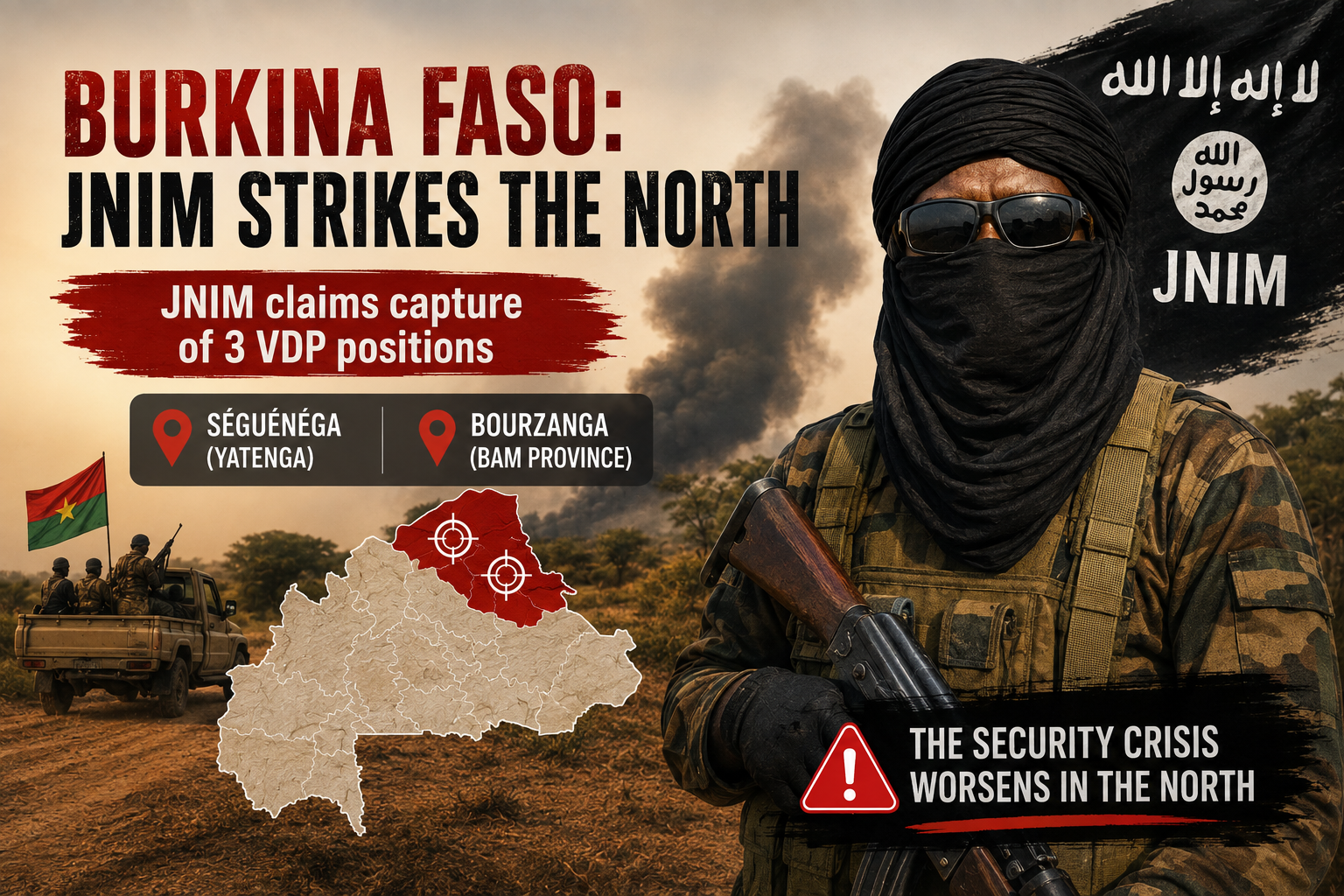
Burkina Faso is grappling with an escalating security emergency that threatens to destabilise the nation, while the government’s communication tactics are increasingly met with public doubt. On August 19, the terrorist faction JNIM seized three strategically important positions maintained by the Volunteers for the Defense of the Homeland (VDP) in the northern region. These coordinated attacks, marked by extreme violence, targeted Séguénéga in Yatenga and Bourzanga in Bam Province, signalling another critical setback for national security efforts.
The recent surge in militant activity has reignited concerns over the state’s capacity to maintain control over territories that have been retaken or secured. The frequent occurrence of assaults, the severe strain on civilian populations, and the persistent susceptibility of key zones highlight that military recovery alone is inadequate. Effective security measures must be accompanied by consistent governance, accurate intelligence, adequate logistics, and, most importantly, uncompromised civilian protection.
The growing threat posed by JNIM places additional strain on the VDP, a crucial component of Burkina Faso’s defence apparatus. These volunteer forces, often stationed on the front lines, face armed groups possessing superior mobility and destructive capabilities. Each territory lost not only represents a tactical failure but also risks undermining public trust, accelerating displacement, and restricting humanitarian access to affected communities.
The response from Captain Ibrahim Traoré has come under scrutiny. Instead of providing an honest evaluation of security failures, the transitional leader has relied on a series of disjointed public statements. These communications, often laced with populist rhetoric and lacking a coherent framework, seem designed to deflect attention rather than address the crisis effectively. Such an approach may offer temporary relief for public frustration but does little to resolve the underlying security challenges.
Political rhetoric versus ground realities
In times of crisis, public discourse cannot substitute for tangible action. While appeals to sovereignty, resistance, or a rupture from previous partnerships may resonate with certain segments of society, they do not safeguard villages, secure critical routes, or prevent attacks on military and auxiliary installations. Citizens ultimately demand measurable improvements in their daily security.
The central issue is no longer about the government’s messaging but rather the tangible impact on the lives of Burkinabè people. When a region remains vulnerable, when families flee their homes, or when defence outposts fall despite allocated resources, the debate shifts from communication to performance. It reflects the effectiveness of the security strategy and the state’s ability to honour its commitments.
The erosion of press freedom
The nation’s broader crisis is exacerbated by the suppression of dissenting voices. Once a hub of dynamic journalism, Burkina Faso’s media landscape now operates under severe restrictions. Journalists and critics attempting to expose ground realities face relentless repression whether through detention, forced enrolment in ‘re-education’ camps, or conscription under nationalist pretences. The penalisation of truth-tellers does not resolve security challenges; it merely widens the gap between official narratives and ground-level realities.
In a conflict zone, independent reporting is essential for assessing progress, identifying shortcomings, and prompting corrective measures. Silencing those who document the crisis does not eliminate its existence; it merely obscures it. The government may seek to influence public perception, but battlefield realities attacks, displacements, and casualties remain unchanged.
The contradiction is stark: as security demands transparency, evaluation, and open debate, the space for critical dialogue shrinks. An effective counterterrorism strategy requires acknowledging failures, understanding their origins, and implementing swift corrections. Suppressing dissent may provide short-term political comfort, but it deprives leaders of the insights needed to refine their approach.
By restricting free and independent information, the authorities entrench themselves in a reality-denying stance that does little to address pressing security concerns. The fight against terrorism demands determination and collective mobilisation, but it also necessitates transparency, accountability, and an honest recognition of challenges.
At its core, success is measured not by words but by the safety of the people. So long as militant groups continue to advance, occupy territory, or exert pressure on civilian areas, the government must acknowledge the consequences of its strategy. Public perception may be shaped by rhetoric, but the battle against terrorism cannot be won by communication alone.
Comments are closed, but trackbacks and pingbacks are open.