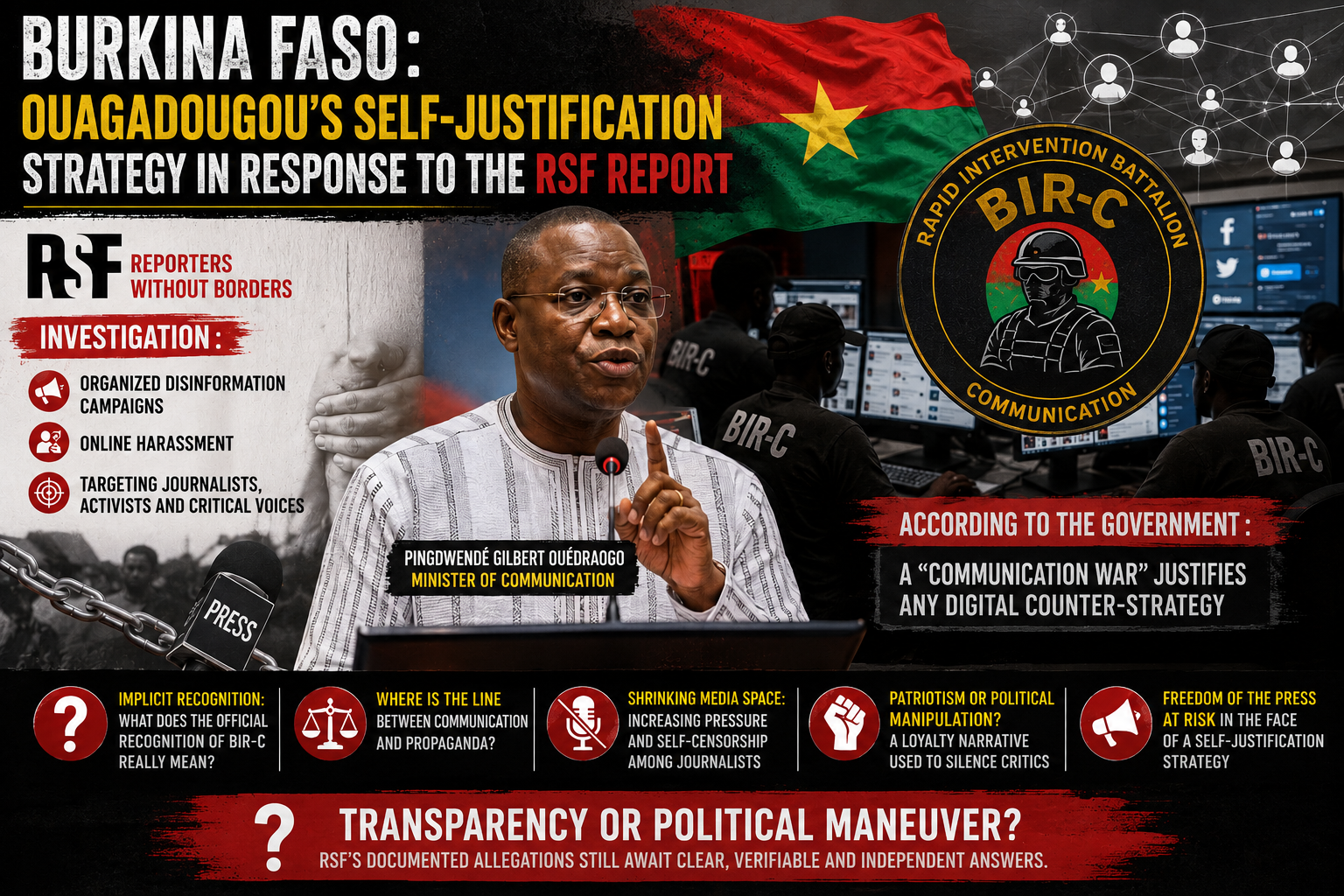
In a recent public address, Burkina Faso’s Minister of Communication, Pingdwendé Gilbert Ouédraogo, reiterated the government’s stance during a flag-raising ceremony on August 3. His remarks, however, did little to dispel concerns raised by an investigation into alleged coordinated disinformation campaigns targeting journalists and activists.
The minister’s tribute to the Bataillon d’Intervention Rapide – Communication (BIR-C), described as a tool for information defense, has only intensified debates rather than providing clarity. The government’s decision to publicly endorse this unit coincides with findings that suggest its involvement in systematic online harassment and smear campaigns against critics of the military-led transition.
Mounting evidence and official silence
An investigation alleges that the BIR-C, along with associated networks, orchestrates digital campaigns to manipulate public discourse, discredit dissenting voices, and exert pressure on independent media professionals. Rather than addressing these claims with an independent inquiry or factual rebuttals, authorities have chosen to champion the unit’s activities, further fueling suspicions about its true objectives.
The government frames the situation as a “communication war” waged by external actors seeking to destabilize Burkina Faso. Under this narrative, any digital strategy employed by state-aligned entities is framed as a patriotic duty. Yet this justification blurs the line between legitimate crisis communication and political propaganda, raising critical questions about the limits of state-controlled information tactics.
Press freedom at a crossroads
In a climate of heightened political and security tensions, combating manipulation is a legitimate concern for any government. However, international standards on freedom of expression prohibit the use of targeted harassment, defamation, or intimidation against journalists. When dissent is systematically equated with treason, public debate inevitably narrows, and self-censorship becomes a survival tactic for media professionals.
The timing of the BIR-C’s public endorsement is particularly noteworthy. It follows suspensions of international media outlets and reports of increasing pressure on local journalists, contributing to a shrinking media landscape. Observers argue that these developments foster an environment where criticism is increasingly perceived as a threat to national unity rather than a cornerstone of democratic accountability.
Patriotism as a shield against scrutiny
The government’s strategy appears less about transparency and more about political counteroffensives. By emphasizing the BIR-C’s “patriotic commitment”, authorities shift the conversation from verifiable facts to national loyalty, portraying critics as enemies of the state rather than advocates for accountability. This approach does little to resolve concerns; instead, it reinforces perceptions that the unit operates as a central pillar of the regime’s communication apparatus.
The broader issue extends beyond the BIR-C itself. It reflects Burkina Faso’s approach to information management in the digital age. Social media, now a battleground for political narratives, must be wielded within frameworks that respect fundamental rights and press freedom. Without independent verification of the allegations, official endorsements risk being interpreted not as rebuttals, but as admissions of a communication system shrouded in opacity.
For now, the government’s response—rooted in patriotic mobilization rather than factual clarification—leaves lingering doubts about Burkina Faso’s commitment to a free and pluralistic media environment.
Comments are closed, but trackbacks and pingbacks are open.