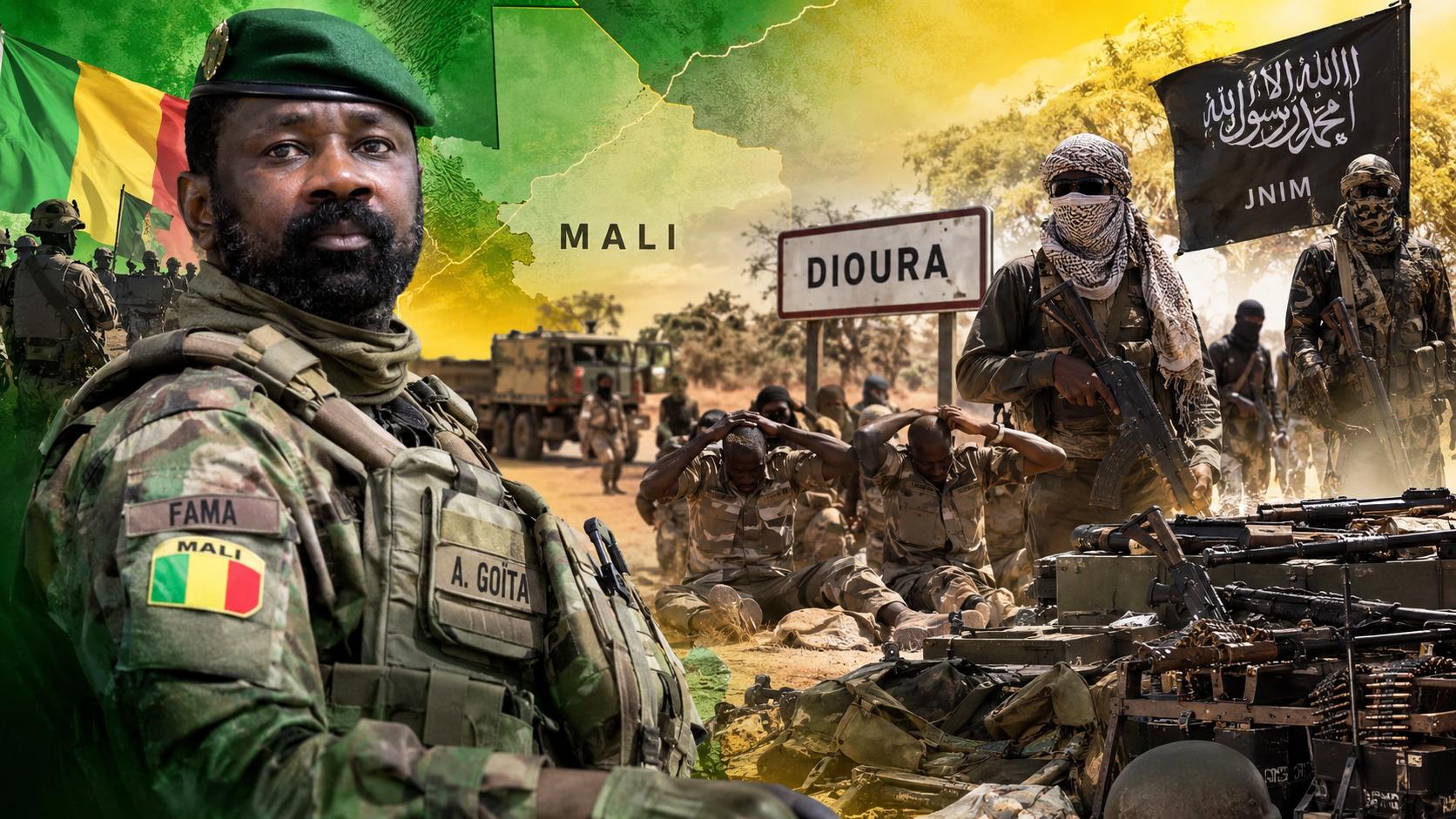
A dawn assault that shattered a Malian army camp
On the morning of Thursday 10 September 2026, fighters of the Group for the Support of Islam and Muslims (JNIM) stormed the military base at Dioura, a locality in the Tenenkou circle of central Mali. For hours on end the position was shelled, overrun and then emptied of its hardware, before the assailants withdrew carrying heavy weapons and dozens of captives.
Long before the first shots rang out, villagers around Tenenkou had grown accustomed to watching the camp’s perimeter shrink. Now they are bracing for the reprisals that habitually follow a withdrawal.
A provisional toll of about 130 dead and 70 prisoners
The Malian Armed Forces and the transitional presidency have kept their public communication to a bare minimum, as they have in earlier episodes of this kind. On the ground, however, the picture emerging is devastating: roughly 130 Malian soldiers killed, and close to 70 troops taken away as captives.
Footage circulated by the group shortly afterwards shows rows of young conscripts, fear written across their faces, next to confiscated stocks of arms and ammunition. For the families of the missing, the wait is unbearable, made worse by Bamako’s silence and its slow reaction.
Residents describe streets emptied of all authority
Dioura woke up to a town without a garrison. Shops stayed shut, and word of the assault spread faster than any official statement. By nightfall, the only certainty for those living nearby was that the state’s presence had vanished along with the soldiers.
Central Mali’s civilians bear the brunt of the collapse
Beyond the military loss, it is the civilian population of the Mopti region that absorbs the consequences. In Dioura, bewilderment has given way to resignation and despair.
“Every time the camp falls or pulls back, we know exactly what awaits us: reprisals, fear and a total vacuum,” said a resident of the area, who asked not to be named. “In Bamako they talk about sovereignty on television, but out here we have no protection, no state and no future.”
Fairs cancelled, roads cut, supplies running dry
Traders in the zone report a complete economic standstill. Weekly markets have been called off, insurgents control the main roads, and bringing in basic goods has become a gamble. After the attackers pass through, the fear of reprisals or of being caught in the middle pushes many villagers towards the larger towns, swelling the ranks of the internally displaced with little attention from the outside world.
The Russian partnership and the promise of a rebuilt army
The fall of Dioura exposes the gap between the security narrative promoted by the military authorities led by Colonel Assimi Goïta and the reality on the front line. Since the coup and the geopolitical pivot towards Moscow, the regime has pledged a stronger army and the imminent eradication of the terrorist threat, with the backing of Russian mercenaries.
In the field, that triumphalist rhetoric crumbles. The departure of international forces (MINUSMA, Barkhane) and the inability of the Russian partners to stabilise the territory have left Malian units isolated, poorly equipped and exposed. Forward bases such as Dioura end up encircled by mobile armed groups that now strike where and when they choose, a clear illustration of the state’s failure to hold its own defence lines.
A political and military dead end
What happened at Dioura is a stark warning for the transitional authorities. By favouring a communication war over the reality of operations in the field, the junta is locking itself into a corner. Shrinking troop numbers, sinking morale and the gradual loss of territorial control in the centre and north raise an urgent question: how much longer can reclaimed sovereignty serve as a screen for the unravelling of national security?
Without a deep rethink of its alliances, its military tactics and its dialogue with local communities, Mali risks sinking further into a vicious circle in which civilians and soldiers alike remain the first victims of political blindness.
Comments are closed, but trackbacks and pingbacks are open.