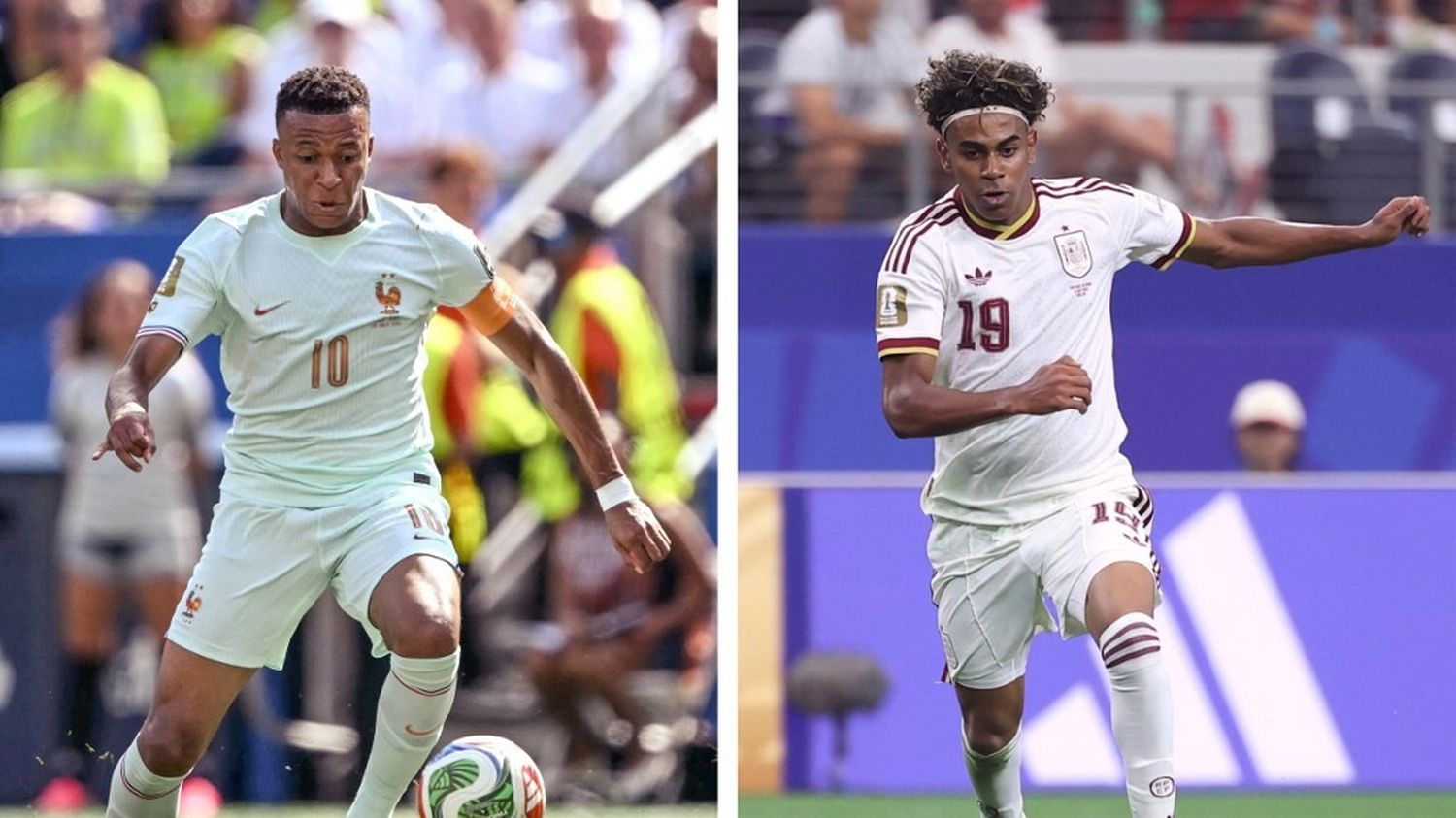
France vs Spain: why this World Cup semifinal is called the final before the final
For the third time in as many competitions over the last three years, France and Spain face off in the semifinals on Tuesday.
“It’s not an exaggeration to call this match the final before the final.” Luis de la Fuente, Spain’s head coach, made this bold statement about the World Cup semifinal between his team and France on Tuesday, July 14, following his side’s victory over Belgium in the quarterfinals. “The clear favorite? Spain. I have no doubt about that,” Didier Deschamps had declared before the tournament began.
Both teams have arrived at this stage of the competition as expected, with one goal in mind: to secure a place in the final on Sunday against the winner of the other semifinal between England and Argentina. After their clashes in the semifinals of Euro 2024 and the 2025 Nations League, the World Cup is now the stage where these two favorites will settle the score once more. But why does this matchup feel even more anticipated than the other semifinal?
Because both teams boast the strongest defenses and most potent attacks in the tournament
With just two goals conceded and one conceded respectively since the start of the competition, France and Spain lead the rankings of the best defenses in the World Cup (Colombia has conceded just one goal but was eliminated in the Round of 16). With five matches without conceding a single goal, Spain holds a slight edge over France (four matches). Both teams are far ahead of the other two semifinalists, as Argentina and England have each conceded six goals and have only managed two matches without conceding.
“This could very well be a spectacular match.”
Didier Deschamps, France’s head coachin a pre-match press conference
Their attacking prowess is equally impressive, as evidenced by a statistic released by FIFA: 110 shots attempted. Only Belgium has done better (112), while Argentina and England lag behind with 98 and 94 shots respectively.
Efficiency, however, is not always consistent: La Roja has scored just 11 goals—the lowest total among the four semifinalists—while Les Bleus have found the net 16 times, one fewer than Argentina and three more than England. With Lamine Yamal on one side and Michael Olise on the other—who tops the assist charts in the tournament with five key passes—both teams possess exceptional playmakers. And they are not alone in their creative firepower.
Because the bench can turn the tide of the match
Mikel Merino embodies the spirit of this relentless Spain side. Subbed on against Portugal in the Round of 16 and Belgium in the quarterfinals, the Arsenal midfielder delivered the goods by scoring the winning goal in stoppage time against Portugal and at the very end of regulation time (88th minute) against Belgium. With Merino, Ruiz, Gavi, Baena, Rodri, Zubimendi, and Pedri, Spain boasts an extraordinary midfield where each player can seamlessly replace another without any drop in performance. The standout figure, Ballon d’Or 2024 winner Rodri, is the fulcrum of the team’s play, completing 629 passes—the highest total in this World Cup. Even though Lamine Yamal has scored just once, his dribbling often creates space for his teammates, including Oyarzabal (4 goals), Ferran Torres, Dani Olmo, and Nico Williams, who has returned from injury.
France, too, has benefited from a strong bench. Bradley Barcola, introduced against Senegal in the opening match, scored within two minutes to give his team the lead and lift a tense squad. He followed that up with another goal as a starter against Sweden in the Round of 16. Désiré Doué proved decisive by winning a penalty against Paraguay after coming on in the 9th minute, while players like Manu Koné, Malo Gusto, Warren Zaïre-Emery, and Rayan Cherki have consistently stepped up when called upon.
Because the rivalry has intensified in recent years
After a brief lull following their golden era (Euro 2008, World Cup 2010, Euro 2012), Spain has rediscovered its brilliance, claiming the European title in 2024 and the Nations League in 2025. On both occasions, Rodri’s squad eliminated France in the semifinals.
Their dominance during Euro 2024 was striking: a pale French side managed just one goal (from the penalty spot) during the group stage, leading to a 2-1 Spanish victory. A year later, a disastrous first half saw La Roja on the brink of an easy qualification (leading 4-0 at the 55th minute and 5-1 at the 67th minute). But a wave of French resilience turned the tide, though they fell just short of equalizing (5-4).
“We are fully aware of their immense potential, but we also know we are the only team to have beaten them in two semifinals,” Luis de la Fuente pointed out. “If France needs to fear anyone, it’s us. We are the ones who eliminated them last time. We’ll see what happens, but we are not afraid,” Lamine Yamal declared with confidence and a touch of provocation.
“He says exactly what he means,” responded Ibrahima Konaté, France’s defender. “You should never fear anyone. Stay humble and don’t fall into that trap, especially at this stage of the competition.” The last time Spain entered a match against France with such confidence—even vowing to push a Real Madrid player into retirement—the French side led by Zinedine Zidane prevailed 3-1 in the Round of 16 of the World Cup. Without a single Real Madrid player but with eight Barcelona players in their 26-man squad, Spain will keep an eye on Kylian Mbappé and Aurélien Tchouaméni, perhaps motivated by the chance to settle scores against their club rivals.
Comments are closed, but trackbacks and pingbacks are open.