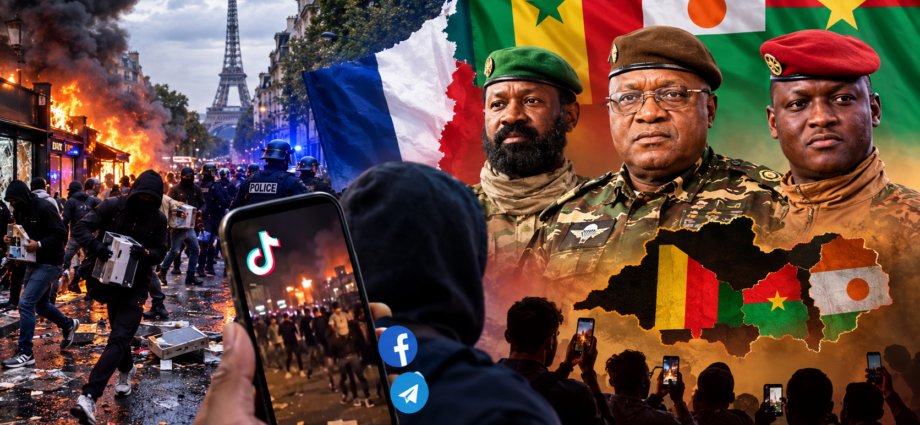
The recent urban unrest in France has not only generated reactions within the country but has also been seized upon by political factions in Mali, Burkina Faso, and Niger. Since military-led governments took power in these nations, relations with Paris have deteriorated significantly. Footage of looting, property damage, and clashes with law enforcement circulating on platforms like TikTok, Facebook, and Telegram is being repurposed to fuel anti-France rhetoric in Sahelian digital spaces.
How foreign unrest is weaponized in Sahel propaganda
For supporters of the Alliance of Sahel States (AES), these images serve as ammunition to undermine France’s credibility. By juxtaposing the violence in French cities against Paris’s own criticisms of Sahelian governments on democracy, security, and rule of law, they argue that France’s moral authority is eroded. This narrative aims to enhance the image of military regimes while undermining the former colonial power’s standing in the region.
The strategy relies on a simple yet effective premise: if France cannot maintain order at home, why should it dictate governance standards abroad? This line of reasoning is systematically amplified in online spaces sympathetic to the AES, where French instability is framed as irrefutable proof of systemic failure.
Legal accountability remains non-negotiable
The spread of these images, however, raises a critical question: what happens when foreign nationals are implicated in the unrest? Reports indicate that some individuals from Sahelian countries, including those in irregular administrative situations, may have participated in acts of violence or property destruction. If investigations confirm their involvement, they must face legal consequences under French law regardless of nationality.
For those found guilty, judicial proceedings will proceed as they would for any other individual. Authorities may also review their immigration status if applicable, but the primary focus remains the establishment of individual responsibility. The principle is unequivocal: no one, irrespective of origin, is above the law in France.
Distinguishing propaganda from judicial facts
While the AES-aligned commentary frames the unrest as emblematic of France’s collapse, such claims require scrutiny. A single video of looting or police clashes does not substantiate a broader narrative of systemic failure. Similarly, isolated incidents should not be conflated with national crises, nor should they be used to validate alternative governance models in the Sahel.
Misinformation tactics often accompany these narratives. Authentic footage may be mislabeled, outdated clips presented as current, or localized events magnified into national catastrophes. Establishing coordinated disinformation campaigns demands more than surface-level observations it requires verifying sources, cross-referencing accounts, and identifying patterns of dissemination.
No collective guilt, only individual responsibility
Critics of France’s handling of the crisis must also acknowledge a fundamental principle: guilt is personal, not collective. The overwhelming majority of Sahelian migrants living in France play no role in the unrest and should not be stigmatized. Nationality alone cannot serve as evidence of involvement or affiliation with political movements.
Yet, when responsibility is established, it must be addressed impartially. If judicial proceedings confirm that certain individuals from the AES participated in illegal acts, they must be held accountable without exception. This duality rejecting collective punishment while upholding legal consequences is the cornerstone of a fair and transparent justice system.
Diplomatic tensions and the battle for narrative dominance
The fallout from the unrest has intensified the information war between Paris and Sahelian military regimes. French struggles are framed as evidence of Western decline, while the AES governments’ policies are presented as superior alternatives. However, such assertions demand empirical validation. Real progress in governance, security, and human rights cannot be declared through propaganda it must be demonstrated through verifiable outcomes.
The judicial process in France will proceed independently of political narratives. Investigators will examine the evidence, and courts will determine culpability based on facts, not viral clips or ideological agendas. The strength of any democracy lies not in its ability to silence criticism but in its commitment to due process and the rule of law.
As investigations unfold, one question remains paramount: will the pursuit of truth prevail over the exploitation of crisis?
By Alasane OUEDRAOGO — Journalist
Comments are closed, but trackbacks and pingbacks are open.