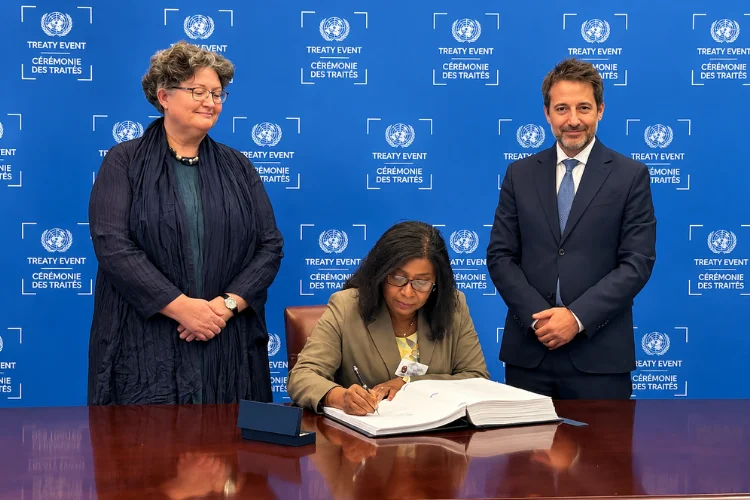
The 81st United Nations General Assembly in New York has become a stage for intense debate as Gabon steps into a newly acquired vice-presidency role. Elected in June, Libreville joins the UN General Assembly Bureau, the organization’s key decision-making body, signaling a shift in its international diplomacy strategy. Under this spotlight, Gabon’s delegation, led by Foreign Minister Marie-Édith Tassyla-Ye-Doumbeneny, faces both scrutiny and opportunity.
The historic role arrives at a moment when Gabon is actively redefining its global presence, seeking to align its national priorities with broader multilateral goals. While proponents hail the move as a step toward greater African representation, critics question whether this symbolic shift will translate into tangible influence on major global issues.
Marie-Édith Tassyla-Ye-Doumbeneny, mandated by President Brice Clotaire Oligui Nguema, is not merely attending the high-level discussions—she is carrying forward Libreville’s diplomatic agenda on the world stage. Her delegation, carefully coordinated ahead of the assembly, has already made headlines by signing two pivotal international treaties: the Treaty on the Prohibition of Nuclear Weapons (TPNW) and the Cybercrime Convention. These actions underscore Gabon’s commitment to key global agendas, including nuclear disarmament and digital security.
Yet, beyond treaties and declarations, the real test lies in how effectively Gabon navigates the complex dynamics of the UN General Assembly. On September 26, Tassyla-Ye-Doumbeneny will deliver Gabon’s official statement to the assembly, a moment watched closely by diplomats, analysts, and citizens alike. The speech is expected to outline Libreville’s vision for its new role and address pressing concerns such as climate change, forestry conservation, ocean protection, healthcare access, urban development, and digital transformation—areas central to Gabon’s national policy.
As debates unfold in New York, reactions from the international community are divided. Some see Gabon’s vice-presidency as a strategic win for Central Africa, offering a platform to amplify African voices on climate action and economic diplomacy. Others remain skeptical, arguing that without substantial behind-the-scenes influence, the symbolic gesture may fall short of delivering real change. Meanwhile, at home, the move has sparked discussions about what tangible benefits this diplomatic leap could bring to Gabon’s citizens and economy in the coming years.
What Gabon’s UN vice-presidency means for Africa’s voice
Gabon’s entry into the UN General Assembly Bureau comes at a time when African nations are increasingly asserting their presence on the global stage. As one of the few Central African countries holding this position, Gabon is uniquely positioned to advocate for regional priorities, from climate justice to sustainable resource management.
The vice-presidency provides Libreville with an unprecedented opportunity to shape discussions on critical global issues. Whether through coalition-building in the assembly or spearheading initiatives on biodiversity and digital governance, Gabon’s leadership role could serve as a catalyst for stronger African unity in international affairs. However, success will depend on the ability to translate diplomatic rhetoric into actionable outcomes that benefit both Africa and the wider global community.
Domestic expectations: will the diplomatic win translate to real change?
Back in Gabon, citizens and policymakers are weighing the potential impact of this newfound international status. Many hope that Gabon’s active participation in the UN will attract investment, boost trade opportunities, and enhance the country’s profile as a stable and forward-thinking nation. The signing of major treaties, for instance, signals Gabon’s alignment with global norms on disarmament and cybersecurity—areas that could strengthen its appeal to foreign partners.
Yet, skepticism lingers. Critics argue that without concrete policy shifts or visible improvements in governance, Gabon’s diplomatic achievements may remain largely symbolic. Will the vice-presidency lead to increased development funding? Can it influence trade agreements or security partnerships in Central Africa? These questions dominate conversations across Libreville’s political and economic circles, reflecting both optimism and cautious realism about the road ahead.
Key moments and Gabon’s strategic priorities at the UN assembly
The Gabonese delegation’s coordination ahead of the assembly reflects a meticulous approach to multilateral diplomacy. Prior to the general debate, a preparatory meeting at the Permanent Mission of Gabon to the United Nations ensured alignment on national positions. This coordination highlights Libreville’s intent to present a unified front and maximize its influence within the assembly’s complex negotiations.
Among the priorities shaping Gabon’s agenda are:
- Climate action and forest conservation: Leveraging Gabon’s role as a global leader in sustainable forestry to advocate for international support in combating deforestation and promoting carbon neutrality.
- Marine ecosystem protection: Championing ocean health and sustainable fisheries, particularly in the Gulf of Guinea, to align with global sustainability goals.
- Healthcare innovation: Promoting access to medicines and pandemic preparedness, especially in light of lessons learned from recent global health crises.
- Urban development and digital transformation: Highlighting progress in smart city initiatives and digital governance to attract investment and innovation partners.
These focus areas are not only aligned with Gabon’s national development plans but also resonate with broader UN objectives. How effectively Gabon champions these causes in New York could determine its legacy in this high-stakes diplomatic role.
Reactions from the international community: praise, skepticism, and debates
The global response to Gabon’s UN vice-presidency has been a mix of praise and scrutiny. Supporters emphasize the symbolic significance of Central African representation in the assembly’s leadership, particularly as the continent faces pressing challenges such as climate vulnerability and economic inequality. They argue that Gabon’s involvement could help bridge divides between Global North and South policies, particularly on environmental and social justice issues.
On the other hand, skeptics question the practical impact of the role. They point out that the vice-presidency, while prestigious, does not equate to a vote on key resolutions or direct control over agenda-setting. This has led to debates about whether Gabon’s presence will merely reinforce existing power dynamics or catalyze meaningful change. Analysts note that success will hinge on Gabon’s ability to build coalitions and leverage its position to advance African interests without being sidelined by more dominant diplomatic players.
The road ahead remains uncertain. Will Gabon’s vice-presidency mark the beginning of a new era in Central African diplomacy, or will it be remembered as a fleeting moment of international recognition? As the 81st UN General Assembly unfolds, the world watches closely to see how Libreville navigates this pivotal opportunity.
Gabon’s path forward: turning diplomacy into tangible results
The coming months will be critical for Gabon as it seeks to solidify its new role at the UN. Beyond signing treaties and delivering speeches, the true measure of success will be in the tangible outcomes achieved for Gabonese citizens and the wider African region. Potential areas of impact include:
- Strengthening trade ties with global partners through enhanced diplomatic engagement.
- Securing international funding for climate adaptation and sustainable development projects.
- Promoting Central African interests in high-level negotiations on security and economic cooperation.
- Enhancing Gabon’s soft power through cultural and educational exchanges, positioning Libreville as a hub for African innovation and leadership.
For now, the world awaits the outcomes of Gabon’s diplomatic gambit. As Marie-Édith Tassyla-Ye-Doumbeneny prepares to address the assembly, all eyes are on Gabon—not just as a participant, but as a potential leader in reshaping Africa’s voice on the global stage.
Comments are closed, but trackbacks and pingbacks are open.