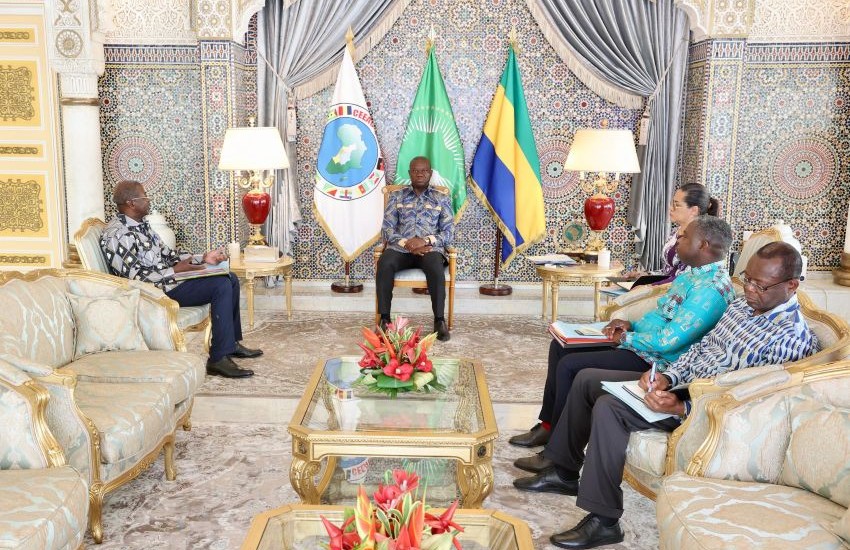
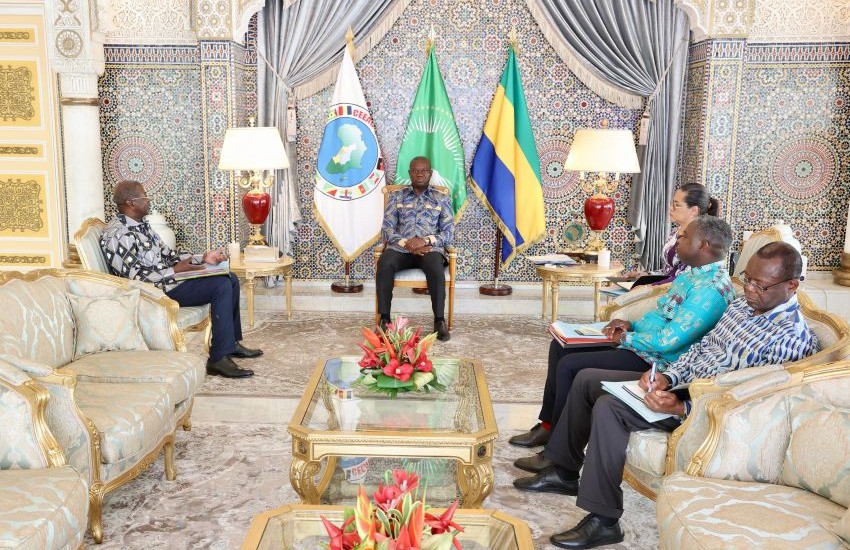
Is Gabon’s Fifth Republic trying to craft a fresh way of governing the country? That is the underlying question raised by the 11 September meeting between Brice Clotaire Oligui Nguema and Séraphin Moundounga.
By receiving the president of the National Commission for Democracy and Citizen Participation, the head of state did not merely monitor the rollout of a new institution. He put ordinary citizens at the heart of a project that could durably reshape the relationship between the population and those in power.
The National Commission for Democracy and Citizen Participation, which replaces the National Council for Democracy, forms part of the institutional architecture of the Fifth Republic. Its creation was decided under the institutional reform launched in 2026, with the stated aim of strengthening the credibility and stability of the democratic system. The new framework notably includes a Democracy Observatory tasked with collecting and analysing data on political life and election campaigns.
But the real challenge begins now. A democratic institution only becomes useful when it turns a principle into practice.
From institution to real dialogue
Séraphin Moundounga came to receive presidential guidance before the commission is formally installed. The agenda includes forming its bureau, setting up the various committees, organising plenary sessions and drafting the texts needed for the body to function.
Those points may sound technical. Yet they are decisive. They will determine how citizens can be heard, how concerns from the ground are channelled upward and to what extent they can feed public decision-making.
That is where the difference lies between a democracy that is merely representative and one that is more participatory. Voting chooses representatives. Citizen participation, by contrast, must keep dialogue alive between elections, bring forward proposals and compel institutions to listen to society more regularly.
This shift responds to a difficulty shared by many democracies. A population can elect its representatives while still feeling unheard. Participation therefore only has value if it produces visible results, opens accessible spaces for expression and ensures institutions account for what they do with the contributions they receive.
The real test will be independence
This is where the CNDPC will have to prove its credibility. Its role cannot be limited to backing the institutional narrative. It will need to listen to citizens, including when their expectations disturb, criticise or challenge public action.
That requirement is all the more important because the commission has already been called upon to take positions on sensitive matters. In August 2026, its president notably argued for a tougher response to abuses observed on social media, reigniting the debate over the boundary between protecting institutions, maintaining public order and safeguarding freedom of expression.
That sequence is a reminder of a democratic truth. Citizen participation can only be credible if it also welcomes disagreement. An institution tasked with bringing citizens closer to the state must be a space for listening, not just validation.
The choice of Séraphin Moundounga, appointed to lead the CNDPC in May 2026, now gives the institution a face and political responsibility. His challenge will be to make the commission a body that Gabonese people recognise, understand and above all find useful in their daily lives.
A democracy that no longer stops at the ballot box
The ambition carried by Oligui Nguema goes beyond the mere birth of a new structure. It touches on the very philosophy of the state. Making the citizen an actor in national transformation means creating regular consultation mechanisms, encouraging the circulation of ideas and giving identifiable follow-up to society’s contributions.
The success of the CNDPC will not be measured by the number of meetings held or the volume of texts adopted. It will be measured by its capacity to reduce the distance between the real country and its institutions.
Gabon is thus entering a phase in which democracy will have to be judged less on its declarations than on its practices. The citizen must no longer appear only at election time. He or she must be heard before, during and after public decisions.
Only on that condition will citizen participation cease to be new institutional vocabulary and become a true pillar of the Republic. And it is probably there, more than in organisational charts or procedures, that the political success of the CNDPC will be decided.
Comments are closed, but trackbacks and pingbacks are open.