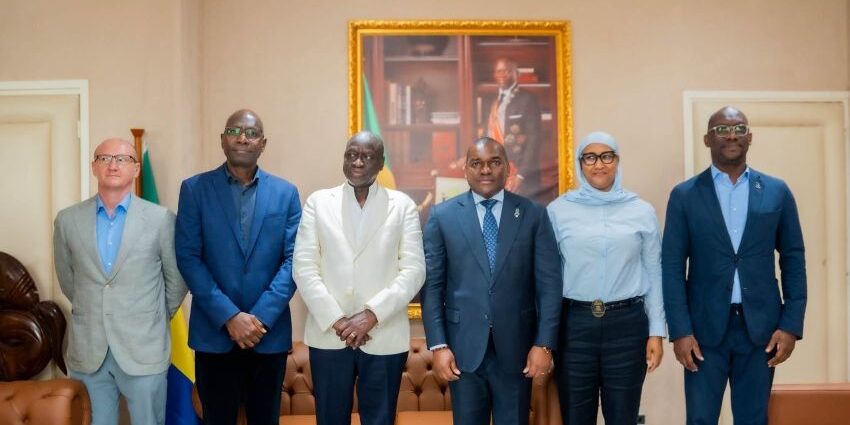
Libreville, November 16, 2026 — Gabon is taking decisive steps to transform its iron ore potential into a cornerstone of industrial growth. The Bélinga–Kobe-Kobe corridor, centered around the Bélinga iron deposit and the future Kobe-Kobe mineral port in Ogooué-Ivindo, is evolving from a mere extraction project into a fully integrated industrial and logistics hub. The November 15 visit of Ousmane Diagana, World Bank Vice President for West and Central Africa, to meet with State Minister of Transport Ulrich Manfoumbi Manfoumbi, underscores the project’s growing international momentum.
The corridor’s momentum: from mining to industrialization
At the Zero Base of Kobe-Kobe port, government officials showcased the project’s progress, highlighting its key components and established partnerships. This initiative is part of Libreville’s broader strategy to attract financial and industrial stakeholders capable of converting natural resources into sustainable economic value. The stakes are high: transforming iron ore from a raw export commodity into a catalyst for industrialization, job creation, and economic diversification.
The corridor is not just about mining—it represents a systematic shift toward high-value local processing. By integrating mining, energy, transportation, and industrial transformation, Gabon aims to retain a greater share of the value chain within its borders.
A network of global partnerships
The Bélinga–Kobe-Kobe project has gained significant traction through a series of high-level agreements. In April 2026, Gabon finalized a partnership with Africa Global Logistics (AGL) and Algest Investment Bank. By June, groundbreaking ceremonies marked the start of construction for the Kobe-Kobe mineral port. In July, a commercialization agreement with Swiss trader Trafigura was signed, further solidifying the corridor’s development roadmap.
High-level missions to Paris and China followed, fostering discussions with industrial and financial partners to refine the project’s architecture. While these efforts signal strong progress, key components—including full funding and infrastructure completion—remain works in progress.
Key players in the corridor’s development
- Fortescue — Iron ore extraction
- China Harbour Engineering Company — Railway and port infrastructure
- Gabon Power Company & Sinohydro — Energy infrastructure
- Wabtec & Progress Rail (USA) — Railway equipment
- PIH (Qatar) — Access road infrastructure
- AGL — Port operations
- Trafigura — Commercialization support
- Algest Investment Bank — Financial structuring
A comprehensive plan also includes local transformation initiatives, workforce training, and robust environmental and social studies.
From extraction to industrial value: the critical leap
Unlike traditional mining projects, Bélinga–Kobe-Kobe is designed to be an end-to-end ecosystem. Iron ore extraction alone cannot unlock its full economic potential without a seamless logistics chain—energy, rail, service roads, port access, and maritime transport must all function in harmony. Yet, the most transformative opportunity lies not just in logistics, but in Gabon’s ability to process ore domestically.
Industrial units, localized services, and workforce development could elevate the project far beyond export revenues. Authorities project up to 100,000 direct and indirect jobs—an enormous boost for Gabon’s labor market. However, the actual impact will depend on execution timelines, investment mobilization, and the share of opportunities accessible to local workers.
Sovereignty through execution: balancing ambition and reality
Championed by President Brice Clotaire Oligui Nguema, the Bélinga–Kobe-Kobe corridor embodies a vision of economic sovereignty and industrialization. But success hinges not on the presence of international partners, but on Gabon’s ability to coordinate them, secure financing, manage costs, and uphold transparency.
Environmental and social considerations are equally critical. In a region rich in ecosystems and communities, infrastructure development must follow rigorous environmental assessments, impact mitigation, and ongoing monitoring. The promise of industrialization cannot come at the cost of local livelihoods.
Gabon is playing for high stakes with Bélinga–Kobe-Kobe. If realized as envisioned, the corridor could redefine the country’s relationship with its natural resources, uniting extraction, transport, energy, and transformation into a cohesive industrial engine. Yet, the decisive moment lies ahead: the transition from ambition to execution. It is in the realization of infrastructure, the creation of on-site value, and the tangible benefits to local communities that this strategic project will ultimately be judged.
Comments are closed, but trackbacks and pingbacks are open.