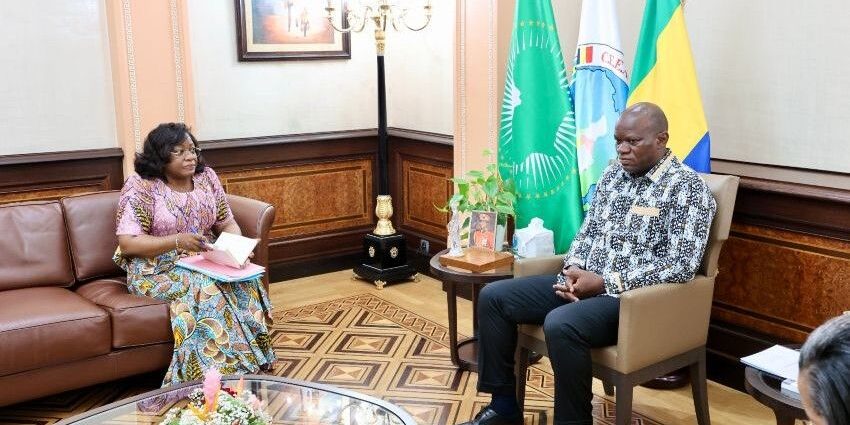
Libreville – A pivotal meeting between president Brice Clotaire Oligui Nguema and senate leader Huguette Nyana Ekoume signals a turning point for Gabon’s decentralisation. The focus: transferring genuine authority, securing local funding, and professionalising regional administrations. The critical question now: how can Gabon empower its territories with real resources, not just responsibilities?
Decentralisation stands as a cornerstone reform to bring governance closer to the people. Its goal is to enable local authorities to address community needs directly, tailor public policies to provincial realities, and bridge territorial inequalities. Yet, its success hinges on a delicate balance: aligning competencies with financial resources and administrative capacity.
In Gabon, the gap between ambitious objectives and practical implementation remains stark. The recent high-level discussion between the president and the senate leader underscores this challenge. The senate’s proposals aim to accelerate decentralisation while identifying the obstacles hindering its progress.
A moment of truth for local empowerment
The political momentum is unmistakable: the executive branch is pushing for a decisive shift in decentralisation. The real test, however, lies in translating this vision into operational mechanisms that can reshape territorial governance for good.
Competencies without resources are empty promises
At the heart of the discussions is the effective transfer of competencies to local authorities. Assigning new responsibilities to municipalities and regional administrations alone does not ensure their autonomy.
True decentralisation requires qualified personnel, predictable budgets, and genuine decision-making power. Without these, the reform risks shifting burdens without altering dependence on central government. The dialogue highlighted the need to strengthen administrative and financial capacities, enabling local bodies to execute their roles fully and design projects that meet local needs.
Clarifying the division of responsibilities between the state and local authorities is equally critical. A coherent structure must prevent administrative overlaps, decision-making delays, and funding shortfalls.
Thus, decentralisation is far more than an institutional reform—it demands a transformation in how public resources are mobilised, distributed, and utilised for the benefit of all citizens.
Ground reality: the senate’s role in bridging gaps
The senate president proposed field missions for senators to assess the real-world constraints faced by local authorities. These visits aim to identify administrative and financial hurdles while evaluating the capacity of regions to shoulder their new responsibilities.
Such initiatives are vital for connecting institutional debates with on-the-ground realities. The needs of a rural municipality, a growing urban centre, or a resource-constrained community often differ vastly. The insights gathered could help prioritise needs and refine transfer mechanisms, provided the findings are acted upon with rigour.
Training and professionalising local officials emerged as another priority. Key areas include local administration, taxation, revenue collection, and budget management. These skills are essential for bolstering financial autonomy. A local administration that can identify resources, improve revenue collection, and manage expenses effectively gains greater ability to fund community projects.
Yet, skill-building must be paired with proper tools, adaptive procedures, and stringent oversight. Training will only yield lasting results if local bodies also possess the means to apply their new knowledge.
Local autonomy: the ultimate governance test
Beyond administrative reorganisation, decentralisation poses a fundamental governance question: how can transferred public resources deliver visible results for citizens?
The presidential ambition is to transform local authorities into genuine development actors. This requires transparent financial management, heightened accountability from elected officials, and the ability to set priorities aligned with community needs.
Financial independence is central to this vision. Boosting local revenue should enable communities to reduce reliance on central funding and progressively finance more projects. However, not all regions share the same fiscal potential or economic capacity. Effective decentralisation must therefore account for disparities, ensuring less advantaged areas are not permanently disadvantaged.
The state’s role remains pivotal. It must orchestrate transfers, support local administrations, and ensure equitable resource distribution. Meanwhile, empowering local leaders should be backed by control and evaluation mechanisms to track the use of public funds.
The October 23 meeting marks a new phase for Gabon’s decentralisation. However, success will not be measured by the number of competencies transferred or institutional announcements. The true benchmark lies in the ability of local authorities to fund projects, improve public services, and meet citizen expectations. Real change will begin when territories possess not only responsibilities but also the means to fulfil them.
Comments are closed, but trackbacks and pingbacks are open.