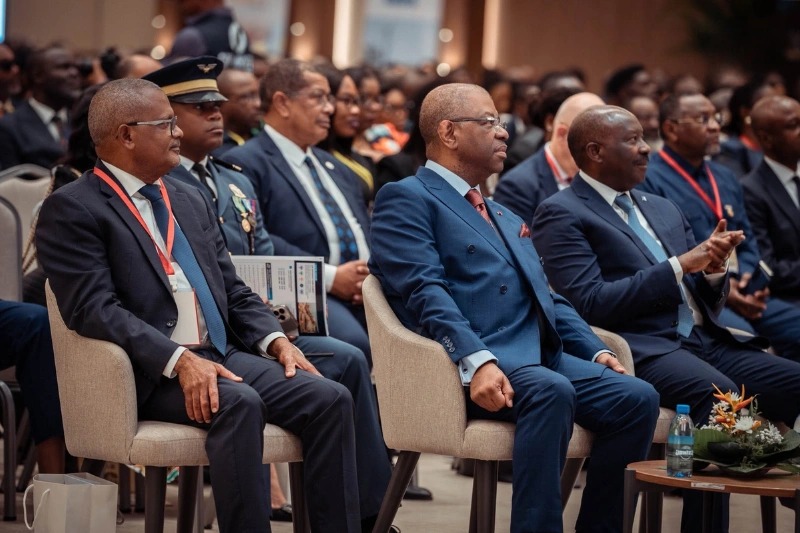
The recently concluded Gabon Economic Forum (GEF) underscored the nation’s ambitious growth trajectory, centering its discussions around the theme “Strong businesses for sustainable growth and shared prosperity.” This overarching vision resonated through the addresses delivered by both economic stakeholders and former government officials, emphasizing Gabon’s commitment to robust development.
Last Saturday, the second edition of the Gabon Economic Forum (GEF), organized by the Fédération des entreprises du Gabon (FEG), convened at the Palais des congrès de la Cité de la Démocratie. The forum’s agenda focused intently on defining the pivotal role and positioning of the private sector within Gabon’s evolving economic strategy.
Alain-Claude Kouakoua, President of the FEG, championed a clear call for action, advocating for a foundation of mutual trust in the partnership between the private sector and the State. This, he stressed, is paramount for Gabon’s economic development and competitiveness. Hugues Alexandre Barro Chambrier, the Vice-President of the Republic, readily concurred, acknowledging, “Without this trust, nothing can be accomplished; investments will simply not materialize.”
Building upon the previous edition, which provided an objective assessment of the challenges facing the Gabonese economy, GEF 2026 urged participants to advance to a new phase. Mr. Kouakoua emphasized this crucial transition, stating, “A diagnosis, however relevant, holds value only if it leads to solutions; because observations do not improve lives; because reports do not create jobs; because, ultimately, only results truly matter.”
Mr. Barro Chambrier affirmed that each party has a distinct role to play. He reassured attendees that “the State will continue to fulfill its part by creating an attractive business environment and by ensuring that public finance reforms enable timely payments to businesses.”
These declarations collectively reinforce the undeniable truth that no nation has achieved sustainable development without robust national enterprises. Similarly, no State has generated widespread employment without significant private investment and a dynamic entrepreneurial ecosystem. In essence, businesses are not peripheral players in development; they are its fundamental engine.
Demonstrating a profound grasp of economics and development, the Vice-President of the Republic articulated that “the private sector must embrace its role as the driving force behind economic transformation, wealth creation, and the enhancement of citizens’ living conditions.” Naturally, this endeavor requires consistent government support.
—
—
Following the second Gabon Economic Forum, there is a collective hope for a cessation of rhetoric and a genuine shift towards concrete action. While advancements have been observed in recent years, they do not obscure a clear reality: the true challenge is no longer about announcements, but about effective execution.
Capital holders do not invest based on promises or intentions. Their decisions are driven by visibility, confidence in institutions, the reliability of public discourse, regulatory stability, justice, and the collective capacity to honor commitments. “This is why the FEG will continue to advocate for an economic environment founded on predictability, legal certainty, transparency, and respect for engagements,” declared Alain-Claude Kouakoua.
For him, the implementation of the African Continental Free Trade Area (AfCFTA) marks a new chapter in the continent’s economic narrative. For Gabonese businesses, the focus is no longer solely on producing for the domestic market. The imperative now is to strategize on how to produce for Africa, how to penetrate new markets, how to integrate into regional value chains, and how to foster national champions capable of representing Gabon far beyond its borders.
Comments are closed, but trackbacks and pingbacks are open.