Guinea’s media regulator takes decisive action against RTB
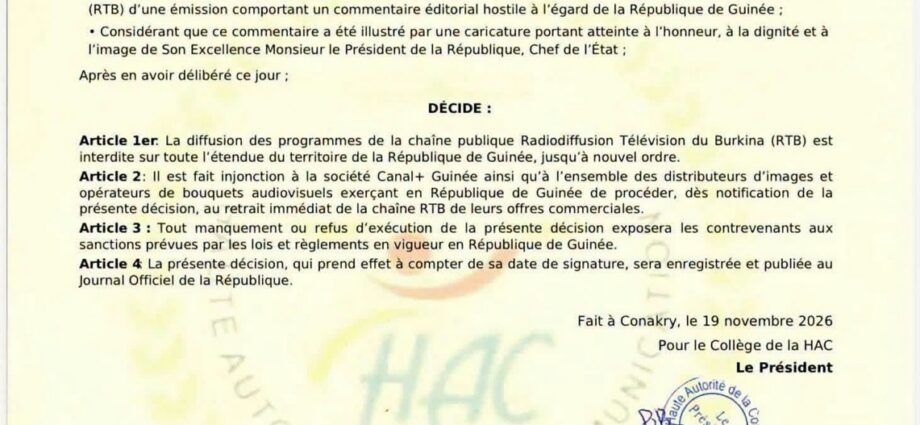
The Guinean High Authority for Communication (HAC) has issued an immediate nationwide ban on transmissions by the Radiodiffusion Télévision du Burkina (RTB), pending further review. This unprecedented move underscores growing concerns about the role of state-owned broadcasters in West Africa’s political landscape.
Public broadcasters must prioritize journalism over political alliances
State-funded broadcasters hold a unique position: entrusted with delivering accurate, balanced news while upholding the principles of journalistic integrity. Yet, recent criticism suggests that under the leadership of Burkina Faso’s transitional authorities, the RTB has increasingly blurred the line between news reporting and partisan advocacy.
Such a shift risks undermining the very foundation of public broadcasting trust. When citizens perceive a broadcaster as an extension of political power rather than an independent source of information, the consequences are severe. Key expectations of public media to inform objectively, present multiple perspectives, and foster informed citizenship diminish when editorial decisions are driven by political agendas.
Accusations of biased coverage spark regulatory intervention
The HAC’s decision follows mounting allegations that the RTB has systematically marginalized dissenting voices, favored pro-government narratives, and failed to maintain journalistic neutrality in its coverage. These concerns highlight a broader issue in the region: the erosion of public trust in state broadcasters when their content appears to serve the interests of ruling elites rather than the public good.
Public broadcasters are not tools for political propaganda. Their mandate is to provide citizens with the facts they need to participate meaningfully in democracy. When this mandate is compromised, the legitimacy of the broadcaster and, by extension, the credibility of the information ecosystem comes under scrutiny.
Regional implications: media sovereignty vs. political control
The ban on RTB signals a critical juncture for public broadcasters across West Africa. As governments navigate transitional phases, the temptation to use state media as a vehicle for political messaging grows. However, this approach contradicts the core principles of media pluralism and transparency that define a healthy democracy.
Media sovereignty cannot be equated with the suppression of dissent. A truly independent public broadcaster must serve the public interest, not the interests of those in power. The RTB’s suspension in Guinea is a reminder that when state media falters in its duty to inform, regulators must act to uphold the integrity of public broadcasting as a cornerstone of democratic societies.
By Alasane OUEDRAOGO — Journalist
Comments are closed, but trackbacks and pingbacks are open.