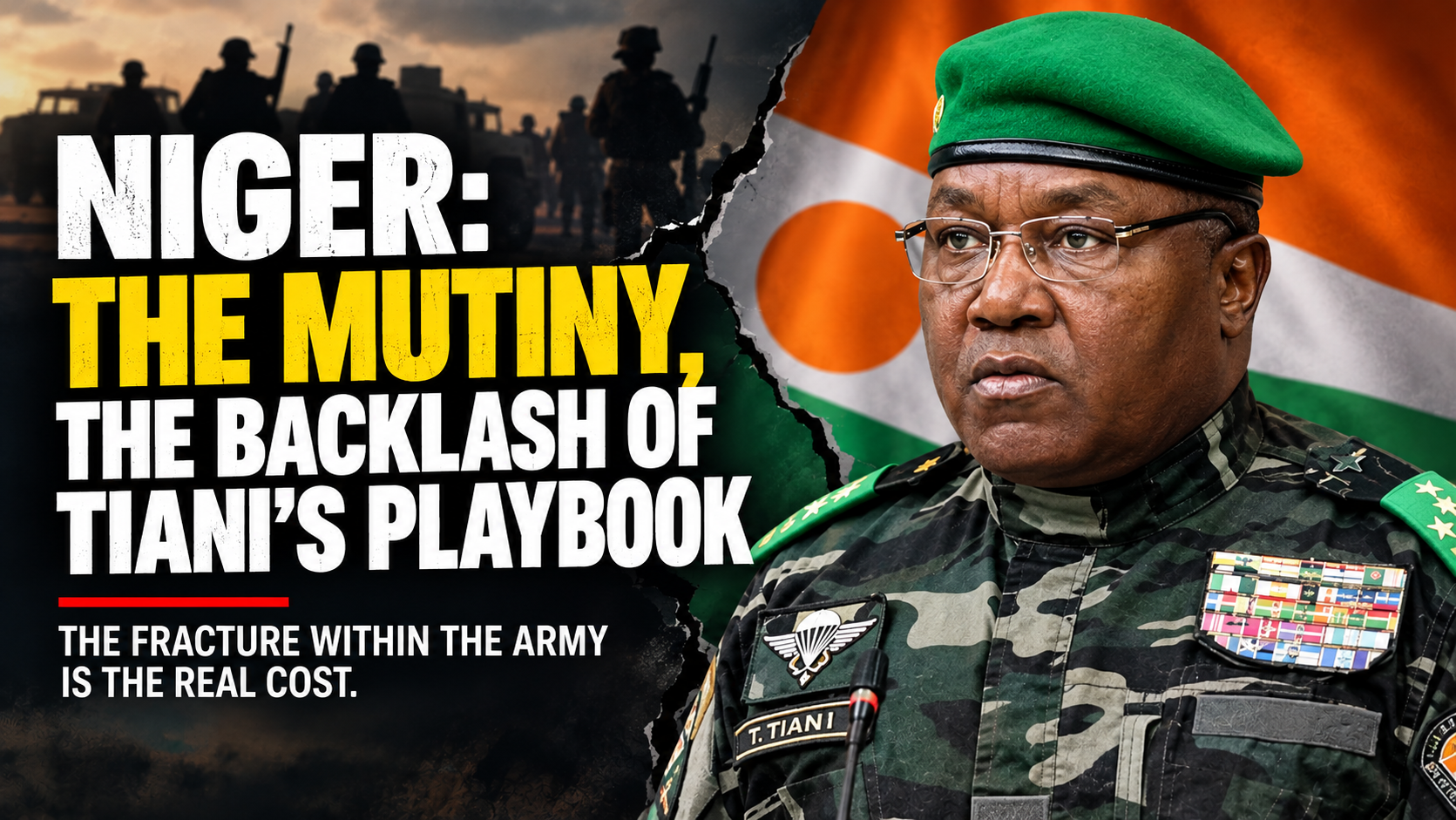
Under the leadership of Tiani, the Nigerien armed forces have undergone a profound transformation, shifting from an institution dedicated to national defense to an instrument of political control. By prioritizing personal allegiance over professional merit, the leadership in Niamey has dismantled the internal balance that previously maintained military unity. This shift has replaced professional competence and institutional neutrality with a system where loyalty to the head of state is paramount, fostering deep-seated suspicion within the ranks.
The systemic roots of the August mutiny
This politicization of the military hierarchy has inevitable repercussions on the ground. When officers realize that career advancement depends on political alignment rather than merit and service, feelings of systemic injustice quickly take root. The accumulation of these grievances and rivalries severely damages the trust between different echelons of command. Consequently, the mutiny that occurred on August 28 and 29 cannot be dismissed as a minor breach of discipline or an isolated act. Instead, it reflects a much deeper malaise within the security apparatus, fueled by years of mounting frustration and internal friction.
This internal divide poses a severe threat to a nation constantly facing active security threats on multiple fronts. To remain effective, an army must rely on a unified command structure. However, when soldiers view their peers with suspicion, operational solidarity breaks down. For Niger, whose forces are engaged in combat across several active fronts, any internal fracture directly undermines territorial integrity.
Opacity and media narratives as tools of control
The government’s complete silence regarding the fate of the detained soldiers is a deliberate strategy of crisis management through ambiguity. By withholding information on who has been arrested, where they are being held, or what charges they face, the administration fosters a climate of fear. This uncertainty serves as a mechanism of control, leaving every member of the armed forces to wonder if they might be the next target of a purge.
This lack of transparency also blocks any path toward reconciliation. Rather than resolving the crisis institutionally, the official silence fuels speculation, mistrust, and conflicting interpretations. Families of the detained personnel remain in limbo, fellow soldiers grow increasingly wary, and the credibility of the military leadership continues to erode. What could have been handled as a localized disciplinary issue is thus transformed into a broader crisis of confidence.
Furthermore, the regime’s decision to display seized military vehicles and equipment on state television is a calculated attempt to shape public perception. By presenting these items as absolute proof of a conspiracy, authorities seek to legitimize the arrests. Yet, this media spectacle fails to address critical questions: what were the actual demands of the mutineers? Who bears individual responsibility? What legal procedures are being followed? Most importantly, why did such a severe crisis erupt within the very institution tasked with protecting the state?
The operational cost of political survival
This dynamic exposes a fundamental contradiction in the current governance style. While the administration claims to restore state authority, it rules the military through suspicion. An army cannot remain combat-ready when its members believe that any form of dissent will be treated as a threat to the regime. True military discipline requires not just obedience, but also faith in a fair justice system and a shared commitment to national service.
Moreover, the ongoing purges carry a heavy operational price. Every sidelined commander and destabilized unit represents a loss of invaluable combat experience. In a conflict against highly adaptable armed groups with extensive local intelligence networks, Niger cannot afford to weaken its own command structures to settle domestic political scores.
A troubling paradox has therefore emerged: while the administration’s discourse focuses heavily on national sovereignty and territorial defense, significant energy is diverted toward monitoring and neutralizing internal dissent within the security forces. Prioritizing the political survival of the regime over national defense risks leaving the country highly vulnerable. An army preoccupied with internal purges inevitably loses its focus on its primary mission, which is protecting the population and defending the borders of Niger.
Ultimately, the August mutiny highlights how Tiani conceptualizes power and military loyalty. Restructuring a national army to serve as a political shield inevitably triggers internal resistance. By focusing on internal threats rather than military cohesion, the leadership risks undermining the very institution upon which the nation’s security rests, confusing the survival of the regime with the security of the state.