The religious fervor that defines Senegal’s spiritual landscape has long intersected with its political agenda. Today, a resurgent nationalist narrative is drawing from the anticolonial legacy of Sufi brotherhoods, reshaping the nation’s identity while securing vital support from religious leaders.
Political elites embrace religious icons to champion sovereignty
From President Bassirou Diomaye Faye to Assembly President Ousmane Sonko, Senegal’s leadership is turning to the historical narratives of these spiritual guides to craft a self-reliant national vision. While their relationship has faced strains, both figures share a common strategy: visibly aligning with influential religious figures to bolster their legitimacy.
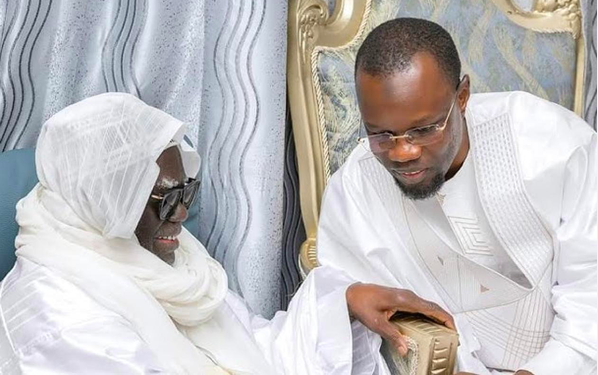
In late July, ahead of the Grand Magal pilgrimage, President Faye visited Serigne Mountakha Mbacké, the Mouride Brotherhood’s supreme leader in Touba—a symbolic gesture highlighting the enduring role of these spiritual guides as « pillars of national unity » amid institutional crises. Days later, Ousmane Sonko followed suit, underscoring the unyielding influence of Sufi leaders in shaping Senegal’s socio-political fabric.
Sonko’s ideological pivot: reclaiming Cheikh Ahmadou Bamba’s legacy
During his visit, Sonko took a bold ideological stance by invoking the legacy of Cheikh Ahmadou Bamba, the Mouride founder renowned for his nonviolent resistance against French colonial rule. By drawing parallels between his policies and Bamba’s principles—including the refusal of foreign funding to preserve the autonomy of believers—Sonko positioned himself as a torchbearer of the marabout’s vision for economic and spiritual independence.
From spiritual guides to political symbols: a nationalist awakening
This revival is not coincidental. It reflects a broader intellectual movement rediscovering the anticolonial contributions of Senegal’s religious leaders. Cheikh Gueye, a Mouride scholar, notes that younger generations are increasingly viewing these figures through an anticolonial and political lens. Figures like El Hadj Oumar Tall of the Tijaniyya Brotherhood and Thierno Souleymane Baal—who established a theocratic state in the 18th century—are now celebrated as inspirations for modern sovereignty movements, such as Frapp, without being deified.
Yet this narrative confronts historical complexities. Some revered religious leaders later facilitated the recruitment of Senegalese soldiers for the French colonial army, a duality modern youth are increasingly willing to acknowledge. Mamadou Fall, editor of the upcoming General History of Senegal, advocates for integrating these religious icons into school curricula while addressing their contradictions—highlighting how certain figures are perceived in other regions as « violent conquerors » who wielded the sword.
Balancing reverence and critical history
The challenge lies in reconciling these figures’ anticolonial heroism with their later actions. As Senegal navigates its post-colonial identity, the fusion of religion and politics offers both unity and contention, reflecting the nation’s evolving quest for sovereignty.
Comments are closed, but trackbacks and pingbacks are open.