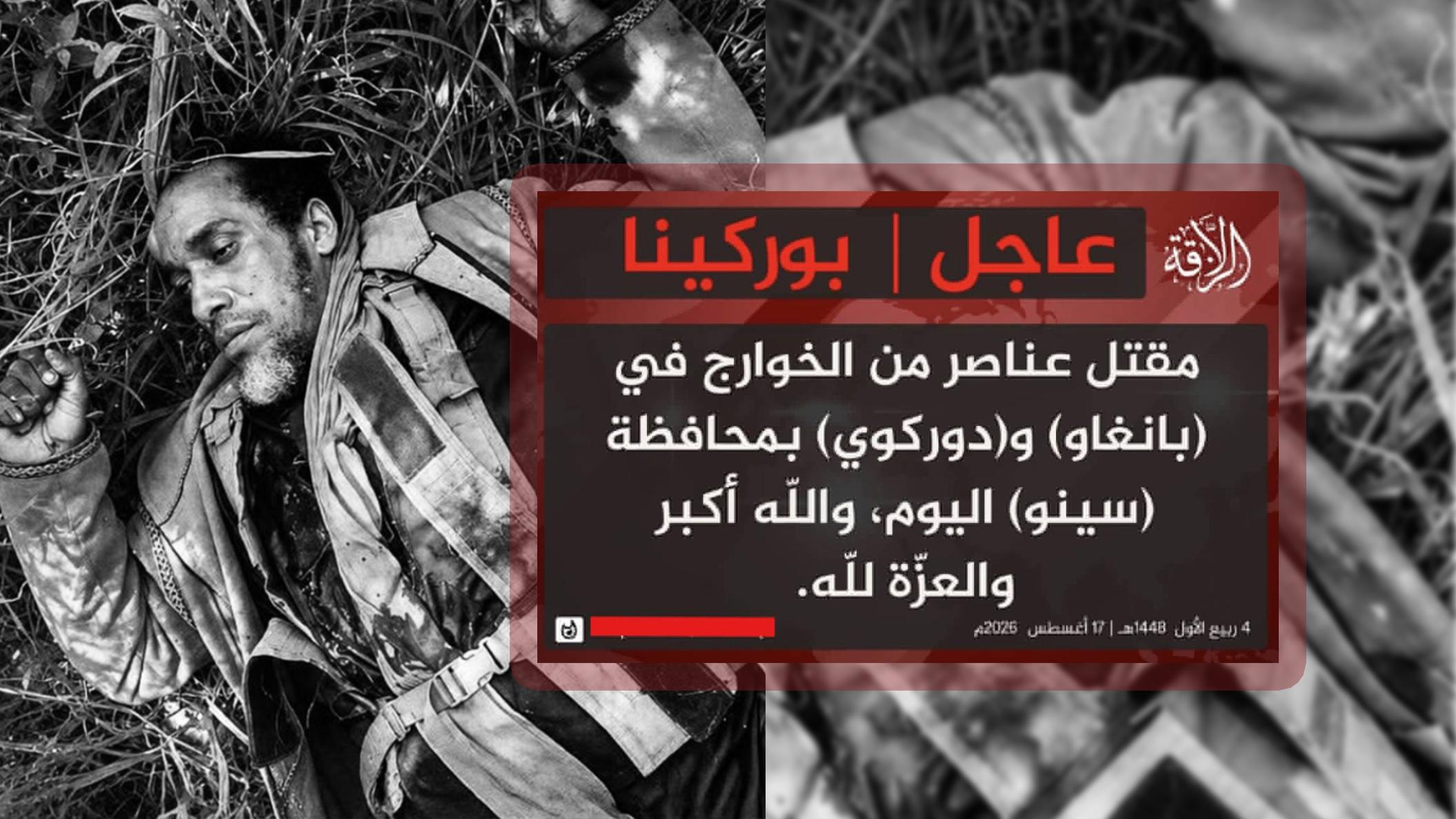
A senior figure within the Islamic State in the Sahel (EIS), Abou Zeid Al-Burkinabi, met his end on August 17, 2026, in the Séno province. Contrary to initial assertions circulating from certain official channels and opinion influencers, the terrorist commander was not neutralized by the Burkinabè army. Instead, he perished during deadly clashes with the rival Jama’at Nasr al-Islam wal-Muslimin (JNIM) group. This event starkly highlights the brutal internal power struggles tearing apart the regional jihadist network.
This development represents a significant setback for the Islamic State in the Sahel (EIS) and offers fresh evidence of the extreme tensions gripping the Sahel’s security landscape. Consistent local and security intelligence indicates that jihadist commander Abou Zeid Al-Burkinabi was killed this Monday, August 17, amidst fierce fighting between his loyalists and those of the Al-Qaïda-affiliated JNIM.
The confrontations unfolded in the localities of Bangao and Dorkoye, situated within the Séno province in northeastern Burkina Faso. This border region, adjacent to Niger, has for years been a hotbed of armed insurgency. While early accounts on social media attributed this neutralization to a major operation by Burkinabè armed forces, the facts confirm a different reality: Abou Zeid Al-Burkinabi succumbed to bullets fired by his own ideological adversaries.
A pivotal figure for the Islamic State in the Sahel
Abou Zeid Al-Burkinabi was far from an ordinary combatant. A native of Burkina Faso, he had steadily risen to become one of the most prominent operational and propaganda leaders for the EIS across the tri-border area encompassing Burkina Faso, Mali, and Niger.
His deep familiarity with the local terrain, combined with an extensive recruitment network spanning Séno and neighboring provinces, rendered him an indispensable component in the group’s expansion. As a zone commander, he orchestrated ambushes against defense forces, conducted intimidation campaigns targeting civilian populations, and forcibly extorted local resources through compulsory zakat collection. His demise deals a severe blow to the EIS command chain, which was already weakened by broader military pressure and intense competition from the JNIM.
The narrative surrounding his demise
Immediately following the announcement of his death, a fierce battle of narratives erupted across communication channels. Several influential accounts and pro-government propaganda outlets swiftly attributed the terrorist leader’s death to an airstrike or an ambush executed by the Burkinabè Defense and Security Forces (FDS), supported by the Volunteers for the Defense of the Homeland (VDP).
This attempt to claim credit aligns with a context where wartime communication has become a central concern for transitional authorities, eager to emphasize the growing strength of the national army. However, cross-referencing information from the ground and the dissemination of precise details by rival channels quickly clarified the true sequence of events. The Burkinabè army, despite its active presence in the region, did not directly participate in this specific engagement. Abou Zeid Al-Burkinabi was indeed eliminated as part of the hegemonic conflict waged between the two dominant terrorist entities in the Sahel.
JNIM versus EIS: a history of fratricidal conflict
The confrontation in Bangao and Dorkoye is not an isolated incident but the latest chapter in a brutal conflict that has raged since 2019 between the JNIM and the EIS. While both movements share overarching Salafist-jihadist goals and a desire to destabilize regional states, they fundamentally diverge in their doctrinal, tactical, and strategic approaches.
- Ideological discord: The JNIM, pledging allegiance to Al-Qaïda’s central leadership, adopts a pragmatic strategy focused on local integration, sometimes engaging in negotiations with community leaders. Conversely, the EIS enforces an ultra-violent doctrine, characterized by extreme takfirism (excommunication) and widespread massacres of civilians deemed ‘disloyal’.
- Struggle for resources: Across the Sahel, control over smuggling routes, artisanal gold mines, and transhumance corridors constitutes a vital source of funding. Both groups are in perpetual contention for these strategic financial zones.
- History of clashes: As early as 2020, exceptionally violent clashes erupted in Mali’s Gourma region and the Liptako area, resulting in hundreds of casualties on both sides. In 2022 and 2023, conflicts in Mali’s Ménaka region and northern Burkina Faso escalated to the intensity of full-scale battles, involving hundreds of combatants utilizing armed vehicles and heavy weaponry.
The August 17 confrontation demonstrates that despite the pressure exerted by regional governmental forces, the deep-seated animosity between these two factions remains undiminished.
Security landscape shifts and challenges for communities
The elimination of Abou Zeid Al-Burkinabi by the JNIM could temporarily alter the balance of power within the Séno province. By neutralizing a prominent EIS leader, the JNIM aims to solidify its territorial dominance and conclusively dislodge its rival from strategic border areas.
For the civilian populations of Séno, this internal conflict among armed groups offers very little respite. While these clashes mutually weaken the capabilities of the terrorists, they also expose residents to retaliatory actions and a constant state of insecurity. The eradication of terrorist commanders by their own peers underscores the intricate nature of the security environment in the Sahel, where the defeat of one faction often benefits another equally menacing group.
Abou Zeid Al-Burkinabi’s death marks a significant juncture in the war of attrition unfolding among terrorist groups in Burkina Faso. Far from the official narrative of a direct military victory, this event serves as a reminder that the Sahel is a theatre of multi-sided conflict, where intra-jihadist dynamics play a role just as crucial as the operations of state armed forces. For observers and stakeholders in the region, monitoring these internal divisions remains a key element for understanding the security trajectory of Burkina Faso and the broader pan-African current affairs.
Comments are closed, but trackbacks and pingbacks are open.