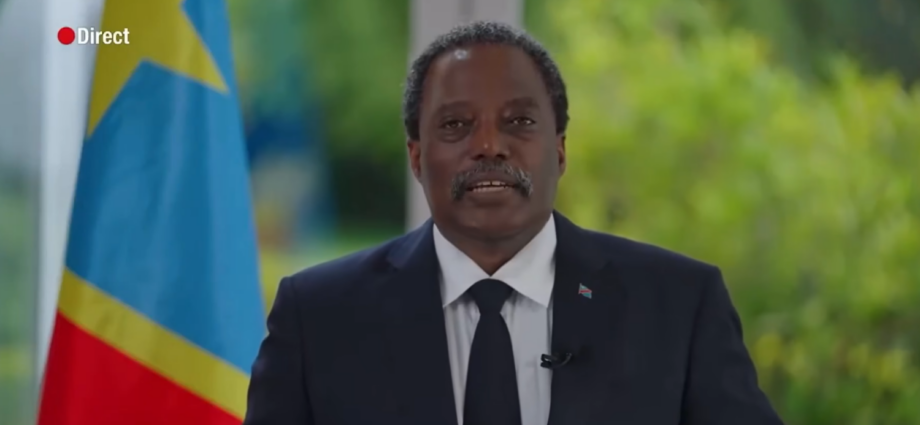
Joseph Kabila, former president of the Democratic Republic of the Congo (2001–2019), has officially taken command of the Front pour la refondation de la nation (FRN) in a move that risks escalating the country’s crisis into a full-blown civil war. His leadership of this coalition, which includes the M23 rebel group and the former Alliance fleuve Congo, is widely seen as a strategic endorsement of the rebellion backed by Rwanda—raising alarms about the potential for further regional destabilization.
Kabila’s military resurgence: from statehouse to rebel alliance
Kabila’s return to the frontlines traces back to the 1990s, when his father, Laurent-Désiré Kabila, led a Rwanda-backed rebel movement, the AFDL, to overthrow former dictator Mobutu Sese Seko. After seizing power in 1997, Laurent-Désiré later clashed with his Rwandan allies, triggering the Second Congo War before his assassination in 2001.
Joseph Kabila ascended to the presidency at age 29 in 2001, inheriting a nation fractured by militia violence, regional rivalries, and Rwanda’s persistent ambitions in eastern DRC. His latest alliance with proxies—including the M23, which he has historically opposed—signals a dramatic shift: Kabila now seeks to convert a localized insurgency into a national power grab aimed at toppling President Félix Tshisekedi.
Legitimizing rebellion: how Kabila empowers Rwanda’s proxy forces
The M23, long dismissed as a Tutsi ethnic militia and Rwanda’s armed extension in the DRC, lacked political credibility—until now. By joining the FRN as its public leader, Kabila lends the rebellion a veneer of legitimacy, transforming it from a fringe insurgency into a perceived national opposition movement.
Analysts describe this as a calculated gamble. “Kabila’s involvement gives the M23 a face and a past—it’s no longer just another armed group representing foreign interests. It becomes a movement with a historical narrative.” — a former intelligence officer in the region.
This elevation of the rebellion’s status is widely interpreted as a deliberate strategy to weaken Tshisekedi’s government and realign DRC’s political landscape in favor of regional patrons—particularly Rwanda, whose military and economic influence has long shaped the conflict.
DRC’s fragile giant: riches and instability in the heart of Africa
The Democratic Republic of the Congo spans over 2.3 million square kilometers—nearly 90 times the size of Rwanda—but its vast territory belies deep fragility. The mineral-rich eastern provinces of Kivu and Ituri hold colossal reserves of cobalt, gold, coltan, and copper—resources critical to global supply chains, from smartphones to electric vehicles.
Yet this wealth has become a curse. Rwanda and allied militias systematically exploit DRC’s mineral wealth, smuggling coltan and gold through porous borders while the international community condemns the violence but continues to purchase the minerals through intermediaries. “It’s a system where war finances extraction, and extraction fuels war,” notes a regional security analyst. “The same countries that express outrage at the killings are the ones buying the minerals—through shell companies and regional brokers.”
Meanwhile, over 150 armed groups—including criminal syndicates, self-defense militias, and Islamist factions like the ADF-Nalu—operate across the eastern DRC, maintaining a climate of perpetual violence.
Human cost soars as conflict risks escalate
Civilians bear the brunt of the crisis. Eastern DRC has long been ranked among the most dangerous places in the world for women and children, with sexual violence and mass killings a daily reality. “Every time the guns grow louder, the death toll rises—and it’s the villages, not the battlefields, that pay the price,” states a humanitarian worker in Goma.
By lending his name and political weight to the FRN, Kabila has placed the population at greater risk. Analysts warn that this alliance could trigger a broader military confrontation, drawing in foreign powers and plunging the region deeper into chaos—one that civilians may struggle to survive.
Comments are closed, but trackbacks and pingbacks are open.