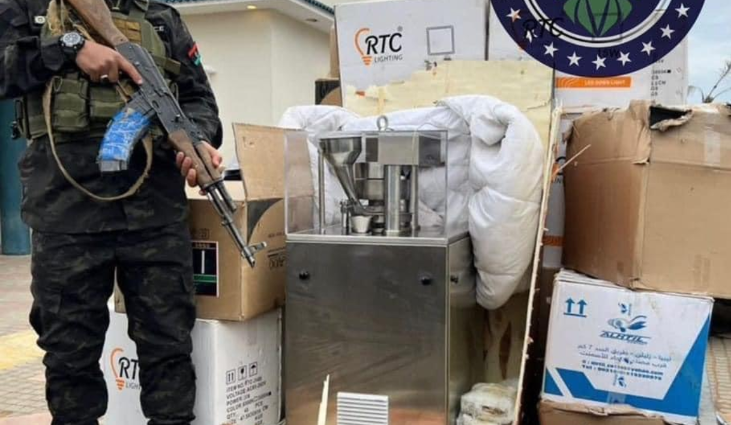
The revelation by investigative journalist Mehdi Ghezzar that Emirati officials may be bankrolling industrial-scale psychotropic drug plants in eastern Libya has intensified regional tensions, particularly between Algeria and the United Arab Emirates. While diplomatic frictions have simmered for years, these accusations—if verified—could escalate into a full-blown geopolitical crisis, with accusations flying but concrete evidence still elusive.
Unverified allegations vs. documented drug production
According to Ghezzar’s televised claims, the facilities in question are not merely small-scale clandestine labs but fully operational industrial units equipped with specialized machinery, allegedly financed by Abu Dhabi and designed to flood Algerian streets with synthetic drugs. The goal, he asserts, is to destabilize Algeria by targeting its youth through mass drug distribution.
However, despite the gravity of these assertions, no independent public proof has been presented to confirm that UAE authorities directly oversee or finance these operations, nor that the campaign is specifically aimed at Algeria. The distinction between unverified claims and verifiable facts remains critical in assessing the credibility of such serious accusations.
Libya as a narcotics hotspot: documented evidence
While the Emirati link remains unproven, Libya’s role in regional drug trafficking is not. After years of political fragmentation and weakened state control, the country has become a key node in the flow of illicit substances from the Middle East to North and West Africa.
In November 2026, a court in Qubbah, eastern Libya, sentenced six individuals—including one in absentia—to life imprisonment for manufacturing and trafficking Captagon pills. Investigative footage showed seized tablets, packaging materials, and industrial compression equipment, confirming local production capacity.
Just weeks earlier, military units under Khalifa Haftar’s Libyan National Army seized over 1.3 million Captagon tablets in Kufra, demonstrating both the scale of production and the vulnerabilities of local authorities in combating it.
Haftar’s alliances and the geopolitical shadow
The suspected Emirati-backed drug labs are located in territory controlled by Haftar’s forces, raising immediate questions about regional partnerships. The UAE has long been a key backer of Haftar’s campaign to dominate eastern and southern Libya, a strategy seen by observers as part of a broader regional influence drive.
While this alliance is well-documented, it does not by itself prove direct involvement in illicit drug manufacturing. To substantiate Ghezzar’s claims, investigators would need to:
- Trace financial flows to identify the true owners of the facilities.
- Document equipment origins and supply chains.
- Uncover any links between production sites and political, military, or economic elites.
- Establish a clear supply route from Libya into Algeria.
Without these steps, the allegations remain speculative, even amid growing diplomatic distrust.
Algiers vs. Abu Dhabi: a diplomatic rupture intensifies
The timing of these accusations is particularly sensitive. In September 2026, Algeria severed diplomatic ties with the UAE, citing deep-seated disagreements over regional alliances, security policies, and North African conflicts. This decision followed escalating rhetoric and mutual accusations, making any new claim—especially one involving cross-border drug trafficking—potentially explosive.
President Abdelmadjid Tebboune has repeatedly warned that drug trafficking constitutes a “*real war against our youth*,” calling for tougher action against both dealers and source networks. His comments underscore Algeria’s growing alarm as psychotropic substances flood domestic markets, with authorities blaming porous borders and weak regional enforcement.
The human cost: Algeria’s youth under siege
Beyond geopolitics, the real tragedy lies in the social and public health fallout. Psychotropic drugs—whether diverted medical supplies or homemade synthetic versions—are tearing through Algerian communities, particularly among young people.
Criminal networks exploit unemployment, social inequality, and weak prevention programs to recruit dealers, turning addiction into a pipeline for organized crime. Street-level seizures only scratch the surface; dismantling the trade requires cutting off funding, intercepting precursor chemicals, and providing rehabilitation—not just border patrols.
Who really profits? Separating fact from speculation
The central unanswered question remains: Who is behind the Libyan psychotropic labs, and what are their real objectives?
So far, the record shows:
- Confirmed local production of Captagon in eastern Libya.
- Documented smuggling into Algeria, with no clear evidence of state sponsorship.
- Strong circumstantial links between Emirati support for Haftar and the emergence of industrial drug labs, but no direct ties.
Until financial trails, ownership records, and political connections are exposed, accusations of a deliberate Emirati campaign to destabilize Algeria remain unproven. Yet even the possibility raises alarms about regional stability and the future of drug control in North Africa.
The way forward: investigation, accountability, and regional cooperation
This is not just a security issue—it’s a test of regional integrity. If future inquiries confirm state-linked involvement in drug production aimed at destabilizing neighboring countries, the implications would be severe. But even without such proof, the facts demand action:
- Independent forensic audits of seized facilities.
- Joint intelligence sharing between Algerian, Libyan, and international investigators.
- Stricter controls on chemical precursors entering Libya.
- Rebuilding state authority in eastern Libya to dismantle criminal ecosystems.
One thing is clear: the psychotropic pipeline from Libya is already a reality. Whether it’s a weapon of foreign policy, a criminal cash cow, or both—remains to be proven.
Comments are closed, but trackbacks and pingbacks are open.