
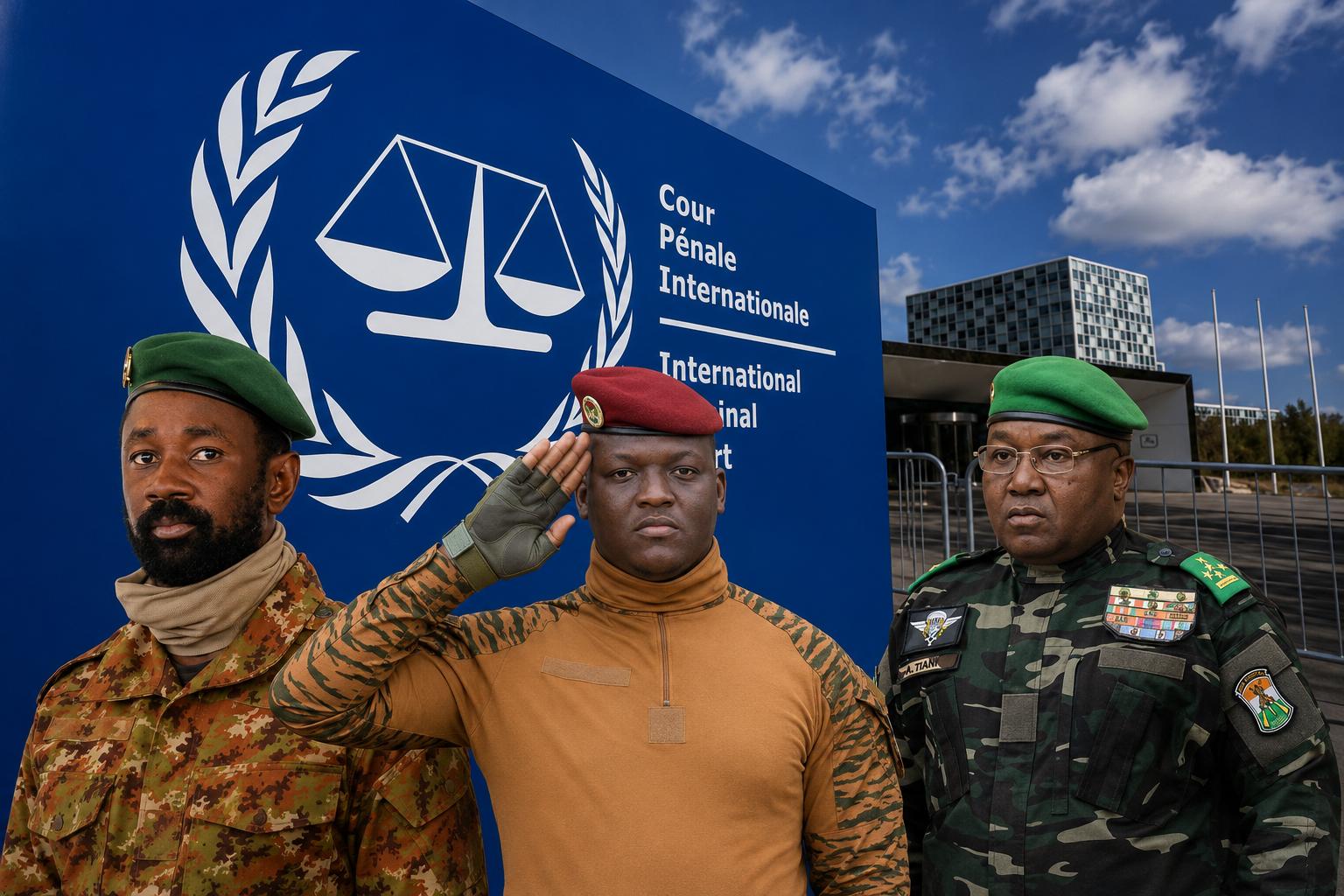
Following Niger’s lead, both Mali and Burkina Faso have formally declared their departure from the International Criminal Court (ICC). While the military juntas forming the Alliance of Sahel States (AES) cite a supposed commitment to “sovereignty” against a judicial body they deem “politicized,” this separation primarily reveals a familiar tactic employed by authoritarian regimes: sidestepping international law to shield their leaders from accountability.
This triple withdrawal resounds like an admission. Within mere weeks, the three military governments across the Sahel region finalized their disengagement from the global legal framework. After Niamey, it was Bamako and Ouagadougou’s turn to officially inform the United Nations of their decision to withdraw from the Rome Statute, the foundational treaty of the International Criminal Court.
The official narrative from these juntas is well-rehearsed: the ICC is merely a “neo-colonial” instrument, a biased justice system manipulated by Western powers. However, beneath this veneer of sovereign and populist rhetoric lies a far more pragmatic and cynical reality. By severing ties with The Hague, these regimes are endorsing a classic dictatorial strategy: institutionalizing impunity to perpetuate their hold on power.
the legal shield for autocrats
The International Criminal Court was established for a specific purpose: to intervene when national justice systems fail, refuse, or are unable to prosecute the most egregious offenses, including war crimes, crimes against humanity, and genocide. By withdrawing from this jurisdiction, the military leaders of Mali, Burkina Faso, and Niger are attempting to secure a form of legal immunity.
In a region plagued by devastating asymmetric conflicts, human rights organizations consistently publish reports that paint a stark picture. These reports not only document the horrific abuses perpetrated by jihadist groups but also highlight the escalating atrocities committed against civilian populations by regular armies and their auxiliary forces (such as the Russian mercenaries of the former Wagner group in Mali). By closing the door on the ICC, the heads of these juntas seek to ensure that neither they nor their subordinates will ever face an international tribunal.
populist rhetoric to mask fear of justice
The argument of “selective justice,” allegedly targeting only Africa, has long been a popular refrain on the continent. While it may have held some legitimate resonance in the past, it is now entirely distorted by these dictatorial regimes. The ICC currently pursues war criminals in Ukraine and the Near East, demonstrating that its scope extends far beyond African borders.
In reality, modern history indicates that a state’s withdrawal from the ICC is almost always linked to an authoritarian shift or a desperate fear of its leaders being indicted. Burundi, under Pierre Nkurunziza, set this precedent in 2017 amid accusations of mass violence. Today, the Sahel juntas are applying the same formula: criminalizing internal dissent, silencing the press, muzzling civil society, and cutting ties with international observers to operate behind closed doors.
the primary victims: civilian populations
This proclaimed surge of “sovereignty” by the AES regimes comes at the direct expense of Sahelian citizens. Local populations, caught between terrorist terror and the violence of states lacking checks and balances, find themselves deprived of their ultimate recourse.
By leaving the ICC, these regimes do not erase the past, as procedures already initiated or crimes committed while the treaty was in force theoretically remain within the Court’s jurisdiction. However, they send a disastrous signal for the region’s future: that of a blank cheque granted to state violence. History has consistently shown that impunity has never guaranteed the stability of a dictatorship; it merely postpones its downfall, making the ultimate cost heavier for the people.
