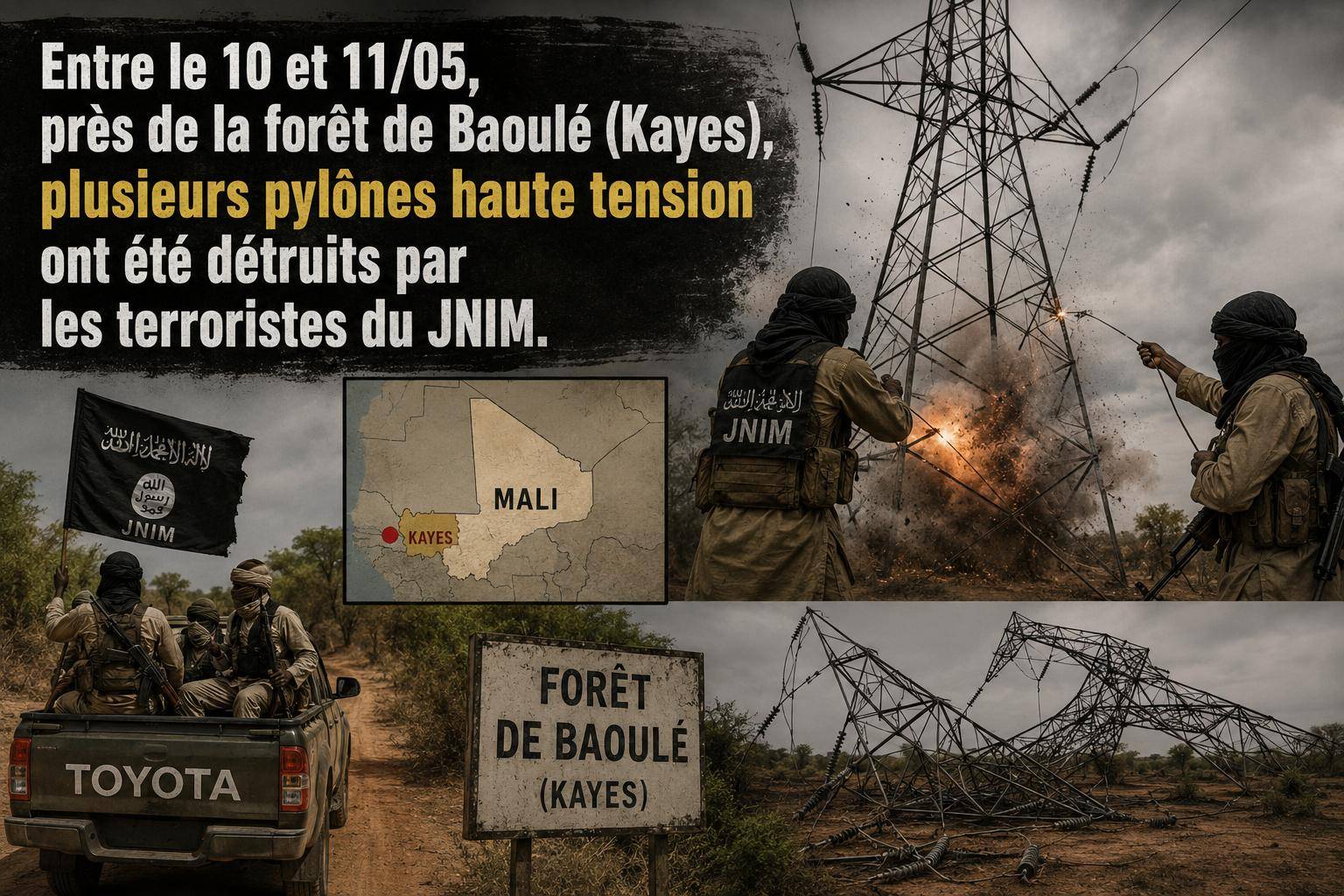
The weekend of May 10-11, 2026, will be etched in Mali’s energy crisis as a dark chapter. Near the Baoulé forest in the Kayes region, militants from the Group for the Support of Islam and Muslims (JNIM) targeted and demolished several high-voltage transmission towers. This calculated assault unfolded under the watch of Russia’s Africa Corps, whose on-ground performance is raising serious doubts about its effectiveness in countering insurgent threats.
The consequences are immediate and severe. Bamako, already grappling with record heat waves pushing temperatures to 45°C, has been plunged into total darkness. Water pumps and fans have ground to a halt, turning daily life into a suffocating ordeal. Meanwhile, JNIM’s reach extends dangerously close to the Manantali and Sélingué hydroelectric dams—key energy lifelines for Mali and neighboring nations.
JNIM’s escalating war on Mali’s infrastructure
What began as sporadic roadside ambushes has evolved into a calculated siege. JNIM militants have systematically targeted supply routes, torching commercial trucks and public buses, while now directing their firepower at the nation’s electrical backbone. The attack on Kayes’ power grid was no accident—it was a precision strike against Bamako’s stability and the transition government’s legitimacy.
The sabotage near the Baoulé forest, a terrain notorious for its rugged inaccessibility, exposed glaring vulnerabilities. The downed towers severed electricity to entire districts, exacerbating an already crippled energy sector. Yet, the Africa Corps and Malian Armed Forces had repeatedly claimed control over these zones, raising troubling questions: How do militants transport explosives, rig heavy metal structures, and vanish without detection in areas supposedly secured by foreign paramilitaries?
Russia’s Africa Corps: propaganda vs. reality
The Africa Corps’ presence in Mali has been framed as a game-changer in the fight against terrorism. But on-the-ground results tell a different story. While Moscow’s forces excel in urban displays of strength and media-savvy operations, their ability to thwart hybrid attacks on critical infrastructure remains virtually nonexistent. Drones and joint patrols have failed to detect or deter the sabotage, leaving Bamako’s residents to face the brunt of the crisis.
The government cites fuel convoys protected by the Armed Forces and Africa Corps as proof of progress, yet this narrative collapses under technical scrutiny. Backup generators are too few to offset the collapse of the high-voltage network. Hospitals, including emergency wards and maternity units, now operate under extreme duress, putting countless lives at risk.
Manantali and Sélingué: a regional catastrophe in the making
The most alarming development? JNIM’s threats now loom over the Manantali and Sélingué dams. These installations are not just Mali’s energy backbone—they are lifelines for the entire West African subregion. An attack here would plunge Bamako into prolonged darkness and ripple across borders. Senegal and Mauritania, which rely on shared energy agreements, would face severe disruptions. Agriculture across the Senegal River basin would collapse, triggering a food security crisis of unprecedented scale.
The trajectory of JNIM’s strategy is clear: from road sabotage to power grid destruction, and now, potential dam strikes. Each move escalates the chaos, while the government and its allies struggle to respond. Transition officials once promised liberation and stability, but the reality is a nation watching its vital arteries wither. The Africa Corps’ costly deployment has yet to secure Mali’s economy or protect essential services.
Bamako’s citizens are no longer satisfied with patriotic rhetoric. They demand tangible solutions: reliable electricity, clean water, and real security—not just hollow assurances. With temperatures soaring and darkness spreading, the clock is ticking. If the dams fall, Mali’s credibility—and the well-being of millions—will vanish into the Sahel’s scorching heat.
Comments are closed, but trackbacks and pingbacks are open.