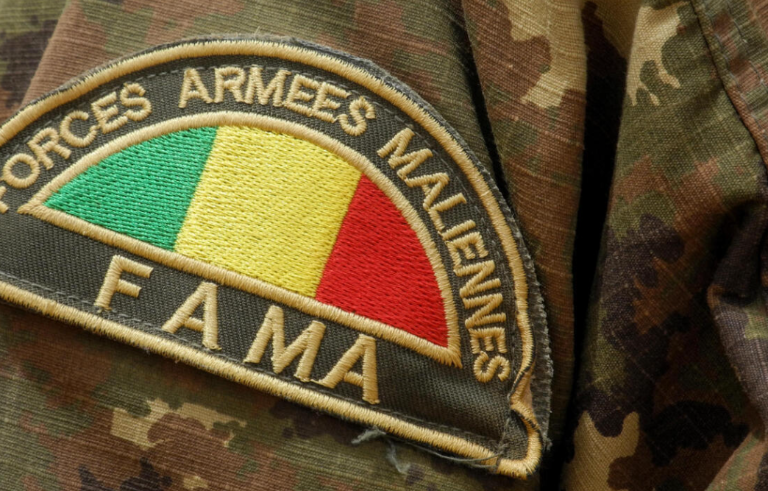
The assault on the army camp at Dioura, in Mali’s Mopti region, has left close to 80 Malian soldiers dead, making it one of the heaviest single losses suffered by the country’s armed forces in recent times. The attack unfolded on 10 September. Hours later, the Group for the Support of Islam and Muslims (JNIM), an Al-Qaeda affiliate, claimed responsibility, saying its fighters had overrun the base — a significant FAMa position — before pulling back. Several troops remain unaccounted for, while others are believed to have been taken prisoner. Among residents of the surrounding area, the news has revived a familiar blend of fear and the conviction that they have been left to fend for themselves.
Dioura: a toll that lays bare the army’s fragility
In terms of casualties, the strike on Dioura ranks among the deadliest endured by the Malian armed forces in recent years. The details available point to roughly 80 soldiers killed during the assault.
Within hours, JNIM issued a statement claiming the operation, asserting that it had seized control of the camp and then withdrawn.
What makes the episode especially troubling is what it reveals about the broader picture. A position long considered strategic can still be hit with devastating force, even after years of military campaigns waged against armed groups.
For people in Dioura and the villages around it, though, the anxiety reaches past the body count. Every attack feeds the same dread: that the violence is creeping steadily closer to the places where they live and work.
For civilians, the camp was meant to mean protection
Across this stretch of central Mali, communities have spent years organising their lives around clashes, displacement and the constraints that insecurity imposes. A military camp is, in principle, supposed to provide a measure of safety.
When such a base falls to an armed group, the message sent to residents is deeply unsettling.
Missing soldiers, possible captures and uncertainty over the fate of individual troops only sharpen the anxiety. Families are waiting for news. Communities dread fresh reprisals or new rounds of fighting.
Everyday life suffers as well. Movement becomes restricted, trade is disrupted, and access to essential services weakens. Over time, a military security failure hardens into a social crisis.
A damaging moment for the junta in Bamako
The timing of the Dioura attack places it squarely in a sensitive political context. Reclaiming control of national territory and restoring sovereignty have been central planks of the ruling junta’s agenda.
The authorities have pointed to a strengthened Malian military and to greater autonomy in the campaign against jihadist groups.
Dioura abruptly exposes the limits of that messaging.
How can a major military position be held for hours by a jihadist group when the government has promised for years to retake the territory? The question is all the more awkward given that Bamako has gradually scaled back cooperation with certain foreign partners while embracing a more self-reliant security strategy.
That approach can be defended in the name of sovereignty. It must also be judged by its results. For people in Mopti, those results still look grim: insecurity endures, and attacks on Malian forces can still inflict mass casualties.
Abandonment as a growing sentiment across rural Mopti
In Dioura, as in other rural parts of central Mali, residents are squeezed between several threats at once — armed groups, military operations and the economic fallout of instability.
The feeling of being abandoned can become as dangerous as fear itself. When people stop believing the state can shield them, confidence in institutions erodes.
Rebuilding that confidence demands more than political statements. It requires lasting security for communities, safe roads, the ability for farmers to work their land and dependable access to public services.
A tragedy that reaches far beyond the battlefield
The events at Dioura should not be reduced to a single clash between FAMa and JNIM. Behind the military toll stand grieving families, missing soldiers, relatives awaiting answers and civilians facing a fresh wave of anguish.
For the Malian junta, the attack amounts to a serious warning. After years of security promises, people now expect tangible results.
At Dioura, the real question is less about who briefly controls a camp than about whether the Malian state is genuinely able to protect those living around its military positions. Until that question is answered, each new attack risks deepening both insecurity and disillusionment.
Comments are closed, but trackbacks and pingbacks are open.