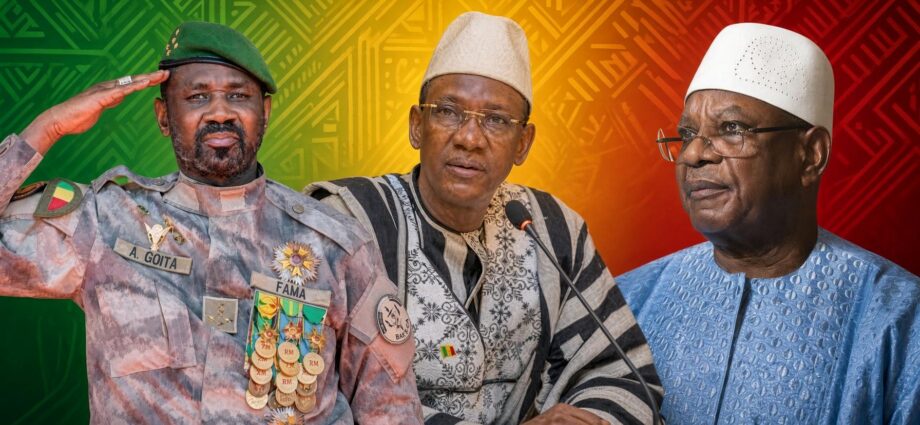
Where have Mali’s once-dominant political figures vanished to? For three decades under multiparty democracy, they shaped governments, dominated media broadcasts, and filled national conference halls. Yet since General Assimi Goïta’s military junta consolidated control, that era has ended—not by accident, but through deliberate eradication of the old guard.
From dominance to marginalization: the systematic sidelining of Mali’s political elite
Under the junta’s rule, the political class that once dictated Mali’s fortunes has been methodically dismantled. No longer do former presidents, prime ministers, or party leaders command public attention. Instead, they’ve been neutralized through a sustained campaign combining legal pressure, forced displacement, and forced silence.
This transformation didn’t happen overnight. It followed a calculated strategy that targeted influential figures from major parties including the ADEMA, RPM, and URD. The result? A once-vibrant political landscape now reduced to a shadow of its former self. Policy debates have vanished from national discourse, and the institutions that once facilitated democratic transitions have been dismantled.
The three pillars of political eradication under the junta
The junta’s approach to dismantling opposition relied on three interlocking mechanisms, each designed to ensure no credible alternative could emerge:
- Judicial persecution and imprisonment: High-profile politicians now face prolonged detention under charges ranging from “undermining state security” to “financial misconduct.” The recent case of former Prime Minister Choguel Maïga—once a regime insider—shows that even loyalty offers no protection. His continued imprisonment, despite his prior contributions, demonstrates that dissent is now a liability, regardless of past service.
- Forced exile: Facing arrest or harassment, dozens of former ministers, party leaders, and civil society figures have fled to neighboring countries like Ivory Coast, Senegal, and France. From abroad, they attempt to sustain political opposition, but their voices struggle to penetrate a national media landscape tightly controlled by the regime.
- Self-censorship and enforced silence: Those who remain in Mali operate under severe constraints. Political activities are suspended, civil society groups dissolved, and any public criticism is swiftly labeled “treason” or “collusion with destabilizing forces.” The message is clear: dissent, even in private, carries severe consequences.
Public disillusionment as the junta’s ally in dismantling democracy
The junta didn’t act alone in its mission to erase the old political class. Widespread public frustration played a crucial role. Decades of perceived corruption, chronic insecurity, and failed governance had eroded trust in traditional leaders. General Goïta capitalized on this sentiment, positioning himself as a reformer purging a corrupt elite.
Yet what began as populist rhetoric quickly solidified into institutional paralysis. Elections remain indefinitely postponed, democratic institutions sidelined, and power consolidated through transitional bodies tailored to the junta’s needs. The result: a political landscape stripped of its traditional power brokers, leaving no structured opposition to challenge the junta’s authority.
The cost of silencing dissent: a democracy hollowed out
By dismantling political parties and isolating their leaders, the military regime has erased the structures that once mediated between citizens and the state. While this has silenced immediate opposition, it has also eliminated space for constructive debate and conflict resolution.
Critics warn that a political vacuum, devoid of democratic counterweights, poses long-term risks. With no institutional safeguards against authoritarian drift, the junta governs without checks, facing only the immediacy of security crises and economic decay. The silencing of yesterday’s leaders may have removed visible dissent—but it has also extinguished the possibility of renewal, leaving Mali’s future uncertain and its governance isolated.
A weakened opposition’s fading influence
Once, Mali’s political elite could mobilize thousands, shape policy agendas, and influence national direction. Today, their remnants operate in the shadows—either imprisoned, exiled, or forced into silence. The regime’s iron grip on the narrative ensures their messages rarely reach national audiences.
The junta’s success in neutralizing opposition leaders has created an uneasy stability—but at what cost? Without credible political alternatives, Mali risks enduring a cycle of crisis without democratic recourse. The dismantling of the old regime has brought neither security nor progress; only a fragile calm overshadowed by democratic absence.
Comments are closed, but trackbacks and pingbacks are open.