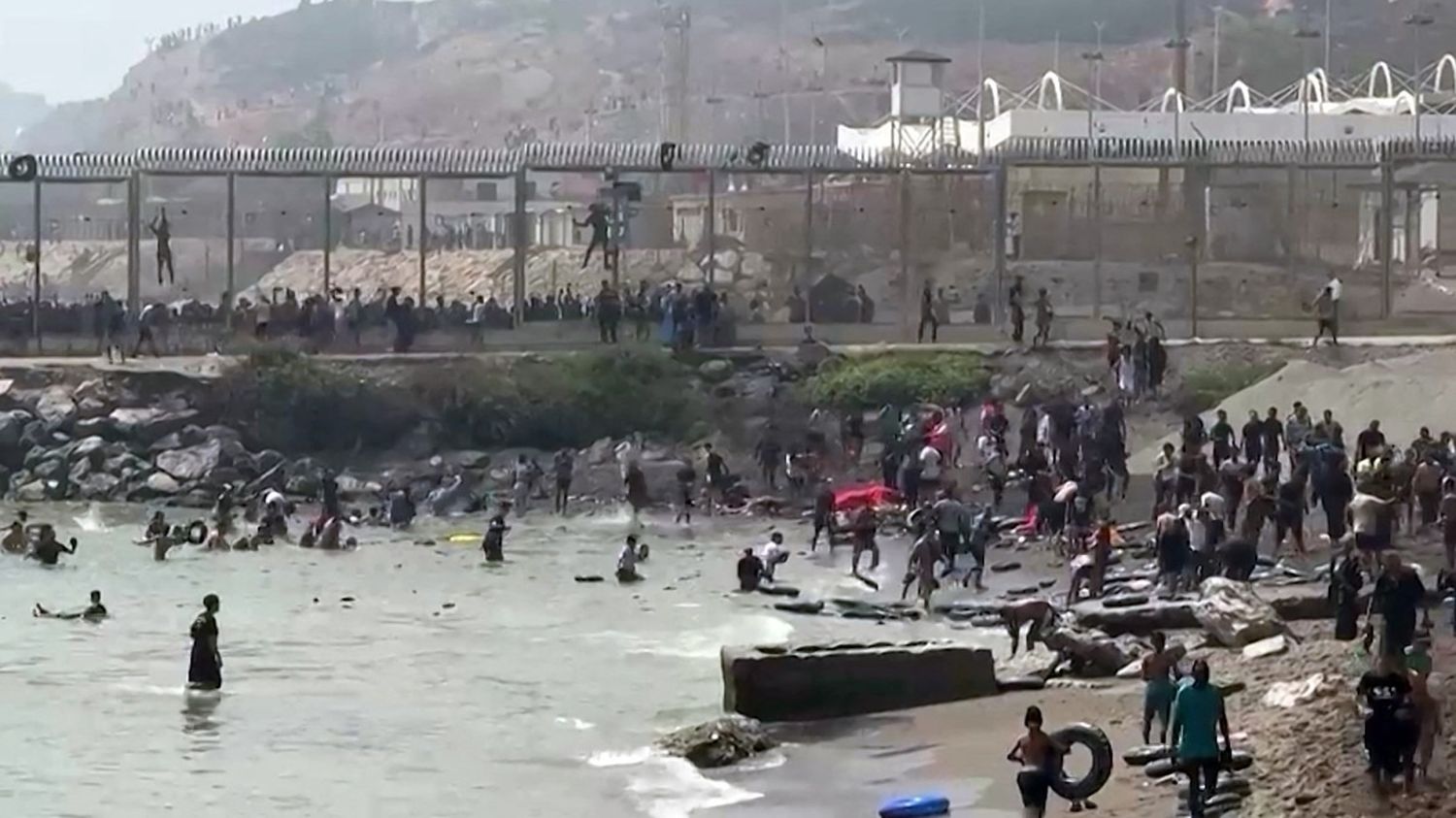
In just 24 hours, nearly 60,000 individuals crossed illegally into the Spanish enclave of Ceuta, a 20 km² territory bordering Morocco with a population of 85,000. The unprecedented influx has plunged the region into chaos, raising serious questions about the motives behind this sudden movement of people.
The Spanish government has pointed fingers at Morocco, suggesting that Rabat may be using the migrant surge as a form of political leverage. This hypothesis gains traction as the timing coincides with a recent visit by Spanish Prime Minister Pedro Sanchez to Algeria, a move that has strained relations with Morocco.
Unprecedented migration crisis unfolds at Ceuta
Thousands of Moroccan nationals, including young adults, families, and individuals with reduced mobility, entered Ceuta by swimming across the border or navigating through mountainous terrain. Despite Moroccan police efforts to block major road access, the sheer scale of the operation overwhelmed local security forces.
The Spanish Interior Ministry has attributed part of the crisis to human trafficking networks that allegedly exploited a recent court ruling. The decision mandates that all individuals entering Spanish territory must receive legal assistance and have their cases reviewed individually—a process misinterpreted by some as an invitation for uncontrolled migration. However, experts clarify that this simply upholds international asylum laws without creating an “open door” policy.
Historical parallels and geopolitical implications
This is not the first time Morocco has responded to diplomatic tensions with Spain by facilitating large-scale migration flows. In 2021, nearly 9,000 people entered Ceuta in retaliation for Spain’s decision to host the leader of the Polisario Front, Brahim Ghali, for medical treatment. The crisis that year was preceded by Morocco temporarily suspending high-level diplomatic meetings with Madrid after the U.S. recognized Moroccan sovereignty over Western Sahara—a move that aligned with Morocco’s interests.
Haizam Amirah Fernández, executive director of the Centre for Contemporary Arab Studies (CEARC), highlights a recurring pattern: “Moroccan authorities have repeatedly used human mobility as a tool to send political messages, particularly when their demands are not met by European partners.”
Ruth Ferrero, a political science professor and researcher at the Complutense Institute of International Studies (ICEI), cautions against oversimplifying the situation. She notes that while some may view the surge as a deliberate strategy, the available evidence suggests that misinformation and human trafficking networks played a more direct role in organizing the migration flow.
Diplomatic fallout and regional tensions
The timing of the crisis—just one week after Sanchez’s visit to Algeria—has intensified speculations about a coordinated response. The visit focused on gas supply agreements, a critical issue amid the broader geopolitical tensions in the Middle East and the ongoing blockade of the Strait of Hormuz.
Amirah Fernández explains: “The rivalry between Morocco and Algeria is deeply rooted in historical disputes over Western Sahara. While periods of cooperation have occurred, recent years have seen relations deteriorate significantly. It is plausible that Morocco perceives Spain’s outreach to Algeria as a threat to its interests.”
Morocco’s approach to Spain and Algeria often follows a “zero-sum game” mentality, where improving ties with one is seen as detrimental to the other. The country has long adopted an assertive foreign policy, particularly in matters concerning Western Sahara, which it considers an integral part of its territory.
Western Sahara: the core of the dispute
The conflict over Western Sahara, a former Spanish colony ceded to Morocco in 1975, remains a flashpoint in Hispano-Moroccan relations. The territory is currently divided, with 80% controlled by Morocco and the remainder administered by the Polisario Front, a Sahrawi nationalist movement founded in 1973.
In 2020, the U.S. recognized Moroccan sovereignty over Western Sahara under former President Donald Trump, aligning with Morocco’s proposal for regional autonomy. This decision, though not legally binding, further strained relations with Algeria and fueled tensions with Spain.
Sanchez’s 2022 letter to King Mohammed VI, expressing support for Morocco’s autonomy plan for Western Sahara, marked a significant shift in Spain’s traditionally neutral stance. While not a formal recognition of Moroccan sovereignty, the move was seen as a concession to Rabat’s demands.
The role of social media and human trafficking
Beyond geopolitical maneuvering, social media has played a critical role in fueling the crisis. A recent study by the Nordic Observatory for Human Rights in Morocco revealed that 81% of young people surveyed believed that content promoting irregular migration was presented as a viable solution for improving living conditions. The study also found that 78.4% of respondents could easily access posts encouraging such migration, while 74.2% followed pages that provided logistical support for these journeys.
The findings underscore the influence of online disinformation and organized crime in facilitating these movements, overshadowing any potential political motives.
Comments are closed, but trackbacks and pingbacks are open.