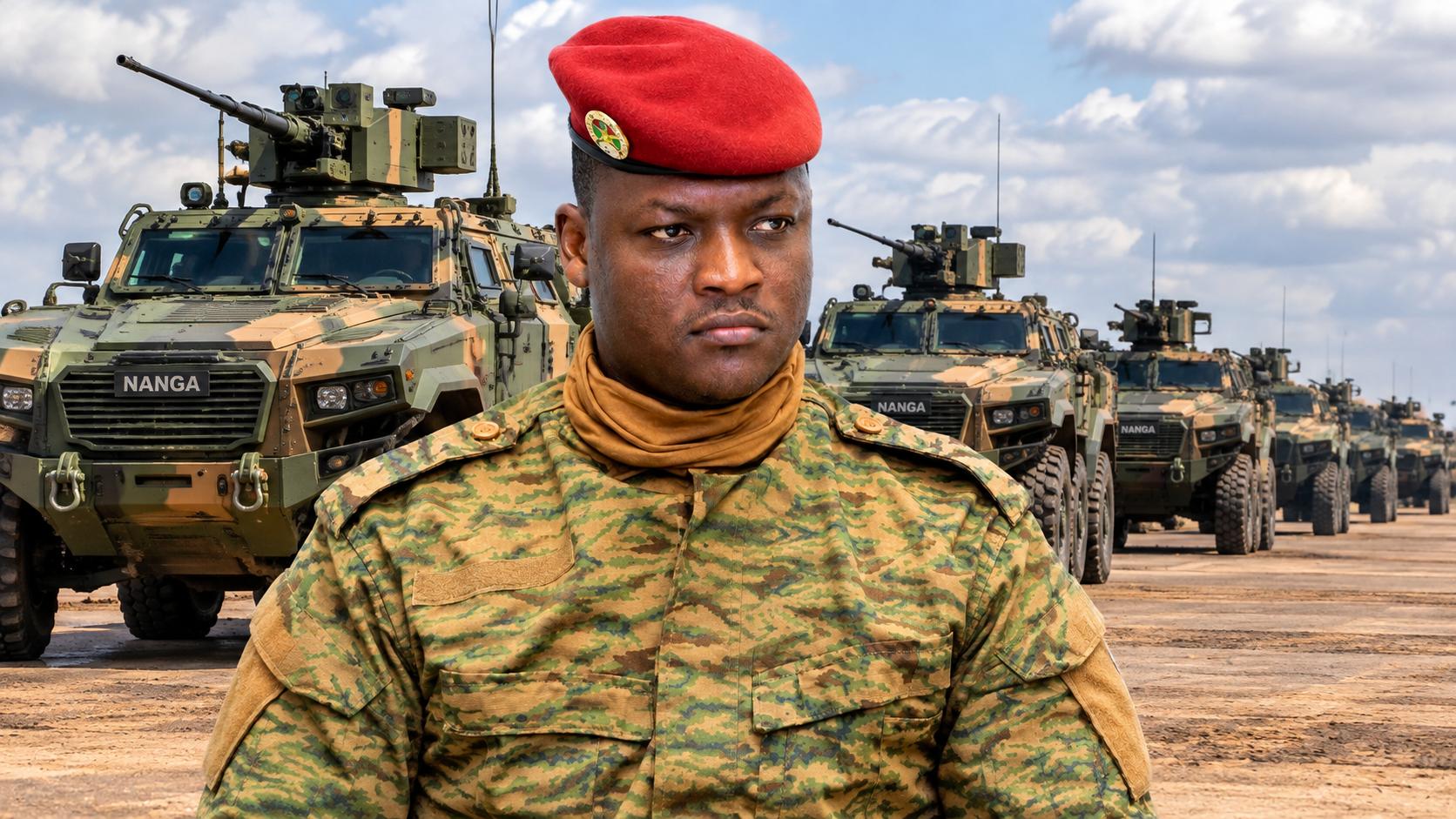
The announcement landed like a thunderclap: Burkina Faso had reportedly produced or adapted nearly 300 armored vehicles dubbed “Nanga” (scorpion) since November 2025. Captain Ibrahim Traoré, head of the Transition, presented the state or mixed company “Faso Armored” as the new engine of Burkinabè military autonomy. The claim stirred pride among sovereignist circles — and immediate skepticism among those who noticed a glaring detail: no one has ever seen the factory. The assembly lines remain strictly confidential, and the authorities invoke a convenient “secret défense” to seal off any independent verification. The fallout has been swift, and the debate is now shifting from celebration to hard questions.
From fanfare to doubt: how the reaction unfolded
What began as a flagship communication success has turned into a public relations puzzle. Military experts, civil society figures and ordinary citizens have started to ask why a national industrial triumph would need to be hidden from view. The more the government insists on secrecy, the more the story fuels suspicion that the “Nanga” program may be less about manufacturing and more about rebranding existing hardware.
The core question refuses to go away: is this a genuine leap toward military self-reliance, or a political shield designed to obscure inflated costs and disguised imports of civilian vehicles?
The “Made in Burkina” label under scrutiny
Building an armored vehicle is not a matter of welding steel plates onto a commercial chassis. It requires specialized foundries, certified ballistic steel, reinforced engines and heavy precision engineering. That reality has become the centerpiece of the doubt now swirling around the Nanga program.
Modified chassis, not manufactured hulls
Several defense-sector analysts argue that the vehicles stamped “Nanga” are, in reality, ordinary utility trucks — mainly modified Toyota chassis — imported at low cost from third countries and then reinforced in artisanal workshops. If true, the “production” would amount to a rapid retrofit rather than an industrial breakthrough.
300 Units in 10 months: a physically impossible pace
Claiming to manufacture 300 armored vehicles in under a year without pre-existing industrial infrastructure stretches technical credibility. For comparison, major arms manufacturers with automated plants take years to deliver such volumes. The arithmetic alone has become a talking point in the growing public debate.
Why “secret défense” now looks like a budgetary shield
If the Nanga program were the undeniable national achievement it is presented as, a controlled media visit — even a partial one — would serve the government’s own narrative. Instead, total opacity has been maintained. Observers say the secrecy serves three convenient purposes:
- Avoiding budget oversight: Tens of billions of CFA francs are directed into military equipment orders without public tenders or scrutiny from the Court of Accounts.
- Concealing the origin and real cost of materials: Hiding intermediary suppliers and the hefty commissions reportedly taken by regime-linked brokers.
- Escaping ballistic certification audits: No certified resistance tests (such as STANAG standards against mines or IEDs) have been produced, directly exposing the lives of Volunteers for the Defense of the Homeland (VDP) and soldiers deployed with potentially vulnerable vehicles.
Communication versus the reality on the front lines
The Nanga announcement came amid a tense political climate in which the authorities needed symbolic victories to sustain popular support. After the high-profile inauguration of military textile complexes such as TEXFORCES-BF, the narrative of “total independence” demanded a spectacular breakthrough in heavy weaponry.
But the situation on the ground tells a different story. Persistent security deterioration across several regions shows that a steady stream of announcements about “revolutionary” equipment cannot offset the deep strategic and logistical gaps facing the armed forces.
Where this leaves Burkina Faso
By elevating financial and industrial opacity into a mode of governance under the banner of “secret défense,” the government is drifting into dangerous territory. Between the reality of large-scale mechanical improvisation and the myth of self-proclaimed industrial sovereignty, the financial and human bill could weigh heavily on the Burkinabè people.
The public debate is far from over. As questions mount and scrutiny intensifies, the coming months will determine whether the Nanga saga ends as a case study in accountability — or as another chapter in a longer story of opaque military spending.
Comments are closed, but trackbacks and pingbacks are open.