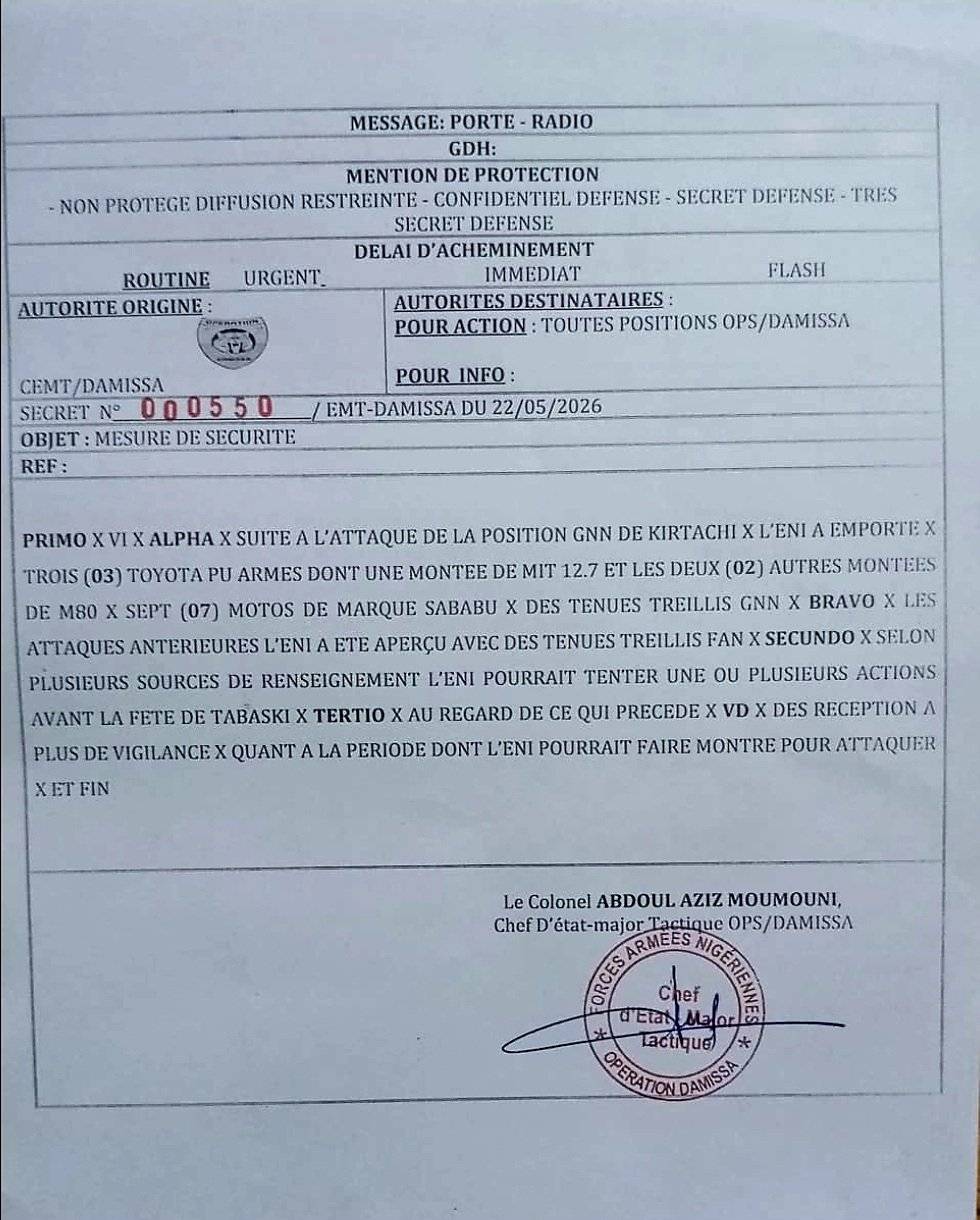
Following a fierce assault on the Niger National Guard (GNN) in Kirtachi, within the Tillabéri region, an internal radio transmission from May 22, 2026, has brought to light the true extent of losses suffered by the Defense and Security Forces (FDS). This official military file, marked “secret defense,” corroborates the significant cache of weaponry and critical gear seized by terrorists from the Group for the Support of Islam and Muslims (JNIM). With a notably high human toll and the looming threat of infiltrations as Tabaski approaches, Nigerien forces are grappling with an immense security challenge.
The revelation of a critical leak
In the ongoing asymmetric conflict plaguing Niger, official reports often present an incomplete picture. However, an intercepted internal radio message, reviewed this Friday, May 22, 2026, has pierced through the customary silence. Originating from senior military command, this classified document meticulously outlines the operational setback endured by the Niger National Guard detachment in Kirtachi, a strategic location within the “three borders” area. The release of this technical brief provides a precise assessment of the assault’s logistical repercussions. Far from the usual conjectures found on social media, this staff document presents a meticulous inventory that has deeply concerned the national operation’s leadership.
Alarming inventory: captured arsenal and logistics
The true impact of this document stems from the detailed list of military equipment seized by JNIM. The attackers executed a comprehensive logistical plunder, stripping the detachment of its mobility and firepower. As per the internal radio communication, the adversaries successfully captured three armed Toyota pickup trucks, all combat-ready. One of these vehicles was fitted with a formidable 12.7 mm heavy machine gun, known for its high rate of fire against ground forces, while the other two were equipped with M80-type machine guns. The assailants also acquired seven Sababu brand motorcycles, light and rugged vehicles ideally suited for swift, hit-and-run operations across the Sahelian terrain. Even more troubling for the integrity of future operations, the document reports the theft of several GNN camouflage uniforms. This appropriation of official attire poses an immediate risk of infiltration attacks, enabling terrorists to impersonate Nigerien soldiers and bypass security checkpoints.
A growing human toll
This material catastrophe is compounded by a human tragedy, the official count of which remains deeply painful. The fierce engagements in Kirtachi claimed the lives of 12 FDS personnel, who valiantly fell while attempting to repel the incursion. Beyond these fatalities, the confidential document also records the disappearance of four additional Nigerien soldiers, officially listed as abducted. The fate of these military captives remains unknown, as JNIM frequently leverages prisoners of war as bargaining chips or as propaganda tools through its media channels. This dual crisis underscores the intense pressure exerted by non-state armed groups throughout the Tillabéri region.
Heightened alert as Tabaski nears
In response to the gravity of the situation and the recovery of such strategic equipment, the military command reacted without delay. The confidential memo dated May 22, 2026, issues an urgent directive for increased vigilance across all operational outposts nationwide. Military strategists fear that JNIM will swiftly capitalize on this captured haul to launch new, significant operations. This period is particularly critical with the approaching Tabaski festival. This time of intense religious observance and widespread population movement presents a window of vulnerability that terrorist groups have historically sought to exploit to make a profound impact.
The Kirtachi attack and the disclosures from this “secret defense” document underscore the intricate and severe nature of Niger’s security crisis. By seizing armed pickups, heavy machine guns, and official uniforms, JNIM has temporarily bolstered its operational capacity and mobility within the “three borders” zone. For the Nigerien army, the challenge is now twofold: safeguarding the populace on the eve of Tabaski celebrations and urgently adapting ground tactics to counter an adversary now equipped with its own former armaments.