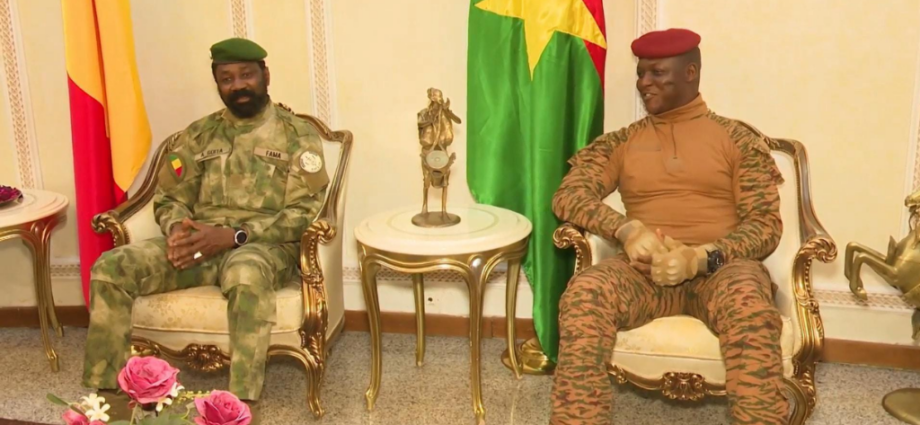
General Assimi Goïta, Mali’s president, arrived in Ouagadougou today for a high-profile bilateral visit with Burkina Faso’s Captain Ibrahim Traoré. The meeting, described as a diplomatic and friendship mission, underscores the deepening cooperation between Bamako and Ouagadougou. Yet, the conspicuous absence of Niger’s leader highlights pressing questions about the operational cohesion of the Sahel Alliance (AES).
As the Malian head of state landed in the Burkinabè capital, all eyes were on the discussions scheduled between the two presidents. While both countries reaffirm their commitment to shared security and economic challenges, the meeting’s restricted format—excluding Niger—raises doubts about the broader decision-making process within the AES.
Bamako and Ouagadougou advance while Niamey stays away
The visit comes less than a month after the AES’s foreign ministers convened in Ouagadougou to align policies on critical regional issues. Despite this prior coordination, Abdourahamane Tiani’s absence from today’s talks suggests a shift in diplomatic priorities or timing. Official statements have not clarified whether this was a deliberate exclusion or simply a bilateral engagement.
Key subjects on the agenda include cross-border security cooperation, mutual defense strategies, and joint economic initiatives to counter regional instability. Both leaders are expected to address the persistent threats posed by armed groups along their shared borders and explore deeper military integration.
An alliance built on three pillars
Formally established in September 2023 and upgraded to a Confederation in July 2024, the AES was designed to unify Burkina Faso, Mali, and Niger under a shared vision. The trio’s stated goal: strengthen sovereignty, enhance regional security, and reduce reliance on external partners. Yet, today’s meeting—without Niamey—challenges perceptions of the alliance’s operational unity.
Why Niger’s absence matters
While no formal indication suggests a rift, the absence of the Nigerien president introduces uncertainty. Analysts point to three possible explanations:
- Tactical bilateralism: The visit may prioritize immediate, actionable outcomes between Mali and Burkina Faso without immediate plans to include Niger.
- Scheduling conflict: Abdourahamane Tiani’s schedule may have prevented attendance, despite strong bilateral ties.
- Strategic signaling: The meeting could subtly signal a realignment in regional priorities, potentially sidelining Niamey temporarily.
Regardless of the reason, the optics of a two-country summit in a three-member alliance are difficult to ignore. The AES’s credibility hinges on visible, consistent collaboration among all capitals.
Can the AES survive without all three?
The Confederation’s success depends on more than periodic bilateral visits. It requires regular, high-level coordination to maintain strategic alignment. Previous meetings—such as the October 16 foreign ministers’ gathering—demonstrated functional cooperation. But without presidential participation, the AES risks appearing fragmented.
Security remains the most pressing concern. All three countries face ongoing threats from insurgent groups, and mutual defense agreements were a core reason for forming the AES. If Bamako and Ouagadougou advance military integration without Niger, the alliance’s deterrent power could weaken.
Equally critical is the diplomatic leverage the AES holds. A unified stance allows the three nations to negotiate more effectively with international partners—especially in the face of sanctions from regional blocs like ECOWAS. Divergence between member states risks diluting this collective bargaining power.
What comes next?
The outcome of today’s discussions will be closely scrutinized. Will assurances be given that Niamey will be briefed and included in future steps? Or will the meeting solidify a perceived leadership duo within the AES?
One thing is clear: the Sahel Alliance’s future cannot be shaped by two capitals alone. The long-term viability of the Confederation depends on President Tiani’s re-engagement and a renewed commitment to trilateral decision-making. Without it, the alliance risks becoming a symbolic entity rather than a functioning coalition.
As General Goïta and Captain Traoré conclude their engagements, the question lingers: Can the AES thrive when one of its three pillars is missing?
Comments are closed, but trackbacks and pingbacks are open.