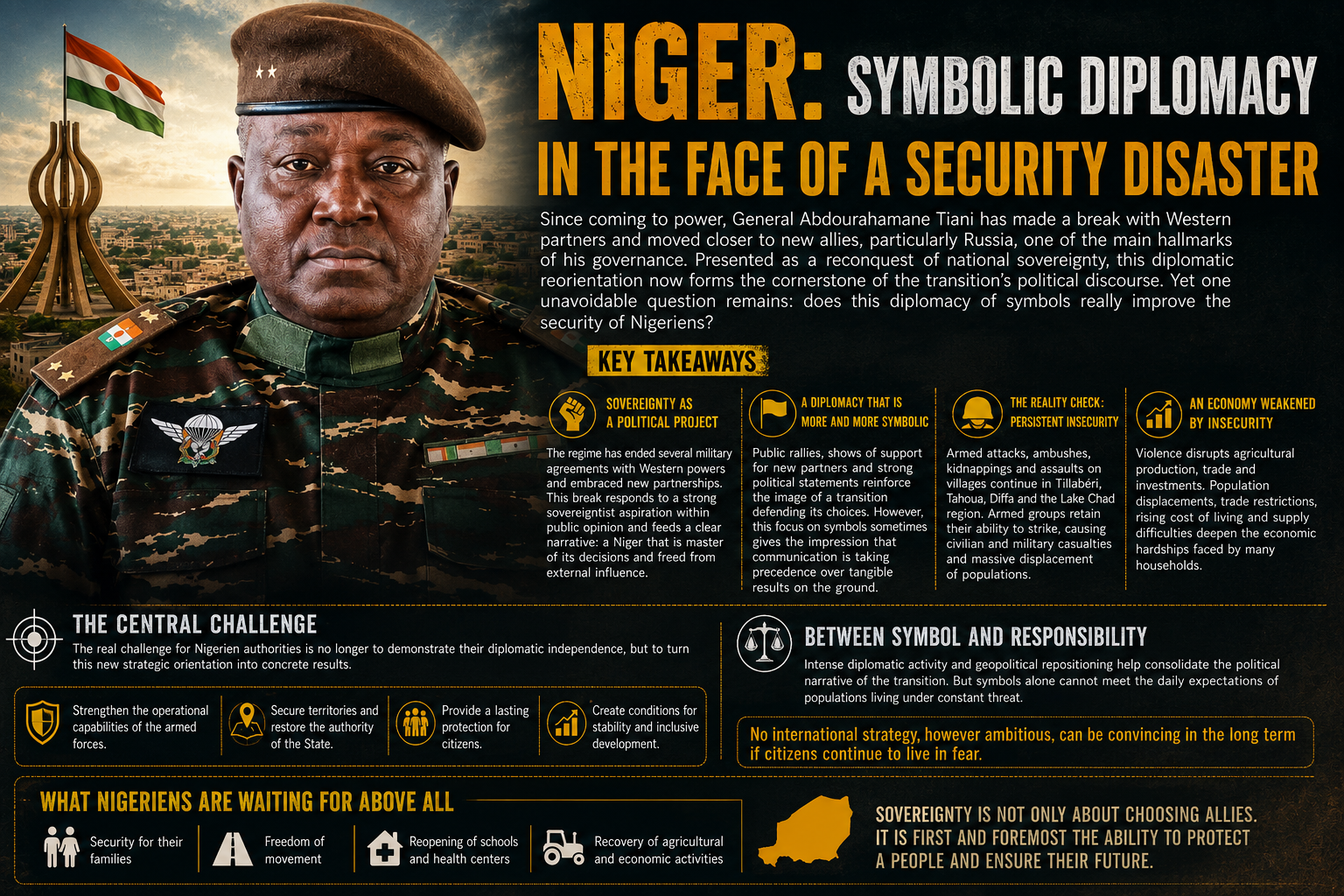
The administration led by General Abdourahamane Tiani has prioritized a strategic pivot away from traditional Western allies toward new partnerships, most notably with Russia, framing this realignment as a restoration of national sovereignty. This diplomatic repositioning has become central to the transitional government’s political narrative, positioning itself as a sovereign actor capable of defining its own priorities without external interference.
Asserting sovereignty as a political vision
Far from being a mere tactical maneuver, the decisions undertaken by the National Council for the Safeguarding of the Homeland (CNSP) reflect a deliberate and widely supported sovereignist aspiration. The withdrawal from several military cooperation agreements with Western nations and the cultivation of alternative alliances—particularly within the Alliance of Sahel States (AES) and with Moscow—underscore a clear political vision: one of reclaiming national dignity and autonomy.
The official discourse emphasizes the necessity of breaking away from decades of perceived dependency, advocating for a governance model rooted in national interests rather than external dictates. For supporters of the transition, this shift represents a historic milestone in restoring the country’s dignity and self-determination.
The limits of symbolic diplomacy
Yet, this diplomatic reorientation, though symbolically powerful, often overshadows practical outcomes. Public demonstrations endorsing new partnerships, frequent diplomatic declarations, and state-led campaigns to showcase international alliances dominate the government’s communication strategy. While these gestures reinforce the image of a resolute leadership, they do little to address the immediate concerns of Nigerien citizens.
The population’s priorities remain focused on tangible security: the ability to move freely, live without constant threat, and restore normalcy to daily life. With the government dedicating considerable resources to projecting its new geopolitical stance, the disconnect between symbolic action and tangible results grows increasingly apparent.
A security crisis that persists
The most pressing concern lies in the persistent insecurity plaguing several regions. Despite the intensification of military operations and the announcement of new defense partnerships, armed groups continue to inflict damage across vast areas of the country. Regions such as Tillabéri, Tahoua, Diffa, and parts of the Lake Chad basin remain hotspots for violence, where civilians, security forces, and public infrastructure are routinely targeted.
Ambushes, abductions, village raids, and mass displacements have become recurring features of life in these areas, fostering an environment of chronic instability. Military operations, though ongoing, have yet to dismantle the operational capacity of these armed factions, as evidenced by the steady toll of civilian and military casualties. For residents in high-risk zones, the lofty themes of geopolitical realignment offer little solace when daily survival is at stake.
Economic strain in the shadow of insecurity
The consequences of prolonged violence extend beyond human suffering, severely undermining the national economy. Displaced populations disrupt agricultural production, trade routes remain perilous, and investment confidence wanes in the face of persistent uncertainty. The political upheavals of recent years have further strained economic conditions, with rising living costs, supply shortages, and dwindling economic opportunities exacerbating household precarity.
In this context, the potential benefits of new international alliances risk remaining unfulfilled for the vast majority of Nigeriens, who continue to grapple with the immediate fallout of insecurity.
From alliances to action: the unmet challenge
The true test for the transitional authorities will not lie in the eloquence of their diplomatic proclamations, but in their ability to translate these alliances into tangible security gains. The success of these partnerships will be measured not by the frequency of official ceremonies or political statements, but by their capacity to enhance the operational effectiveness of defense forces, secure vulnerable territories, and restore state authority.
Sovereignty, in its truest sense, is not merely a matter of choosing allies—it is demonstrated through the ability of a state to protect its citizens, uphold territorial integrity, and foster an environment of stability and opportunity for its people.
The gap between diplomacy and reality
The stark contrast between Niamey’s active diplomatic engagements and the lived experiences of Nigeriens in conflict zones highlights a growing dissonance. While the government’s international posturing strengthens its sovereignist narrative, it cannot substitute for the urgent need to deliver on core promises: safety, freedom of movement, and the restoration of normalcy.
Ultimately, history will assess the military transition not by the strength of its diplomatic resolve or the boldness of its international choices, but by its tangible achievements in securing peace, stability, and development for its people. No grand strategy, no matter how ambitious, can endure if citizens remain trapped in a cycle of violence and uncertainty. The true legitimacy of any government is forged in its ability to ensure the safety and dignity of its population above all else.