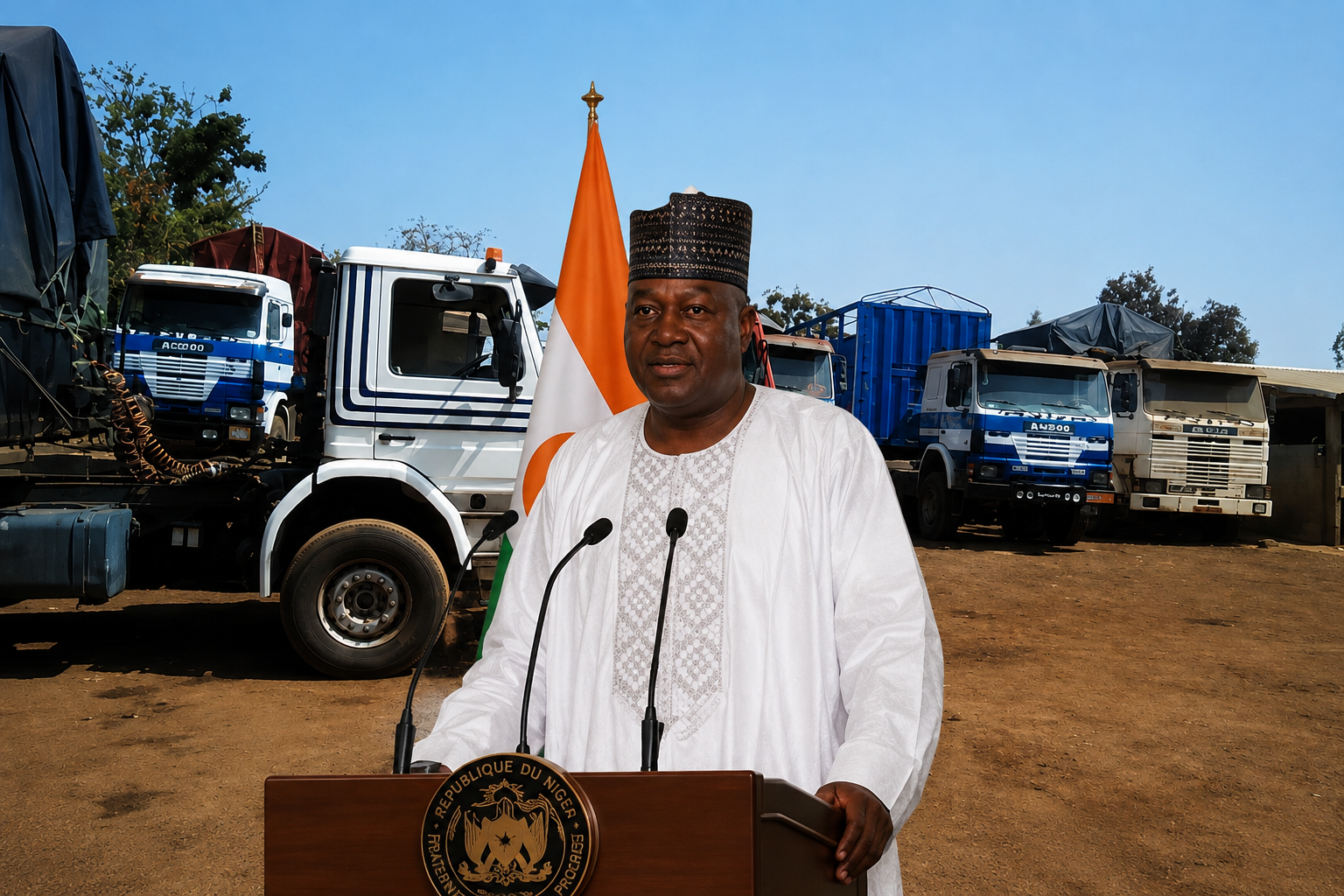
Three years after General Abdourahamane Tiani seized power in Niamey, the initial promises of restored security, national sovereignty, and improved living standards remain largely unfulfilled. What was intended as a decisive break with past governance has instead left Niger grappling with a deepening web of crises—security, economic, diplomatic, and social—that increasingly reinforce one another.
The security gamble that failed to deliver
The 2023 coup was justified primarily on the grounds of restoring security in the face of escalating threats from armed groups. The new leadership pledged a more effective military response than the civilian administration it replaced. Yet, the situation on the ground tells a different story.
Armed factions linked to Jama’at Nusrat al-Islam wal Muslimin (JNIM) and the Islamic State in the Greater Sahara (ISGS) continue to gain ground, expanding their operational reach across multiple regions. Their tactics have evolved beyond isolated attacks on military outposts. Today, they systematically target:
- military and logistical convoys;
- civilian villages and settlements;
- key road networks;
- economic infrastructure;
- supply chains.
Entire communities now live under near-constant threat, severely restricting movement for both civilians and administrative services. The human toll is mounting, with rural populations bearing the brunt of a conflict that shows no sign of abating despite the change in leadership.
An army stretched thin despite rising military spending
A significant portion of the national budget has been redirected toward defense since the change of regime. Yet, the expanded military expenditure has not translated into a decisive shift in the conflict’s trajectory. The armed forces face daunting challenges:
- a vast and difficult-to-control territory;
- multiple active fronts;
- highly mobile terrorist groups;
- logistical bottlenecks.
The relentless operational demands have led to equipment wear, personnel fatigue, and soaring operational costs. Each new attack underscores the limitations of a strategy that relies predominantly on military force to address what are fundamentally economic, social, and territorial issues.
An economy suffocating under regional and internal pressures
Niger’s economic stability remains tightly bound to its regional trade networks. The prolonged closure of the border with Bénin, coupled with broader diplomatic tensions, has disrupted traditional trade corridors. The Cotonou-Niamey route, once the country’s most competitive commercial artery, now faces severe disruptions:
- prolonged supply delays;
- sharp increases in transport costs;
- frequent stock shortages;
- generalized price inflation.
Households are feeling the pinch as purchasing power declines. Essential goods—from food and medicine to construction materials—have seen consistent price hikes, placing additional strain on families already struggling to make ends meet.
Local economies on the brink in border regions
Cities like Gaya, once hubs of transnational commerce, have seen their economic vitality wane. Businesses that thrived on cross-border trade—including transporters, freight handlers, small-scale merchants, logistics firms, and hospitality services—now face dwindling activity. The contraction in trade has also reduced state revenue, further constraining public investment capacity.
Investment paralysis amid political uncertainty
The current climate of instability has dampened investor confidence. Businesses seek predictable conditions—stable institutions, clear legal frameworks, reliable infrastructure, and dependable trade relations. Yet, Niger today presents multiple risk factors:
- ongoing diplomatic sanctions and tensions;
- logistical disruptions;
- elevated security risks;
- regulatory unpredictability.
This environment has slowed capital inflows and prompted many operators to postpone or cancel projects. The once-promising Niger-Bénin oil pipeline, designed to funnel resources from Agadem to the Sèmè terminal, now hangs in the balance. Political frictions between Niamey and Cotonou have cast a shadow over the project, undermining investor confidence in long-term ventures.
Diplomatic realignment with limited dividends
The military-led government has pursued a bold foreign policy shift, severing long-standing partnerships with Western allies and forging closer ties with Russia. Niger has also joined the Alliance of Sahel States (AES), aligning with Mali and Burkina Faso. The stated goal: reclaim national sovereignty and reduce external dependence.
However, this reorientation has not yielded tangible solutions to the country’s core challenges. International financial flows have dwindled, technical cooperation has diminished, and dialogue with neighboring countries has grown strained. While sovereignty rhetoric resonates with a portion of the population, it has not translated into improved economic conditions or enhanced security.
A shift in dependence, not autonomy
The departure of French forces was framed as a victory for national autonomy. Yet, military cooperation with Russian partners has rapidly expanded. The underlying question remains: has Niger truly freed itself from external influence, or merely exchanged one form of dependence for another? On the ground, national security still relies, in part, on foreign support—a reality that challenges the narrative of full strategic autonomy.
The limits of political messaging
Faced with persistent hardships, the government has leaned heavily on a narrative that blames external actors—regional blocs, neighboring countries, and former partners—for the nation’s woes. This discourse, while unifying in parts of the population, does little to address everyday concerns such as surging inflation, youth unemployment, strained public services, declining purchasing power, and food insecurity.
For many citizens, the gap between political rhetoric and lived reality is widening. Concrete results—jobs, stable prices, functioning schools and hospitals—are increasingly what matter most.
Public services under strain
The heavy allocation of resources to defense has left other sectors underfunded. Social services are struggling to meet rising needs amid shrinking budgets. The consequences are visible:
- a shortage of school infrastructure;
- delays in medical supply chains;
- postponed public investments;
- declining quality of local services.
A dangerous cycle is emerging: as military spending rises, development investment lags—precisely when such investments are most needed to address the root causes of insecurity.
Social cohesion fraying under economic strain
The cumulative effects of economic hardship are reshaping daily life for Nigerien families. Continuous price increases, scarce job opportunities, falling incomes in border regions, and pervasive economic uncertainty are eroding social stability. Vulnerable populations, in particular, face growing precarity, with little relief in sight.
A governance model reaching its limits
Three years into the military-led transition, Niger stands at a crossroads. The junta arrived promising security, sovereignty, and prosperity. Yet, the data reveals a country trapped in a spiral of persistent insecurity, economic contraction, fiscal strain, and diplomatic isolation. A strategy centered on military might, regional tensions, and structural economic weaknesses has failed to break the cycle. Each crisis feeds into the next, making it increasingly difficult to chart a path out of the impasse.

Comments are closed, but trackbacks and pingbacks are open.