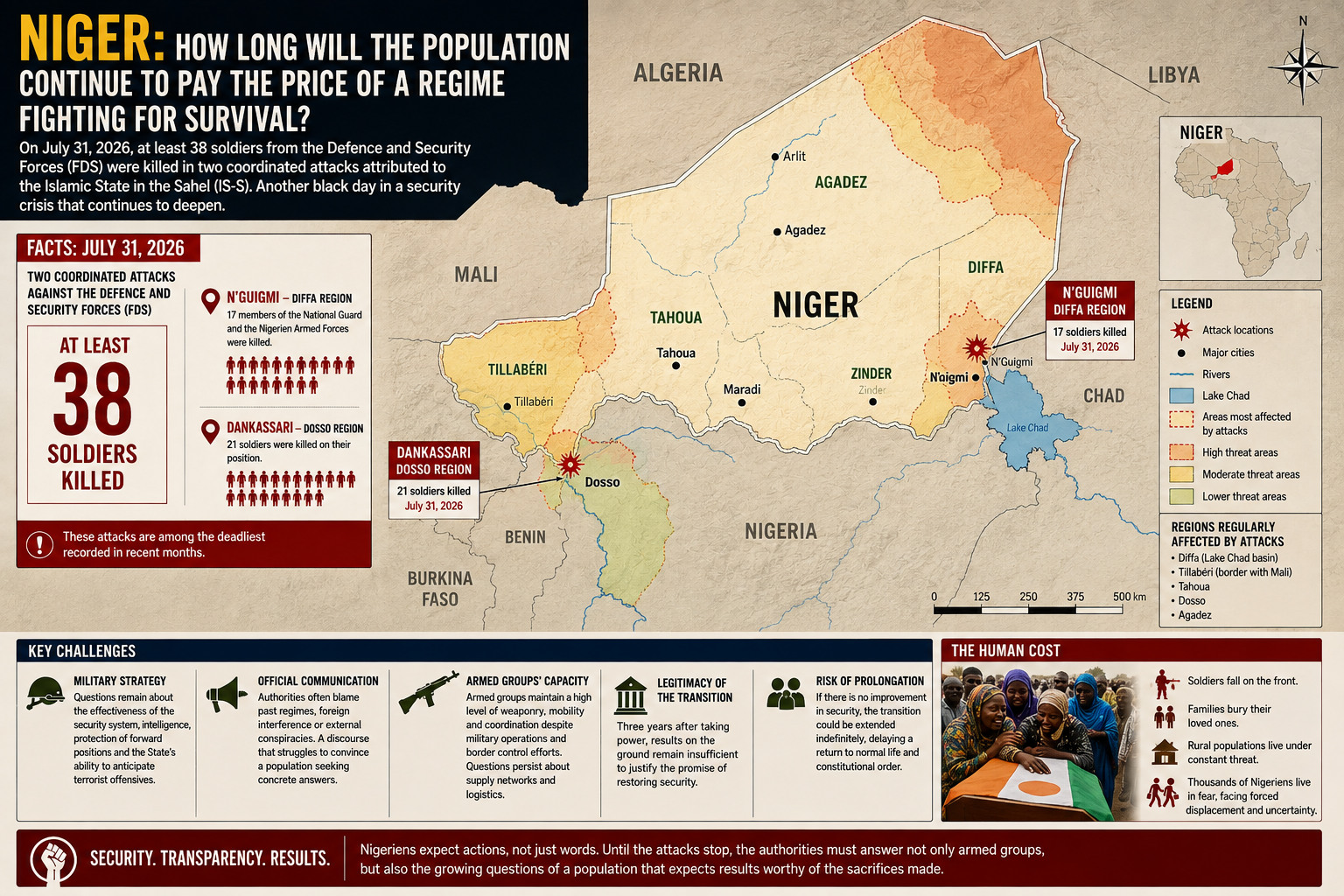
Two coordinated assaults leave 38 soldiers dead
July 31, 2026, marked another tragic chapter in Niger’s ongoing security crisis, as coordinated attacks by the Islamic State in the Sahel (IS-Sahel) claimed the lives of at least 38 members of the country’s defense and security forces.
The first assault struck N’Guigmi in the Diffa region, where 17 soldiers from the National Guard and Nigerien Armed Forces were killed. Hours later, a second attack in Dankassari, Dosso region, resulted in 21 additional fatalities. These incidents rank among the deadliest in recent months, underscoring the relentless advance of terrorism despite repeated military efforts.
Broken promises of security
When General Abdourahamane Tiani assumed power, the primary justification for the coup was the dire state of national security, which military leaders argued had spiraled out of control under civilian rule. The pledge was clear: restore order, reclaim territory, and safeguard civilians.
Three years into the transition, the outcome tells a different story. Attacks persist in critical zones like the Lake Chad basin, Tillabéri, Tahoua, and Dosso. Armed groups continue to execute complex operations against military outposts, despite official announcements of force restructuring. This raises a pressing question: Are the stated objectives translating into tangible improvements on the ground?
Military failures under scrutiny
Each deadly strike does more than claim lives—it exposes systemic weaknesses in Niger’s security apparatus. Questions linger about the effectiveness of military intelligence, the protection of forward operating bases, and the state’s ability to preempt terrorist offensives.
As attacks escalate, public skepticism grows. Is the regime prioritizing political consolidation over the urgent demands of the battlefield? A transition built on restoring security cannot afford to ignore its own performance metrics.
Official narratives fail to ease concerns
Following each attack, authorities frequently deflect criticism by citing inherited challenges, foreign interference, or external geopolitical pressures. While these factors may contribute to the crisis, they do little to address the immediate concerns of affected communities.
Families of the fallen demand accountability for operational failures, concrete corrective measures, and tangible steps to prevent future tragedies. Without visible progress, official statements risk losing credibility, further eroding public trust.
An insurgency gaining momentum
A critical concern is the sustained operational capacity of armed groups. Despite military campaigns and border enforcement efforts, these organizations maintain high levels of firepower, mobility, and coordination. This persistence fuels suspicions about gaps in weapon supply chains, terrorist logistics networks, and intelligence failures.
The lack of transparent information allows rumors to thrive, deepening the rift between citizens and state institutions. Without clarity, speculation thrives, and confidence erodes.
A transition at risk of unraveling
The legitimacy of the military government hinges on its ability to deliver on security. Yet, with each passing attack, that promise grows weaker. The crisis not only delays a return to normalcy but also destabilizes local communities and prolongs the uncertainty surrounding a constitutional restoration.
Analysts warn that prolonged insecurity could indefinitely extend the transition period. Resolving this dilemma will require greater transparency, measurable progress, and a credible roadmap for ending the crisis.
The human toll of a never-ending war
Beyond political debates, the human cost remains undeniable. Soldiers continue to die in combat, families bury their loved ones, and rural populations live under the constant threat of armed groups. Thousands of Nigeriens endure forced displacement and a life dictated by fear.
The promise of security was the cornerstone of the military transition. Today, it remains its most fragile test. Until attacks subside, the authorities must confront not only the insurgency but also the growing demands of a weary population seeking results commensurate with their sacrifices.
Comments are closed, but trackbacks and pingbacks are open.