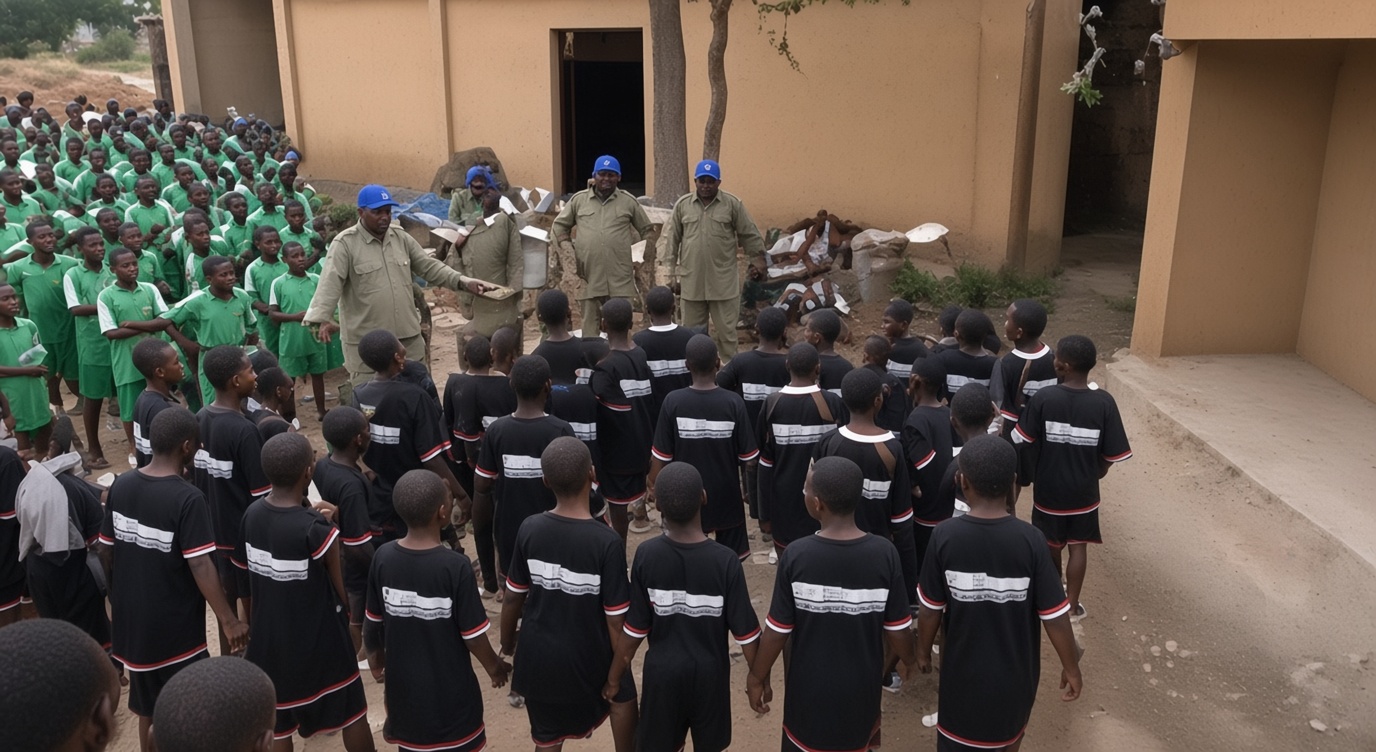
General Abdourahamane Tiani has inaugurated a training facility engaging over 300 young Nigerien individuals. While publicly framed as a drive for civic commitment, national revival, and societal restructuring mirroring the model championed by Captain Ibrahim Traoré in Burkina Faso a closer examination reveals a more disquieting potential. Beneath the meticulously curated public narrative and the celebration of “committed youth,” the military administration appears to be laying foundations for premature militarization.
A militarized environment’s impact on youth
Fundamentally, children and adolescents are ill-suited for militarized or pre-militarized settings. At such formative ages, the primary focus should unequivocally remain on formal education, skill development, athletic pursuits, cultural enrichment, and the cultivation of responsible citizenship. To mold developing intellects around military discipline, unquestioning obedience, and perpetual readiness risks progressively normalizing the use of force and confrontation.
The political message and true civism
The inherent peril extends beyond the nature of the camp itself, encompassing the profound political message conveyed to an entire generation. When a military authority frames youth mobilization as an imperative patriotic duty, there is a distinct risk of valuing allegiance to the governing power above the development of critical thought. True civic responsibility, however, does not imply unquestioning submission; it demands the capacity to scrutinize, to engage in discourse, and to advocate for the collective welfare.
The demarcation between genuine civic instruction and outright indoctrination becomes particularly tenuous when young individuals are continually exposed to a lexicon centered on struggle, self-sacrifice, and national defense. While a mobilized youth can undoubtedly contribute to the nation, they must never be reduced to a human reservoir solely intended to perpetuate a military government indefinitely.
Prioritizing development over ideology
This methodology also prompts a critical query: why allocate substantial resources to the ideological mobilization of youth when thousands of young Nigeriens are primarily in need of operational educational institutions, accredited vocational training, employment opportunities, essential infrastructure, and tangible pathways for their future? Patriotism, in itself, cannot sustain a household, substitute for academic qualifications, or spontaneously generate employment.
Consequently, the discourse surrounding “mandatory civic engagement” can readily function as an exceedingly convenient political diversion. By projecting an image of disciplined, fervent, and self-sacrificing youth, the authorities may inadvertently steer focus away from pressing economic hardships, systemic deficiencies within the educational sector, widespread youth joblessness, and the broader social repercussions of political volatility.
The long-term implications of militarization
Furthermore, it is essential to contemplate the long-term viability of such an approach. A generation nurtured within a culture of perpetual mobilization risks internalizing the militarization of society as a normative condition. What is currently presented as an extraordinary undertaking could, in time, evolve into an institutionalized paradigm for political and paramilitary youth training.
The comparison with Burkina Faso equally warrants careful consideration. The proliferation of initiatives aimed at rallying young people around themes of patriotism and national defense should not precipitate a competitive militarization among Sahelian nations. While the security environment is undeniably challenging, the solution to insecurity cannot entail the gradual transformation of an entire generation into prospective combatants.
Empowering youth for a sustainable future
Nigerien youth merit more than merely serving as an instrument in the communication strategy of a governing power. They deserve access to high-quality education, the acquisition of valuable skills, employment prospects, intellectual autonomy, and the opportunity to engage in public life without being constrained by adherence to a specific political or military doctrine.
The fervor of youth must never be exploited as a moral bulwark to obscure administrative challenges. A robust state is not defined by how early it instructs its children in obedience and combat. Rather, it is characterized by its capacity to equip them with ample knowledge, freedoms, and opportunities to autonomously shape the nation’s future.
Genuine patriotism lies in cultivating citizens capable of construction, innovation, critical deliberation, and defending their homeland when legally mandated, rather than prematurely conditioning minds to military rationales. Niger must remain vigilant to ensure that the imperative struggle against insecurity does not become a pretext for the enduring militarization of its children and young populace.
Comments are closed, but trackbacks and pingbacks are open.