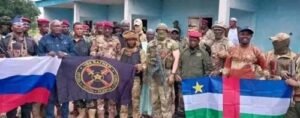
The political landscape in Centrafrique has grown increasingly volatile following the official involvement of Russian mercenary forces in regional security operations. This development has directly impacted the leadership dynamics of the Mouvement Patriotique pour la Centrafrique (MPC), pushing former and current leaders into a tense standoff in Bossangoa.
what led to the current crisis?
The escalation traces back to the arrival of foreign paramilitary units, widely recognized as Russian contractors, who have taken on a more visible role in the conflict-ridden region. Their presence has not only intensified security measures but also triggered a power struggle within the MPC, a key armed faction operating in the country’s northwest.
Didot Ali, a prominent figure within the movement, found himself at the center of this turmoil. His leadership was challenged, leading to a rapid succession crisis that has now placed his successor under pressure to navigate the complex new reality imposed by the foreign mercenaries.
how the mpc’s leadership is reacting
Sources close to the MPC describe a fractured leadership struggling to adapt to the sudden shift in power dynamics. Didot Ali, who had previously held influence over strategic decisions, is now reportedly confined to Bossangoa under the watchful eye of the Russian-backed forces. His successor faces the daunting task of maintaining cohesion within the group while contending with external pressures.
The mercenaries’ involvement has introduced a new layer of complexity, with their methods and objectives still unclear to many within the faction. Reports indicate that their actions have led to tighter control over local territories, raising concerns about the future of regional stability.
potential consequences for Centrafrique
The unfolding situation in Bossangoa could have far-reaching implications for Centrafrique as a whole. The MPC, one of the country’s most active armed groups, plays a critical role in the ongoing conflict, and any internal division risks exacerbating violence in an already fragile environment.
Analysts warn that the mercenaries’ growing influence may further polarize local factions, making reconciliation efforts even more challenging. The international community, including regional bodies, is closely monitoring the developments, though concrete responses remain uncertain.
what’s next for bossangoa and the mpc?
With the Russian mercenaries now firmly embedded in the security framework, the MPC faces a pivotal moment. The faction’s ability to regroup and redefine its strategy will determine whether it can survive this crisis or face irreversible fragmentation.
Residents of Bossangoa and surrounding areas are caught in the crossfire, as the power struggle plays out in real time. The humanitarian impact of these tensions is expected to worsen, with displacement and resource shortages already becoming pressing concerns.