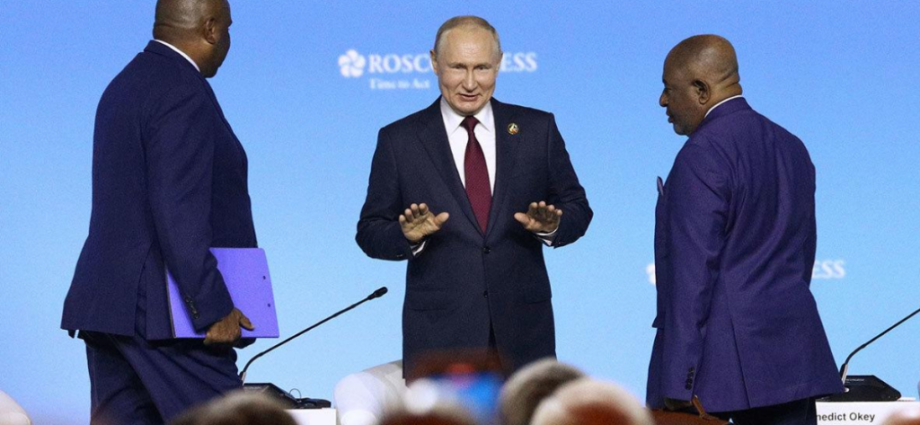
The Russia-Africa Summit 2026 in Moscow, held on October 28–29, has spotlighted sharp differences in representation among leaders of the Alliance of Sahel States (AES). While Mali’s transitional president Assimi Goïta arrived with a full official delegation, counterparts from Burkina Faso and Niger were either represented by lower-level officials or their presence remained unconfirmed.
Mali stands alone at the summit with its president present
Assimi Goïta, head of Mali’s junta-led government, landed in Moscow on October 26, accompanied by senior officials. His arrival was publicly documented, including footage of his reception at the airport and confirmation of scheduled talks with President Vladimir Putin. Goïta’s presence signals a clear intention to reinforce Mali’s diplomatic visibility within the Russia-Africa framework.
Burkina Faso sends prime minister in Goïta’s absence
Despite earlier reports suggesting Burkina Faso’s captain Ibrahim Traoré would attend, no confirmation of his arrival has materialized. Instead, the delegation to Moscow is led by Prime Minister Rimtalba Jean Emmanuel Ouédraogo, who arrived ahead of the summit’s official opening. While this ensures Burkina Faso’s participation in political and economic discussions, it lacks the symbolic weight of a head of state’s personal attendance.
Niger’s leader: presence announced but not yet confirmed
General Abdourahamane Tiani, Niger’s military leader, was also listed among expected attendees by Russian authorities. As of October 28, however, no public confirmation of his presence has been issued. Without an official statement clarifying his status, any assumption about his absence would be premature. The uncertainty underscores a cautious approach to international engagements.
Broader African participation takes shape beyond the Sahel
The summit has drawn dozens of African heads of state and government, including Évariste Ndayishimiye of Burundi (current African Union chair), Emmerson Mnangagwa of Zimbabwe, John Dramani Mahama of Ghana, and Teodoro Obiang Nguema Mbasogo of Equatorial Guinea. President Denis Sassou-Nguesso of the Republic of the Congo is also present, reflecting Russia’s strategy to engage diverse regional partners.
According to Kremlin advisor Yury Ushakov, 48 of Africa’s 54 countries have confirmed participation, with 22 represented by their heads of state. This broad turnout highlights the summit’s diplomatic significance, even if not all delegations share identical policy stances.
Multiple governments opt for ministerial representation
Several African nations, including Algeria (represented by Prime Minister Sifi Ghrieb), Benin (Vice-President Mariam Chabi Talata), and Uganda (Vice-President Jessica Alupo), chose to send high-ranking officials instead of presidents. South Africa’s delegation, led by Zane Dangor—Director-General of International Relations—further illustrates this trend. While such representations fulfill official roles, they reduce the visual and diplomatic prominence of presidential participation.
Six countries not yet accounted for in confirmed attendance
Despite the Kremlin’s claim that 48 countries have confirmed attendance, six remain unlisted in official Russian statements. The lack of transparency makes it difficult to determine whether their absence reflects political disagreement, logistical constraints, or unannounced decisions. In this context, the absence of a head of state does not necessarily signal withdrawal from the summit’s proceedings.
Strategic stakes: visibility vs. tangible outcomes
For the AES trio, the contrast between Goïta’s personal presence and the unconfirmed or indirect representation of Traoré and Tiani raises questions about internal cohesion. Yet, such displays do not automatically translate into divergent strategies toward Russia. The summit’s real test will lie in the concrete agreements forged—particularly in trade, energy, agriculture, security, and long-term investment programs slated for 2027–2029. For Sahelian leaders, diplomatic optics matter, but lasting benefits will depend on deliverables that address pressing regional challenges.
Comments are closed, but trackbacks and pingbacks are open.