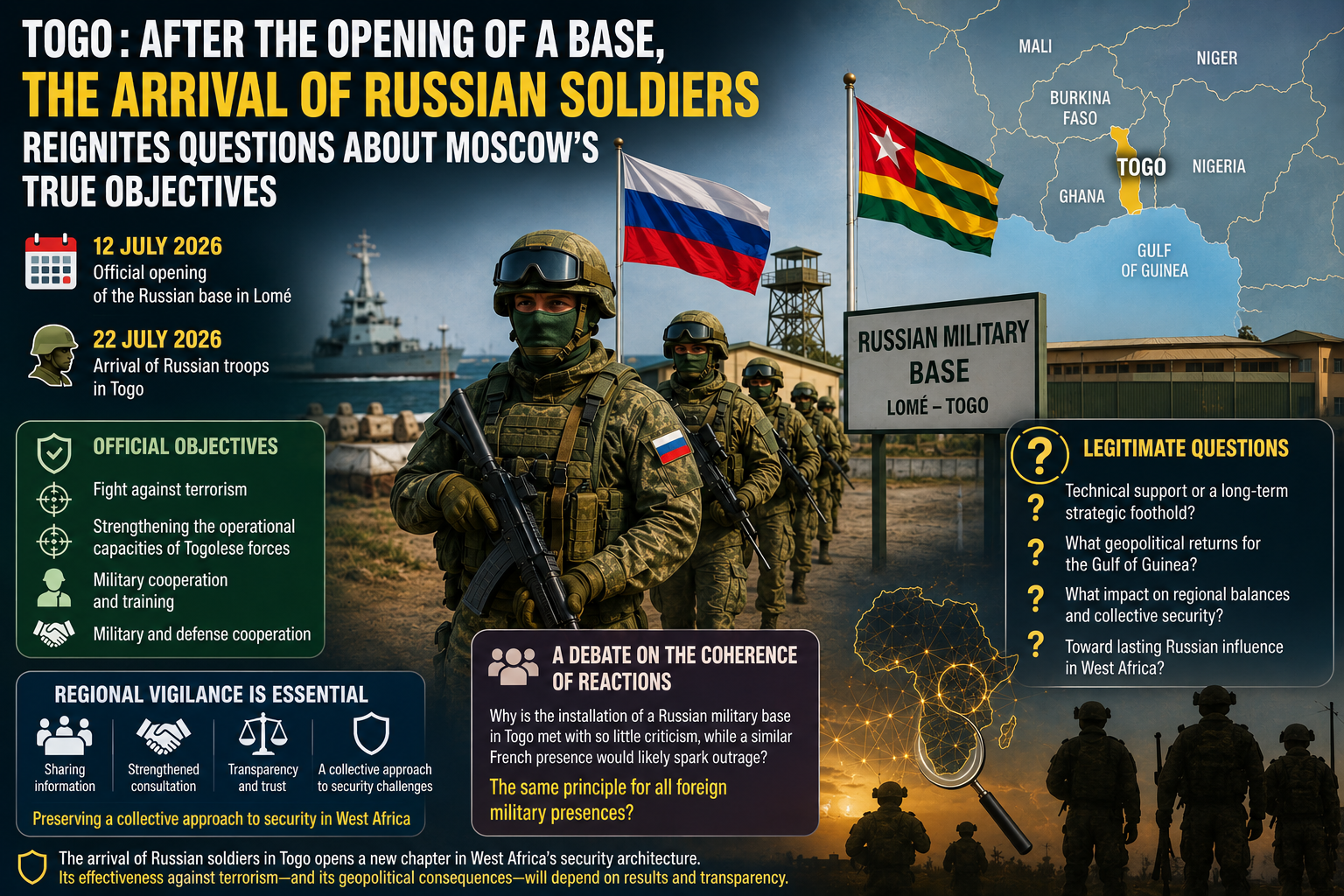
The recent deployment of Russian troops to Togo, following the inauguration of a Russian military base on July 12, 2026, has intensified discussions about the true intentions behind Moscow’s expanding influence in West Africa. According to official statements, these soldiers are positioned to support Togo’s counterterrorism efforts and enhance the operational readiness of its armed forces.
Yet, this development has triggered significant scrutiny among security analysts across the region. While Togo’s government has the sovereign right to forge defense partnerships, the long-term presence of a foreign military in a subregion plagued by persistent terrorist threats could reshape the security dynamics of West Africa.
Moscow’s expanding footprint in Africa
Over the past decade, Russia has steadily increased its military engagements across the continent through defense agreements, training programs, arms deliveries, and, in select cases, direct troop deployments. The arrival of Russian soldiers in Togo aligns with this broader strategy of deepening security cooperation between Moscow and African states.
The central question now revolves around the implications of this partnership. Is the deployment strictly limited to technical and operational support in combating armed groups operating near Togo’s northern borders? Or does it signal a long-term strategic move by Russia to solidify its presence in the Gulf of Guinea? These are concerns that warrant careful examination.
A foreign military presence is never confined to operational assistance alone. It can extend into intelligence sharing, training initiatives, logistical support, industrial cooperation, and defense diplomacy—each carrying implications that transcend the purely military sphere.
a debate on double standards in military partnerships
Public reactions to foreign military bases often reveal stark contrasts based on the country of origin. Analysts point out that had a French military base been established in Togo under similar circumstances, the response—particularly on social media—would likely have been far more contentious. Several governments in the Alliance of Sahel States (AES) have previously criticized the presence of French troops in West Africa, labeling it as interference or a destabilizing factor.
Surprisingly, the establishment of a Russian base and the arrival of its troops have, so far, encountered relatively little criticism from the same circles. This discrepancy has fueled speculation among observers, who question whether the evaluation of foreign military presence is based on objective principles or influenced by geopolitical allegiances.
For some analysts, this inconsistency raises fundamental issues of coherence. If foreign military presence is inherently viewed as a threat to national sovereignty or regional stability, such concerns should apply uniformly, regardless of the partner country. Conversely, if certain military presences are deemed acceptable while others are not, there must be clear, publicly verifiable criteria to justify this distinction. Such transparency is essential to foster an informed public debate rather than one driven by geopolitical narratives.
regional implications and the need for vigilance
For neighboring states, this evolving security landscape demands heightened attention. While Togo’s right to select its defense partners must be acknowledged, countries in the region should closely monitor the consequences of this cooperation. Key areas of interest include its impact on collective security, regional cooperation mechanisms, and diplomatic balances within West Africa.
In an era where terrorist threats transcend borders and competition among global powers intensifies, transparency emerges as a cornerstone of regional trust. Strengthening information sharing and collaborative frameworks could help mitigate misunderstandings and ensure a unified approach to addressing shared security challenges.
The establishment of a Russian military presence in Togo marks a pivotal moment in West Africa’s security architecture. Its effectiveness in countering terrorism, as well as its broader geopolitical ramifications, will only become clear with time—measured by the outcomes on the ground and the evolving relationships between Lomé, Moscow, and other regional actors.