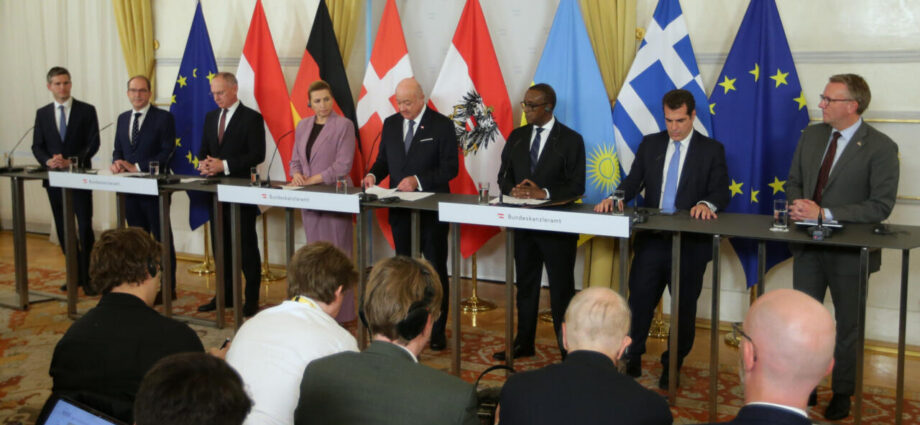
The Democratic Republic of Congo has sharply criticized a landmark migration agreement between Rwanda and five European nations—Germany, Austria, Denmark, Greece, and the Netherlands—announcing it sees the deal as a direct threat to the country’s sovereignty. The pact, which aims to establish a processing center in Rwanda for rejected asylum seekers facing deportation, has triggered a major diplomatic shift in the Great Lakes region, with Kinshasa now taking a decisive stand against what it calls an erosion of regional autonomy.
Why Kinshasa views the Rwanda-EU migration deal as a turning point
The agreement, finalized in Vienna in mid-November 2026, marks the first time European countries have entrusted a third-party nation outside the EU with the responsibility of handling migrants whose asylum applications were denied. Kinshasa argues that this arrangement undermines its geopolitical position and sets a dangerous precedent for cross-border policy enforcement without consultation. The move is seen not just as a routine migration policy shift, but as a pivotal moment that could redefine power dynamics between Central African states and Europe.
Concerns over sovereignty and international accountability
At the heart of the DRC’s opposition is the lack of transparency regarding the treatment and legal status of migrants sent to Rwanda. Kinshasa has raised questions about whether the country’s judicial and human rights frameworks would be respected, especially in light of Rwanda’s controversial track record in handling detainees and asylum seekers. The DRC government has also pointed out the irony in the timing: just months earlier, in April 2026, it had itself accepted migrants expelled from the United States under similar circumstances. This raises concerns about double standards and the externalization of migration control without shared responsibility.
Critics within the DRC’s political and academic circles warn that the deal could normalize what they describe as “outsourced deportation,” where European nations delegate enforcement while sidestepping their own legal and ethical obligations under international refugee law. Legal experts argue that such arrangements risk stripping migrants of due process and exposing them to conditions that may violate international human rights standards.
Could Kigali benefit from the deal?
Despite Kinshasa’s strong condemnation, some analysts suggest that Kigali may indeed gain significant political and economic leverage from the agreement. The influx of migrants could bring financial resources, international aid, and geopolitical attention to Rwanda, potentially strengthening its standing in regional and global forums. However, this perceived benefit is highly contested. Human rights organizations and Congolese policymakers argue that any economic gains would come at an unacceptable cost: the erosion of sovereignty and the potential for Rwanda to become a pawn in Europe’s migration containment strategy.
Professor Bob Kabamba, a political scientist at the University of Liège and a leading voice on African-European relations, cautions that the deal could deepen divides within the African continent. “This is not just about migration—it’s about who controls the narrative of migration management,” he states. “By outsourcing responsibility, Europe is not solving the problem; it’s creating new layers of dependency and conflict.”
Regional implications: a break from the past or a risky precedent?
The Rwanda-EU migration pact is sparking intense debate across Central Africa. While Rwanda has positioned itself as a strategic partner for Europe, neighboring nations like the DRC are alarmed by what they see as a precedent that could be replicated elsewhere in the region. The fear is that more European nations may follow suit, outsourcing deportation logistics to African states deemed “cooperative,” regardless of their human rights records or regional stability.
This has prompted calls from civil society groups for a unified African response. Advocacy organizations are urging the African Union to condemn the deal and push for binding agreements that prioritize human dignity over political convenience. They warn that without such action, the continent risks becoming a passive recipient of Europe’s migration policies, with little say in how its people are treated.
What’s next? Diplomatic showdown or compromise?
As tensions rise, all eyes are on the African Union and regional bodies like the Economic Community of Central African States (ECCAS). Will they convene an emergency summit to address the sovereignty concerns raised by the DRC? Or will individual member states pursue bilateral negotiations with Rwanda and the EU, potentially fracturing regional cohesion?
The outcome of this crisis could define the future of migration governance in Africa. One path leads to greater integration and shared responsibility; the other, to fragmentation and the normalization of externalized enforcement. For now, Kinshasa has drawn a line in the sand—and the world is watching to see if Africa will stand united or divided in the face of this pivotal moment.
Comments are closed, but trackbacks and pingbacks are open.