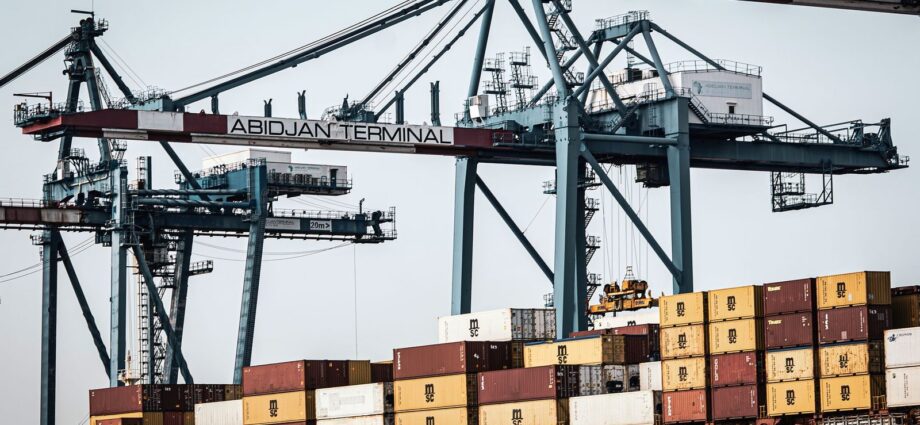
The economic relationship between Senegal and Ivory Coast, the two powerhouses of West Africa, is undergoing a critical turning point. During a landmark visit to Abidjan, Senegalese Prime Minister Ahmadou Alhaminou Mohamed Lo delivered a clear message: bilateral trade, currently locked at 250 billion FCFA (approximately 380 million euros), must be transformed into a major engine for regional growth. This figure, though significant in absolute terms, represents a fraction of what these nations could achieve together.
Why a Senegal-Ivory Coast economic corridor remains underutilized
Despite accounting for nearly two-thirds of the UEMOA’s combined GDP, the trade flows between Dakar and Abidjan remain shockingly low. In Ivory Coast, where annual foreign trade exceeds 20,000 billion FCFA, Senegal’s share barely registers. Similarly, Senegal’s own trade volume nears 10,000 billion FCFA but reflects minimal engagement with its neighbor. The paradox is stark: both countries trade more with Europe, China, and India than with each other—an imbalance long documented by development economists and policymakers.
The root causes are structural. Ivory Coast and Senegal compete rather than complement each other in global markets, especially in agriculture, fisheries, and energy. The rise of Senegal’s offshore gas fields—Sangomar and Grand Tortue Ahmeyim—has intensified competition in hydrocarbons. Weak maritime links between Abidjan and Dakar, combined with high overland freight costs and non-tariff barriers, further stifle commerce. The result? A corridor brimming with potential, yet barely utilized.
From rhetoric to action: the private sector steps into the driver’s seat
Prime Minister Mohamed Lo’s call to action targets the business communities on both sides. Announced in 2025 within the framework of Senegal’s Vision 2050 economic transformation plan, this initiative aims to accelerate industrialization, upgrade services, and diversify exports—areas where Ivory Coast’s expertise in agro-industry and energy could serve as a model for Senegal. Existing cross-border investments already show promise: Ivorian firms dominate banking, oil, and retail in Senegal, while Senegalese operators have entered Abidjan’s insurance, logistics, and telecom sectors. Yet these capital flows have failed to translate into meaningful trade volumes.
“The current volume of economic and commercial exchanges, hovering around 250 billion FCFA, falls far short of what our investment partnerships should yield. This gap must be bridged—our people deserve better.”
The diagnosis is echoed by the UEMOA Commission, which notes that intra-community trade accounts for just 15% of total regional commerce—far below levels seen in Southern Africa or Southeast Asia. The African Continental Free Trade Area (AfCFTA), launched in 2021, has yet to deliver on this front, despite its grand ambitions.
Dakar 2026: more than an event, a catalyst for economic rebalancing
The Prime Minister’s visit to Abidjan coincides with a pivotal moment: the Youth Olympic Games in Dakar, opening on October 31, 2026. As Africa’s first Olympic event, it serves as both a diplomatic showcase and a logistics challenge. Senegal has sought Ivorian support, leveraging Ivory Coast’s advanced sports infrastructure and youth engagement programs. Yet the stakes extend beyond the games. Senegal’s long-term strategy—Senegal 2050—hinges on three pillars: harnessing gas revenues, deepening CEDEAO integration, and forging stronger ties with West Africa’s economic core. In this context, Ivory Coast is not just a partner—it is a strategic lever.
“My mission is to consolidate our shared progress, reaffirm our unbreakable bonds, and open new pathways aligned with our collective vision for prosperity and inclusive growth.”
Breaking barriers: what’s needed to double down on trade
Achieving the 250 billion FCFA threshold is only the beginning. To truly unlock momentum, both nations must address persistent obstacles:
- Infrastructure upgrades: expanding direct maritime routes between Abidjan and Dakar, modernizing border crossings, and reducing transit delays.
- Regulatory alignment: harmonizing standards, reducing non-tariff barriers, and streamlining customs procedures to facilitate smoother trade.
- Sectoral synergy: identifying and developing complementary industries—such as renewable energy logistics, digital services, and value-added agriculture—where both countries can gain without direct competition.
- Private sector leadership: fostering public-private partnerships, joint ventures, and cross-border investment initiatives to turn capital flows into tangible trade.
The message from Dakar is unequivocal: the time for incremental change is over. With the AfCFTA framework in place and both nations pursuing ambitious economic roadmaps, the Senegal-Ivory Coast corridor stands at a decisive turning point. The 250 billion FCFA milestone is no longer a ceiling—it is a floor to build upon.
Comments are closed, but trackbacks and pingbacks are open.