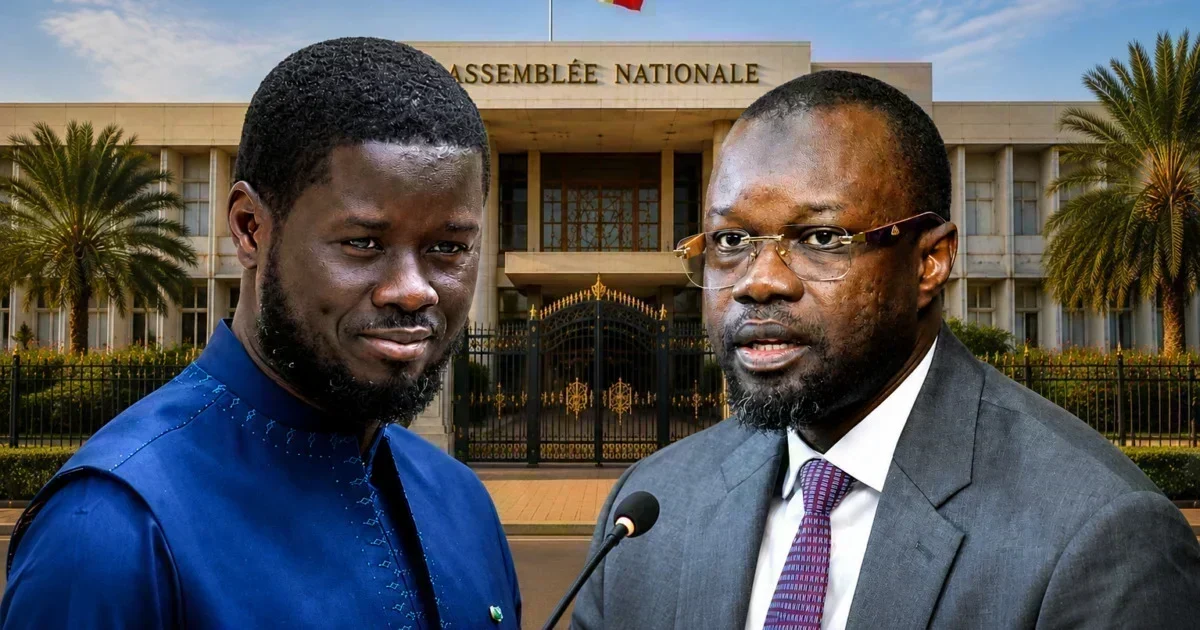
The political earthquake in Senegal’s National Assembly has shifted power dynamics, with Ousmane Sonko—now President of the Assembly—positioned to dramatically reshape the 2026 budget debate. As public scrutiny intensifies and constitutional firewalls come under the spotlight, the fallout from this budget battle isn’t just about numbers. It’s about who controls Senegal’s economic narrative as the country navigates IMF negotiations and growing fiscal pressures.
The constitutional tug-of-war is intensifying: Bassirou Diomaye Faye’s administration insists the budget must pass, while Sonko’s strategic leverage within the Assembly could trigger delays, amendments, or even a full block. But at what political cost?
Constitutional weapons in the Assembly’s arsenal
Under Senegal’s 2024 constitutional framework, the National Assembly holds unprecedented authority over financial legislation. With Pastef controlling 130 of 165 seats, Ousmane Sonko’s bloc could single-handedly reject the 2026 Rectificative Finance Law (LFR 2026). A blunt rejection, however, risks casting Sonko’s party as the architect of a fiscal deadlock. Instead, the Assembly can wield more subtle tools: tight budgetary amendments under Article 82, which allow deputies to slash spending or raise revenues—but only in limited ways. The government can counter this by demanding a single vote, forcing legislators to either accept the entire bill or face total collapse of the budget.
Article 60 further entrenches party discipline by stripping dissenting deputies of their mandates if they defect. This clause, designed to protect the government’s majority, effectively weaponizes unity within Pastef—leaving no room for internal defections to weaken Sonko’s hand.
Delay tactics: a high-stakes gamble
Sonko’s control over the Assembly’s agenda under Article 84 could allow tactical delays, but time is not on his side. Article 68 imposes a 60-day deadline for voting on finance laws. Miss that deadline, and Article 68 empowers the President to enact the budget by decree—complete with any amendments approved by the Assembly and accepted by the Head of State. With the LFR 2026 tabled on September 18, 2026, this deadline falls around November 17—just days before the President gains the constitutional power to dissolve the Assembly.
Yet a legal gray zone persists: the Constitution is silent on whether a rejected budget could still be enacted by decree. Should the Assembly formally reject the LFR 2026, the matter could escalate to the Constitutional Council—a move requiring support from at least one-tenth of deputies.
The government’s nuclear option: Under Article 86, the Prime Minister can stake the government’s survival on the budget vote. If the motion passes a censure vote with an absolute majority (83 votes), the government falls. Pastef holds more than enough votes to trigger this—but doing so would not only kill the budget. It would trigger a full-blown political crisis, weeks before the President regains the power to dissolve Parliament under Article 87.
December 2, 2026: the dissolution cliff edge
Article 87 bars parliamentary dissolution within the first two years of a legislature. Installed on December 2, 2024, the current Assembly enjoys protection until December 2, 2026. Bassirou Diomaye Faye has repeatedly emphasized this calendar, signaling that the clock is ticking—both on the budget vote and the potential dissolution lever.
For Sonko’s Assembly majority, every stall tactic risks backfiring. A prolonged budget block could give Faye ammunition to justify dissolution before December 2. Conversely, a seamless adoption would strip the President of that threat. Either way, the constitutional standoff is less about legal minutiae than about raw political power: who frames Senegal’s economic future—and who bears the blame for its consequences.
What comes next?
- Public pressure: The IMF’s pending approval of Senegal’s program intensifies scrutiny on every clause of the LFR 2026, making Sonko’s moves a front-page battleground.
- Institutional showdown: If the Assembly rejects the budget, the Constitutional Council may be dragged into uncharted territory—reshaping the balance between executive and legislature.
- Political fallout: A censure vote would not only collapse the budget. It would open the door to a government crisis, threatening Faye’s reform agenda and Sonko’s institutional influence.
Senegal’s economy now hangs in the balance. The LFR 2026 isn’t just a fiscal document. It’s a litmus test of cohabitation between two titans—and the public reaction will determine who emerges with the upper hand.
Comments are closed, but trackbacks and pingbacks are open.