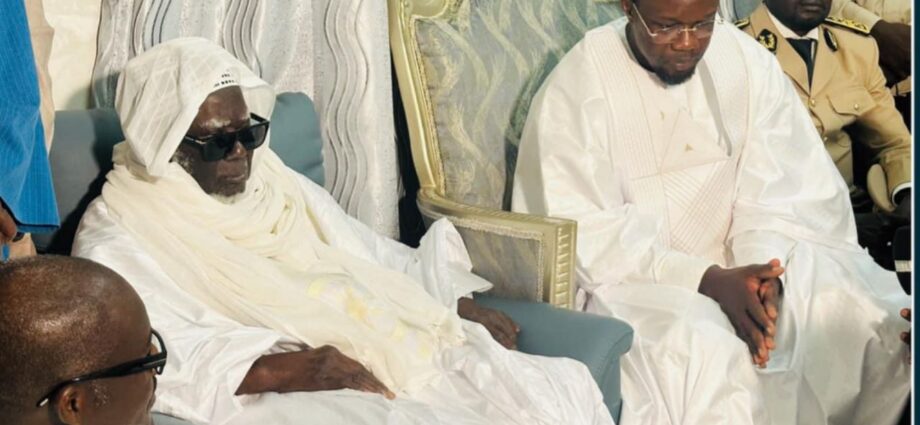
In a move that signals a potential turning point for Senegal’s political landscape, Ousmane Sonko, president of the National Assembly and leader of the Pastef party, made an unannounced late-night visit to Touba. The clandestine meeting with Serigne Mountakha Mbacké, the General Khalife of the Mouride Brotherhood, unfolded under the cover of darkness, marking a strategic shift in the unfolding power dynamics between the executive and legislative branches.
Breaking tradition: sonko’s covert visit to touba’s spiritual heart
The visit, shrouded in secrecy, saw Sonko accompanied by Serigne Cheikh Thioro Mbacké and businessman N. S. The delegation’s arrival in the religious stronghold of Touba went largely unnoticed until reports emerged of the closed-door encounter between the parliamentary leader and the Mouride spiritual guide. What transpired during the hour-long session remains undisclosed, as neither party issued a public statement following the discussions.
Behind closed doors: what we know about the high-stakes meeting
While official details are scarce, insider accounts suggest the meeting centered on the nation’s escalating political tensions. The primary focus appears to have been the deepening rift between Senegal’s executive and legislative authorities. Sonko, a vocal figure in the opposition, reportedly sought the Mouride leader’s counsel on navigating the country’s volatile political climate—a move that could redefine the trajectory of governance in Senegal.
Sources close to the situation hint that the discussions may have explored pathways to reconciliation, with Sonko leveraging the moral influence of the Mouride Brotherhood to mediate between warring factions. The abrupt departure of Sonko and his entourage immediately after the meeting underscores the urgency and sensitivity of the talks.
Uncharted territory: the implications of sonko’s strategic maneuver
The clandestine nature of the visit raises questions about its long-term impact on Senegal’s political future. By seeking the guidance of a religious authority traditionally aligned with the state, Sonko may have signaled a bold new approach to resolving the nation’s governance crisis. The meeting’s timing—amid heightened political unrest—suggests a calculated effort to bridge divides and restore stability.
As Senegal grapples with internal discord, Sonko’s outreach to the Mouride Khalife could mark the beginning of a pivotal chapter in the country’s political narrative. The lack of transparency, however, leaves room for speculation about the true objectives and outcomes of the encounter. What remains clear is that this unprecedented move has set the stage for a potential realignment of power, with far-reaching consequences for the nation.
What’s next? navigating the fallout from a landmark meeting
The reverberations of Sonko’s visit to Touba are expected to unfold in the coming days. Political analysts are already dissecting the implications, with some viewing the meeting as a masterstroke of diplomacy, while others question its motives. One thing is certain: Senegal stands at a crossroads, and the decisions made in the aftermath of this secretive gathering could shape the country’s path forward.
As the dust settles, all eyes will be on the reactions of key stakeholders. Will this be the catalyst for a new era of cooperation, or will it deepen existing fractures? The answers may lie in the unspoken agreements forged during that hour behind closed doors in Touba.
Comments are closed, but trackbacks and pingbacks are open.