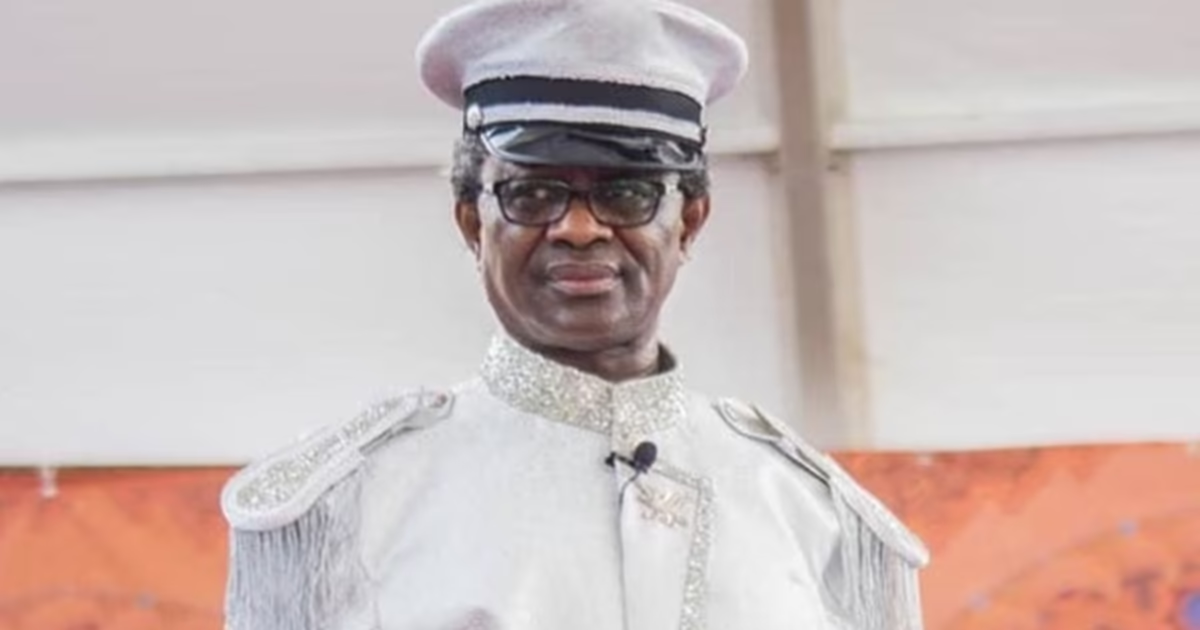
A leading spiritual figure in Senegal has entered the political fray, urging the nation’s president and prime minister to set aside their differences and prioritize the country’s stability.
A call for national unity during challenging times
During the recent Grand Magal of Touba—an annual celebration marking the exile of Cheikh Ahmadou Bamba—Serigne Modou Kara Mbacké, a prominent religious leader, addressed the nation from his residence in Mermoz. His message was clear: the time for personal disputes among the country’s top leaders must end. Speaking to a large gathering of followers, he emphasized that the challenges facing Senegal—economic hardship and social tensions—demand collective action rather than division.
« Their reconciliation is not out of the question, as they represent a minority compared to the broader population. It is essential that they come together for the sake of the nation, » he declared, underscoring the urgency of unity in the face of adversity.
Reconciliation rooted in shared history
Serigne Modou Kara Mbacké did not limit his appeal to political pragmatism. He framed the call for unity within a deeper cultural context, highlighting the long-standing bond between President Bassirou Diomaye Faye and Prime Minister Ousmane Sonko. « Their relationship transcends politics; it is rooted in a shared history of struggle that predates their rise to power, » he noted.
Drawing on Senegal’s tradition of cousinage à plaisanterie—a cultural practice that fosters playful teasing and reconciliation among social groups—the religious leader urged both men to move beyond their current impasse. « They must start anew, like cousins who share a bond deeper than politics, » he insisted. « This is not about politics; it is about the work that united us, until kinship and shared surnames forged a lasting connection. »
A mediator’s role in shaping national discourse
By positioning himself as a mediator, Serigne Modou Kara Mbacké has signaled his intent to influence Senegal’s political trajectory. His intervention comes at a critical juncture, as the country grapples with economic recovery and social cohesion. The religious leader’s stance reflects a broader societal expectation: that spiritual and cultural leaders play an active role in guiding the nation through turbulent times.
The timing of his remarks, delivered during a period of national reflection, underscores the weight of his message. For many Senegalese, the Grand Magal is not just a religious observance but a moment to reaffirm values of solidarity and collective responsibility. In this light, Serigne Modou Kara Mbacké’s call for unity resonates beyond the political elite, offering a moral compass for the nation.
Comments are closed, but trackbacks and pingbacks are open.