Throughout history, military leaders who ascend to power often encounter a persistent pitfall: the conflation of rhetorical power with ground-level reality. The silence of a population—often born from fear or uncertainty—is frequently misinterpreted as unwavering support. In Burkina Faso, this dynamic appears to be unfolding before our eyes.
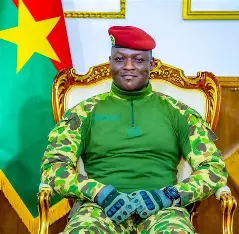
Behind the meticulously staged appearances, the immaculate uniforms, and the vehement denunciations of a « perfidious West »—alongside repeated warnings against any behavior labeled « anti-revolutionary »—a different truth may be emerging. The once self-assured image of leadership is giving way to a regime grappling with escalating internal tensions.
A leadership increasingly marred by suspicion
Critics argue that Captain Ibrahim Traoré is becoming progressively isolated at the helm of a government where distrust has supplanted trust. This perception is fueled by persistent rumors of destabilization plots, shifts within the military hierarchy, and successive reorganizations of the security apparatus.
As one observer noted, « When a regime begins to fear its own guards, it is no longer the nation it protects, but its own shadow. »
The erosion of early alliances
The trajectory of political power in Africa—and beyond—repeatedly demonstrates a troubling pattern: those who enable a takeover often become the first to be distrusted once power is consolidated. Since assuming leadership in September 2022, Captain Traoré has reshaped the military and security chains of command. Several influential officers from the initial inner circle have been sidelined, transferred, or removed, sparking concerns about the cohesion of the armed forces.
The removal of the intelligence services director—widely regarded as a cornerstone of the security framework—has drawn particular scrutiny. Analysts argue that when a head of state begins to overhaul the very structures tasked with safeguarding their authority, it signals a deeper crisis of confidence within their inner circle.
In essence, when power turns inward, questioning those meant to protect it, the issue transcends mere security concerns; it becomes a matter of governance.
From unity to fragmentation
The Burkina Faso armed forces, once united by the urgency of combating armed groups, now appear increasingly fractured by suspicion. Successive promotions, appointments, and replacements have fostered a climate where personal loyalty overshadows operational experience. Observers summarize this evolution as follows:
- 2022: The promise of unity in the face of insurgency
- Present: Persistent security deterioration
- Response: Reorganizations and reshuffles at the highest levels
- Outcome: A climate of growing distrust and strained governance
Governance through fear
Faced with unrelenting security challenges, the regime has adopted a more authoritarian approach. Critics highlight several concerning trends:
- Arrests of prominent figures critical of the government
- Allegations of enforced disappearances and abductions reported by human rights organizations
- Curtailment of media freedom, including suspensions of outlets and restrictions on journalists
- Coercive measures against civil society actors, perceived by supporters as retaliatory actions
These developments have been flagged in reports by international human rights bodies, which warn of a marked decline in public freedoms across Burkina Faso.
Adding to the perception of a personalized leadership, official communications increasingly revolve around the figure of Captain Ibrahim Traoré. State media and pro-government channels amplify his public appearances, speeches, and initiatives, reinforcing among opponents the belief that power is becoming increasingly centralized around his person.
To his detractors, this strategy does not reflect unchallenged authority but rather an attempt to compensate for the regime’s vulnerabilities through information control.
The unaddressed security crisis
The overriding challenge, however, remains unaddressed. Nearly four years after the change in leadership, the issues that justified the coup persist.
On the ground, the State’s authority continues to falter in many localities, where armed groups maintain influence or outright control. The humanitarian situation remains dire, with millions displaced and the consequences of insecurity taking a heavy toll. Meanwhile, attacks targeting civilians, defense and security forces, and local defense volunteers (VDP) continue to be reported regularly. Critics argue that the political consolidation of the regime is increasingly overshadowing efforts to address pressing security and humanitarian crises.
Data from the United Nations, humanitarian organizations, and specialized research centers confirm that the security crisis remains entrenched, despite military efforts. Jihadist attacks continue to destabilize several regions, while internal displacement figures remain among the highest in the subregion.
The peril of isolation
Patriotic rhetoric, no matter how mobilizing, cannot restore security in a nation grappling with multidimensional crises. Slogans cannot replace military results, institutional rebuilding, or the restoration of trust between the State and its citizens.
For regime critics, the gravest danger now lies in the growing isolation of the transitional leader. By severing ties with former allies, repeatedly reshaping security structures, and governing in a climate of perpetual suspicion, Captain Traoré risks undermining the very foundations of his authority.
African political history offers numerous examples of military regimes that concentrated power within an increasingly narrow circle. In many such cases, internal mistrust—rather than external opposition—became the primary catalyst for destabilization.
The true challenge for Burkina Faso remains unchanged: to restore enduring security, rebuild institutional trust, and meet the expectations of a population still bearing the human cost of instability. When a government expends more energy on preempting conspiracies than on resolving the very crises that justified its rise, it risks elevating political survival above the national interest.