Three Years After the Coups: The Unyielding Struggle of the Sahel States
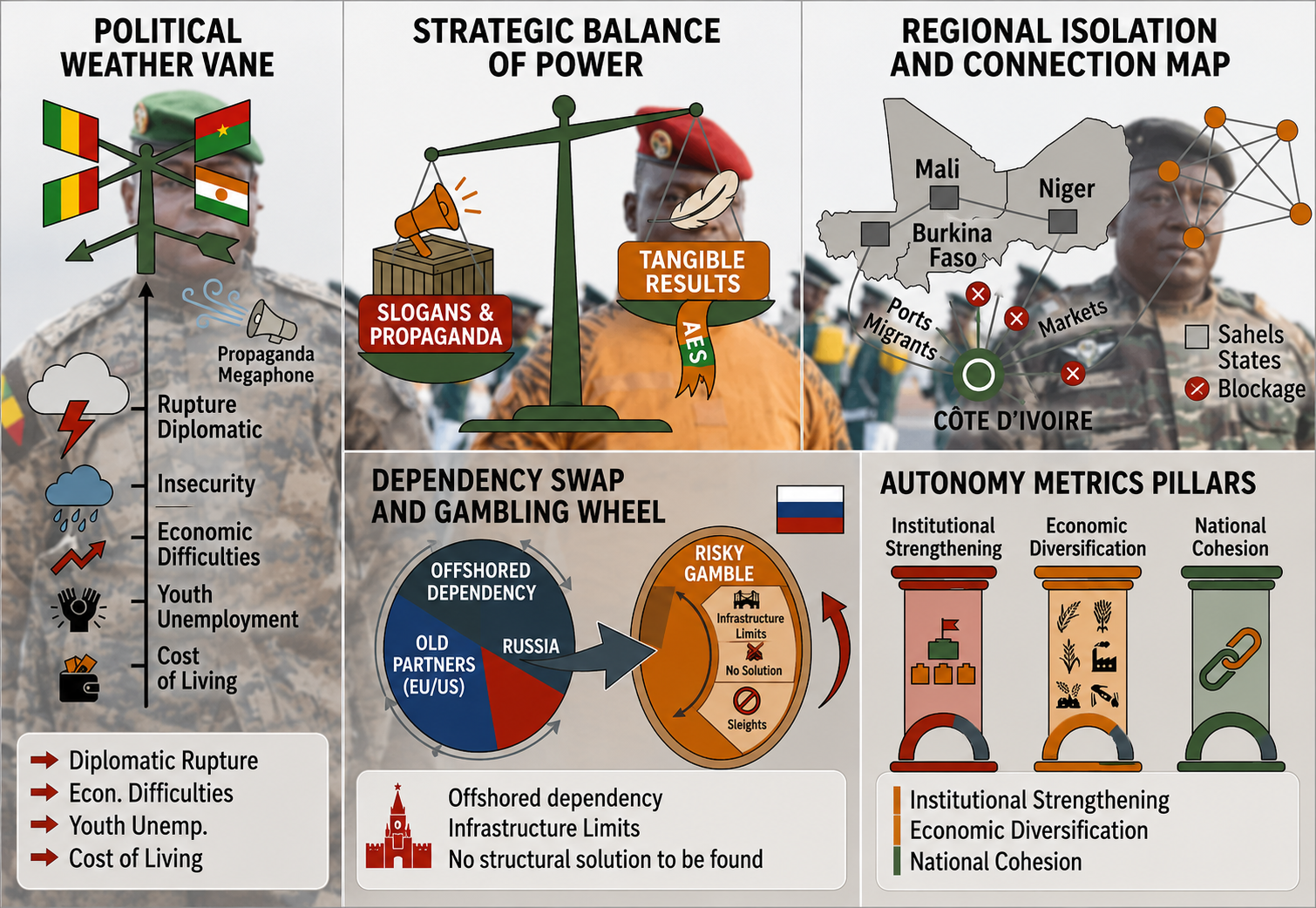
The military authorities of Mali, Burkina Faso and Niger, who seized power in recent years, have built their political narrative around a radical break with regional norms and a rejection of long-standing international partnerships. The formation of the Alliance of Sahel States (AES) was meant to symbolise this shift toward recalibrated alliances and an assertion of sovereignty. Yet, as three years have passed since the initial coups, a sobering reality persists: security threats remain unabated, economies continue to strain under pressure, and the demands of citizens show no signs of diminishing.
A Sovereignty Claim That Struggles to Deliver
The sovereignist discourse championed by the AES resonated with many in the Sahel, where years of unrelenting insecurity and frustration with international cooperation had eroded trust. The promise of full control over diplomatic and military decisions struck a chord with populations eager for change. Yet sovereignty, in practice, demands more than the denunciation of agreements or the replacement of allies. It requires tangible outcomes: secure communities, gainful employment, thriving economies, reliable public services and sustained improvements in living standards.
On these fronts, the challenges remain daunting. Despite the bold rhetoric, the gap between promise and delivery continues to widen, leaving citizens questioning whether sovereignty alone can address their most pressing needs.
The Allure and Limits of Scapegoating
When governments face difficulties in producing visible results, political messaging often shifts toward mobilising support by identifying external adversaries. In the case of the AES, criticism of neighbouring states or regional bodies has become a recurring theme in public discourse. Côte d’Ivoire, in particular, has frequently been portrayed as either a hostile actor or a proxy for foreign interests.
While this strategy may offer short-term political gains by rallying citizens around a common enemy, it carries significant drawbacks. It diverts attention from pressing domestic issues such as unemployment, rising living costs, educational deficits and inadequate infrastructure. It risks inflaming unnecessary diplomatic tensions in a region where economic and social ties run deep. Worse still, it may stifle open debate by equating internal criticism with tacit allegiance to external foes.
Côte d’Ivoire’s Steady Diplomacy Amid Regional Tensions
Against this backdrop of escalating rhetoric, Côte d’Ivoire has maintained a diplomatic stance rooted in dialogue and regional stability. This approach reflects a long-standing tradition inspired by the legacy of Félix Houphouët-Boigny, who championed mediation, economic cooperation and consensus-building.
Abidjan’s strategy is not merely rhetorical; it is pragmatic. Côte d’Ivoire remains a vital commercial partner for Sahelian nations, with its port serving as a lifeline for landlocked countries like Mali and Burkina Faso. The interconnectedness of the region—through trade, investment and human mobility—creates a web of interdependence that transcends political posturing. A sustained deterioration in bilateral relations would carry severe human and economic consequences, far outweighing any short-term political gains.
The Hidden Costs of Diplomatic Confrontation
The pursuit of confrontation, while symbolically satisfying, comes with an economic price tag that is often overlooked. Heightened tensions can deter foreign investment, disrupt supply chains, inflate operational costs and erode the attractiveness of Sahelian states to international investors. Political uncertainty, a recurring feature in such environments, amplifies these risks, making it harder for businesses to operate and for governments to secure financing. In economies already weakened by security challenges, these diplomatic spats can deepen financial woes, stunt job creation and slow growth.
The Risks of Trading One Dependency for Another
The AES’s strategy also hinges on diversifying international partnerships, most notably through a closer alignment with Russia. While sovereign states are entitled to seek new alliances, such diversification is no guarantee of improved security or economic performance. International experience underscores a hard truth: no external partner, no matter how committed, can single-handedly resolve structural issues such as institutional weakness, underinvestment, rural poverty or territorial governance failures.
The danger lies in merely swapping one dependency for another without addressing the root causes of the region’s struggles. True strategic autonomy demands investment in national institutions, professionalisation of security forces, a favourable business climate, economic diversification and human capital development.
From Slogans to Substance: The Test of Governance
The governments of the AES have placed heavy emphasis on communication campaigns centred on sovereignty, resistance and national renewal. While such messaging can bolster patriotic sentiment, it cannot indefinitely substitute for the tangible outcomes citizens demand: durable security improvements, affordable living costs, youth employment, functional healthcare and education systems, modern infrastructure and inclusive economic growth.
In the long run, performance will matter far more than rhetoric. The citizens of the Sahel, weary of empty promises, will measure their leaders by what they deliver—not by the enemies they denounce.
West Africa’s Future Lies in Cooperation, Not Division
The challenges facing West Africa—terrorism, transnational crime, migration, climate change, food insecurity and economic development—transcend national borders. No single country can address them alone. Regional cooperation, whether within existing organisations or through new frameworks, remains an indispensable tool for progress.
Treating neighbours like Côte d’Ivoire as perpetual adversaries risks weakening a region already grappling with multiple crises. The path to stability in the Sahel does not lie in isolation or confrontation, but in dialogue, mutual respect and collective problem-solving.
A Moment of Reckoning for the Sahel Alliance
The AES was born from a desire to break free from a perceived ineffective model. This ambition, driven by real frustrations, initially resonated with many. Yet a break from the past is not, in itself, a policy. The credibility of the Alliance will ultimately hinge on its ability to deliver security, revitalise economies, uphold public freedoms and foster regional cooperation.
The future of the Sahel will be determined not by the identification of external culprits, but by the capacity of its leaders to produce tangible results, restore public trust and transform dialogue into a tool for stability rather than perpetual conflict.
Comments are closed, but trackbacks and pingbacks are open.