The coup’s founding promises and their fading allure
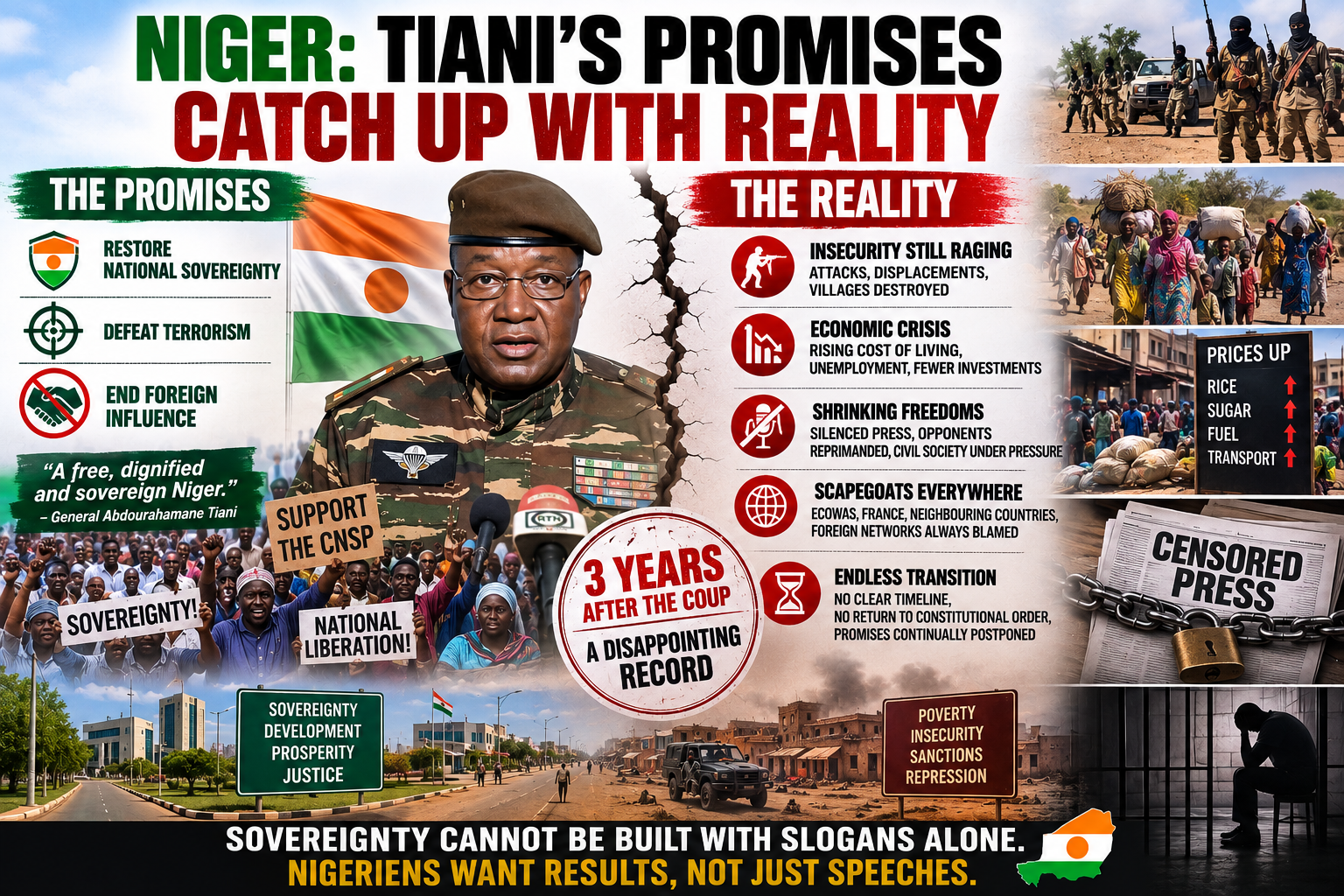
When General Abdourahamane Tiani seized power on 26 July 2023, he framed his takeover as a necessary rupture with the past. The junta’s narrative rested on three pillars: reclaiming national sovereignty, eradicating terrorism, and ending foreign interference in Niger’s affairs. This discourse, amplified by state-aligned media and pan-Africanist movements, resonated with many citizens weary of chronic insecurity and economic hardship.
Yet as the three-year mark approaches, the gap between rhetoric and reality has grown impossible to ignore. While the regime continues to decry neocolonialism, the daily concerns of Nigeriens security threats, economic precarity, and shrinking civic freedoms remain unaddressed.
Sovereignty as political currency
The National Council for the Safeguard of the Homeland (CNSP) has staked its legitimacy on a simple premise: Niger’s sovereignty was restored by severing ties with Western partners. This black-and-white narrative pits a “patriotic” leadership against foreign actors accused of long undermining national interests.
This strategy offers multiple political dividends. It unites segments of the public under a shared national identity, deflects internal criticism by branding dissent as pro-foreign, and distracts from evaluating actual governance. Yet sovereignty is not measured solely by diplomatic ruptures or the expulsion of foreign forces. It demands tangible outcomes: security for citizens, functional institutions, preserved freedoms, and improved living standards. On these fronts, the record remains contested.
Exploiting frustration, sidestepping accountability
The junta has deftly channeled popular disillusionment into support. Years of insecurity, unemployment, inequality, and rising living costs created fertile ground for a narrative portraying the coup as a historic break from failure. Over time, however, state communication has shifted from proposing solutions to sustaining perpetual patriotic mobilization. Political announcements, regime-backed rallies, and denunciations of external conspiracies dominate headlines, while scrutiny of policy performance remains scarce.
This shift reshapes political debate: loyalty to the regime now trumps accountability. The absence of transparent progress reports on public policies further entrenches a culture where fidelity eclipses scrutiny.
Security: the unresolved equation
Improving security was the junta’s flagship justification for seizing power. Yet several regions continue to suffer armed attacks, mass displacements, and pervasive instability. Civilians bear the brunt, facing disrupted livelihoods, restricted access to services, and frayed social cohesion.
The Nigerien armed forces conduct operations across multiple fronts, but recurring assaults on military posts and villages reveal the resilience of armed groups. Success cannot hinge solely on regime change or shifting international alliances. The conflict’s complexity demands deeper, structural solutions solutions that remain elusive.
Blame-shifting and the paralysis of self-reflection
Unable to reverse security setbacks, the regime frequently attributes crises to external forces. Sanctions from regional blocs, former Western partners, neighboring states, and shadowy foreign networks are routinely cited as the root causes of domestic woes.
While geopolitical tensions undeniably shape the Sahel’s security landscape, they do not fully explain Niger’s internal struggles. This habit of externalizing blame risks turning every crisis into a diplomatic standoff, sidelining critical discussions on national responsibility, institutional reform, and governance improvements. Over time, it may erode the state’s capacity for self-criticism and correction.
Economic stagnation under political uncertainty
Economically, the anticipated dividends of the coup have yet to materialize. Regional sanctions, reduced investment flows, trade disruptions, and political instability have dampened growth across key sectors. Households grapple with soaring prices, product shortages, and stagnant job markets. For many, the tangible benefits of political change remain distant.
True economic sovereignty often invoked in official speeches requires sustained improvements in domestic production, infrastructure, public finances, and the business environment. These are long-term challenges demanding coherent, forward-looking policies, not short-term rhetoric.
Civic space: the silent erosion
Observers warn that public freedoms are steadily contracting. Journalists, civil society actors, and opposition figures operate under heightened state surveillance. In many military-led systems, centralized power gradually curtails institutional checks and balances. Niger now faces this dilemma: how to preserve national unity amid security threats without sacrificing the pluralism essential for responsible governance?
The absence of a clear political transition timeline further fuels uncertainty about the junta’s endgame and the prospects for a return to constitutional order.
From patriotism to performance: the ultimate test
Patriotism can unite a nation, but it cannot indefinitely substitute for results. Sovereignty is not proclaimed in speeches; it is built through robust institutions, resilient economies, credible justice, effective security, and transparent governance.
Recent Sahelian history demonstrates that no leadership civilian or military can sustain legitimacy on denunciations of external enemies alone. As time passes, citizens judge their leaders not by their words, but by their ability to improve daily life. For General Abdourahamane Tiani and the CNSP, the challenge is no longer to convince Nigeriens of their sovereignty, but to prove it delivers tangible gains in security, development, justice, and freedom. Without this concrete translation, anti-imperialist rhetoric risks appearing less like a national project and more like a tool for political survival.
Comments are closed, but trackbacks and pingbacks are open.